Minimum wage becomes a bargaining chip as calls grow to reflect growth and inflation
- Input
- 2026-06-24 18:26:21
- Updated
- 2026-06-24 18:26:21
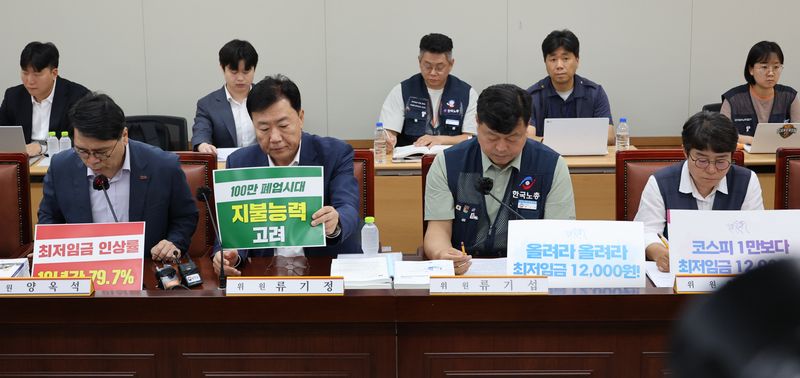
"Economic growth and inflation rates should be reflected in the statistics"
According to MOEL on the 24th, the government is pushing ahead with institutional reforms to improve the minimum wage-setting process, which has drawn controversy every year.
In November 2024, the government formed the Minimum Wage System Improvement Research Group with current and former public-interest members of the commission. After 10 research meetings and consultations with labor and management groups, experts, and stakeholders in the field, the group reviewed the overall operation of the minimum wage system and presented reform measures.
The reform plan proposed reducing the number of commission members from the current 27 to 15 to make discussions more efficient and help build consensus.
It also said the decision-making structure should be redesigned so that the minimum wage is reviewed and set from the perspective of young people, older workers, women workers, small business owners, and other groups most affected by the policy. Among workers earning wages near the minimum wage, 62% are women, 22% are in their 20s or younger, and 42% work at businesses with fewer than five employees, but the current structure does not adequately represent their interests, the group noted.
To that end, the group proposed cutting the number of commission members to 15 and creating a Wage Level Expert Committee and a System Improvement Expert Committee under the commission so that worker and employer representatives can participate as members in the agenda-setting process.
In particular, the research group concluded that the minimum wage-setting process should be reorganized to include economic growth and inflation rates, which are widely considered in other countries, as well as the impact on employment and workers' living costs.
"In the end, the government decides amid labor-management standoffs, so operational improvements are needed"
A MOEL official said, "Because this has long been an area of concern, the government must comprehensively review the research group's proposals as well as expert opinions." The official added, "We are preparing procedures that include hearing from stakeholders in order to carry out the administration's policy tasks."
The official also said, "Because this is an issue in which labor and management are directly involved, a basic consensus among labor, management, and the government must be in place." The official added that "it is difficult for the government to push this forward unilaterally."
In politics, both ruling and opposition parties continue to clash over the Minimum Wage Act, including expanding coverage for contract workers, applying different rules by industry, and abolishing provisions that allow discriminatory treatment of workers with disabilities and probationary workers.
The only bill that has raised the need to improve the commission's structure is an amendment to the Minimum Wage Act introduced by People Power Party lawmaker Koo Ja-geun.
Professor Shin Sedon of Sookmyung Women's University criticized the system, saying, "The views of employers and workers diverge sharply every time, and in the end the public-interest members make the decision." He added, "It is not a practical model to the point that one might think, 'Then shouldn't the government just decide?'"
Professor Lee Young-myeon of Dongguk University said, "Every year, labor or management walks out and the government ends up making the decision." He suggested that expertise and practicality should be improved by operating the commission continuously each year with full-time members.
[email protected] Kim Jun-hyuk Kim Hyun-cheol Reporter