The 30-Year-Old KOSDAQ’s Humiliation: Market Cap Share Falls to a 27-Year Low
- Input
- 2026-06-24 18:24:23
- Updated
- 2026-06-24 18:24:23
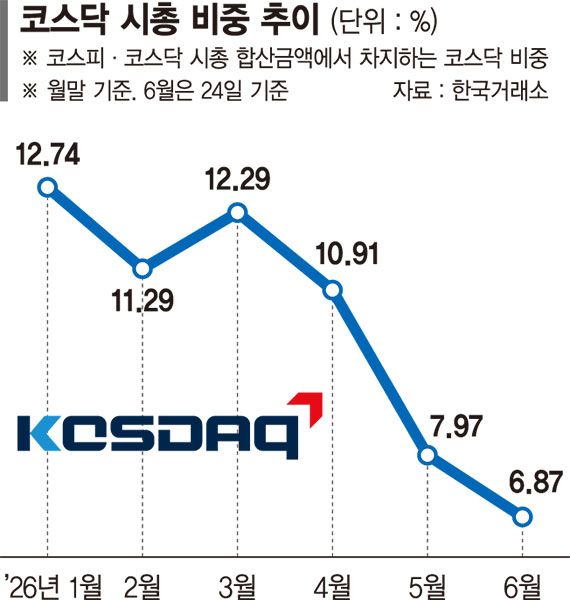
According to the Korea Exchange (KRX) on the 24th, KOSDAQ’s market capitalization stood at 511.2441 trillion won. That brought its share of the total stock market value, including KOSPI’s 6,927.816 trillion won market cap, down to 6.87%. It is the lowest level since 1999. Compared with KOSDAQ’s 12.74% share in January this year, the figure has been cut in half in just six months.
The index has also given back all of its gains from the start of the year. KOSDAQ began the year at 945.57, broke above the 1,000 mark at the end of January, and climbed past 1,200 in April to reach its highest level since 2000. But the previous day, it fell to 891.52, slipping back below 900. That stands in sharp contrast to KOSPI, which rose more than 100% over the same period, driven by large semiconductor stocks, and moved above 9,000. As investor attention has shifted to the semiconductor-led KOSPI, KOSDAQ trading value has been on a downward trend. In fact, KOSDAQ accounted for 35% of total market trading value in January, but that share has recently dropped to around 17%.
Securities analysts say KOSDAQ’s weakness cannot be explained simply by a deterioration in fundamentals. Rather than a broad market problem, they see the semiconductor-led concentration of capital as deepening KOSDAQ’s marginalization.
Kim Jun-young, an analyst at iM Securities, said, "Fundamentals are often cited as the background to KOSDAQ’s weakness, but the main cause should be seen as market concentration." He added, "Even within KOSPI, the concentration in leading stocks such as Samsung Electronics and SK hynix was strong, and KOSPI’s market capitalization excluding those names showed a similar trend to KOSDAQ’s market cap."
Analysts also point to capital flows, earnings, and interest-rate pressures as factors limiting a rebound in KOSDAQ. While retail money continues to leave the market and earnings estimates for KOSPI are being revised upward, especially in semiconductors, KOSDAQ’s earnings improvement has been relatively slow. Given KOSDAQ’s heavy weighting toward growth stocks, the higher discount rates associated with rising interest rates are also weighing on share-price recovery.
Still, market watchers expect sentiment to turn in the second half of the year, when policies to revitalize KOSDAQ are expected to gain momentum. Key measures include the National Growth Fund, tougher delisting rules for troubled companies, and plans to introduce a KOSDAQ segment and a tiered listing system. The key question is whether the government’s push to improve KOSDAQ’s fundamentals and usher in a "KOSDAQ 3000 era" will translate into real market effects.
Lee Sang-yeon, an analyst at Shinyoung Securities, said, "The time is approaching when policy momentum for the KOSDAQ market as a whole will re-emerge." He added, "As the financial authorities are likely to unveil detailed implementation plans in July, policy expectations are also expected to gradually expand."
[email protected] Bae Han-geul Reporter