[Editorial] Even as the stock market sizzles, MSCI inclusion falls through; South Korea must press harder on market advancement
- Input
- 2026-06-24 18:22:42
- Updated
- 2026-06-24 18:22:42
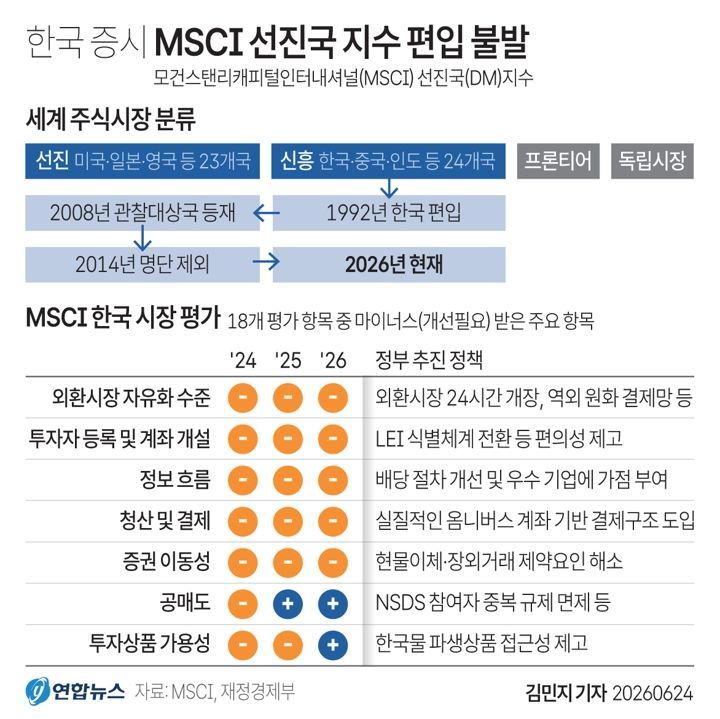
Given the size of the Korean economy, the competitiveness of its companies, and the market capitalization of its stock market, it is disappointing that the market still remains at an emerging-market level. Of course, the government and financial authorities have not stood idle. They have pushed measures such as abolishing the Foreign Investor Registration System, extending foreign exchange trading hours, and resuming short selling. Even so, MSCI likely kept South Korea off the watchlist because it still sees the market as insufficiently open, and because it believes the impact of recent reforms will take time for investors to feel.
The biggest obstacle cited was restrictions on offshore trading of the won. The currency is still not freely traded overseas on a physical delivery basis. Even if domestic foreign exchange trading hours are extended, global index funds and institutional investors face constraints in hedging and managing capital unless actual liquidity is sufficient. Short selling has also been fully resumed, but many say the new monitoring system has created a considerable operational burden for market participants. The government has also been slowing the pace out of concern for market stability and investor protection, so a balance must be found.
The impact of being included in an advanced-market index would be significant. Large amounts of index-tracking funds could flow in, and the base of foreign investment could expand. Market volatility could ease, and valuations could improve substantially. The symbolic meaning would be even greater. As South Korea's stock market would be recognized as an advanced market in global capital markets, it could become an important turning point in resolving the long-standing Korea Discount.
It is out of step with South Korea's economic standing for its stock market to remain in the emerging-market category. The MSCI World Index includes 23 countries, including the United States, Japan, and the United Kingdom, while South Korea is grouped with emerging markets such as China and India. Given the country's position as one of the world's 10 largest economies and the global competitiveness of its semiconductor, automobile, and battery industries, the classification is hardly fitting. Since joining the emerging-market index in 1992, South Korea has repeatedly fallen short of the threshold for entry into the advanced-market index.
That said, it would be unrealistic to expect the market's fundamentals to change overnight simply because inclusion is achieved. Korean stocks have recently surged on expectations surrounding semiconductors and Artificial Intelligence (AI), to the point that some have raised concerns about overheating. In such a situation, renewed hopes for index inclusion could once again attract speculative money. As the country moves out of the emerging-market index, some capital outflows may occur, and concentration in large-cap stocks could intensify. Rather than hesitating over advanced-market inclusion for those reasons, South Korea should treat it as part of the process of market advancement and work to broaden its investor base.
MSCI World Index inclusion is ultimately a matter of market trust. The government should move quickly to reform regulations and improve market accessibility. Multiple efforts are needed so that the stock market, which has finally regained momentum, can secure sustainable upward momentum through MSCI World Index inclusion.