"Korea and Taiwan should block China’s advance through a technology alliance, not semiconductor rivalry" [Visiting Taiwan, the country of semiconductors (Part 2)]
- Input
- 2026-06-24 18:15:25
- Updated
- 2026-06-24 18:15:25
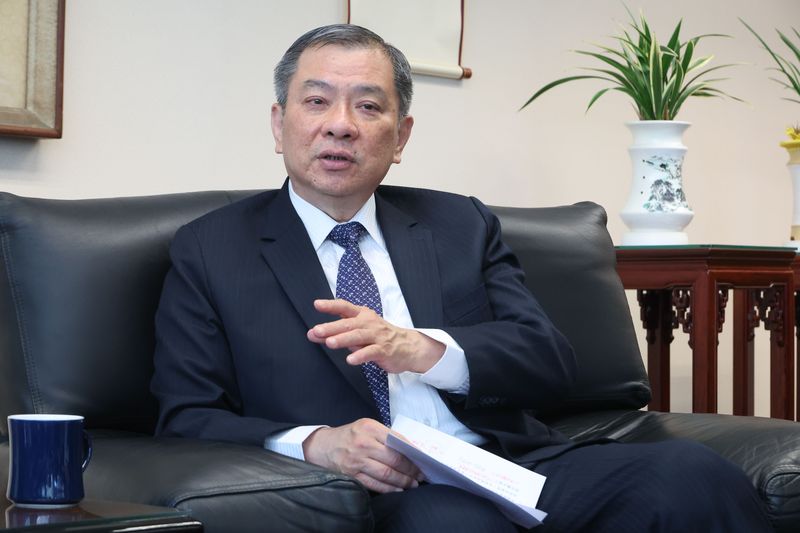
Taiwan’s economic rise, driven by the foundry ecosystem of advanced semiconductors such as TSMC, has gained momentum. To examine the secrets behind Taiwan’s success, its survival strategy, and the room for cooperation with Korea as it builds an independent semiconductor miracle while facing China’s strong pull and diplomatic isolation, Financial News met with Chiu Chao-wei, head of the Taipei Representative Office in Korea, and Kang Jun-young, a professor of international political economy at Hankuk University of Foreign Studies and an expert on cross-strait affairs.
Chiu Chao-wei stressed that cooperation between Korea and Taiwan is essential in the semiconductor industry. He said Taiwan’s advanced foundry capabilities and Korea’s strengths in high bandwidth memory (HBM) must be combined to support the core supply chain of the artificial intelligence era. He also said technology cooperation among Korea, Taiwan, Japan and the United States should be strengthened to respond to China’s aggressive pursuit under state-led industrial policy. He noted that the two sides, which are each other’s fourth-largest trading partners, have ample room to expand cooperation in nonpolitical and practical areas, including the signing of an investment protection agreement.Below are the main points from the interview with Chiu, held on the 18th at the Taipei Representative Office in Korea in Jongno-gu, Seoul.
— What role has the government played in Taiwan’s semiconductor industry development?
▲ The development of the semiconductor industry did not happen through private companies’ efforts alone. Taiwan, which had not succeeded in the automobile or shipbuilding industries, focused on semiconductors. In the 1980s, the government built the first science park in Hsinchu. It also constructed infrastructure such as electricity and water supply, roads, and environmental protection facilities for wastewater and heavy metal treatment. Because technology companies were clustered there, cooperation and supply-chain building became easier. TSMC was also born in Hsinchu Science Park. As the AI industry developed, the government created similar parks in central and southern Taiwan as well. There are now three large science parks and 17 medium and small ones. Time is critical for advanced technology companies. If a factory starts up six months or a year late, competitors can take away technological competitiveness and market share.
— The Taiwanese government provides extensive support for semiconductors. How do companies give back to society?
▲ TSMC operates a public welfare foundation to give back to society, and it has long shared 6% of its profits with employees at a fixed rate. As profits have grown, however, the company is now considering switching to a fixed-amount system. There is no labor union, and performance bonuses are distributed to all employees. Founder Morris Chang believed that everyone should enjoy the same benefits equally, regardless of rank. Discussions are under way over recent changes to the bonus structure, so the situation needs to be watched.
— China’s pursuit is accelerating in strategic industries such as semiconductors.
▲ China, where the state leads industrial policy, is pushing for complete self-sufficiency in strategic industries. It is concentrating national capabilities especially on semiconductor memory and wafer sectors. That means the gap between us and China could narrow quickly. This is why stronger technology cooperation among Korea, Taiwan, Japan and the United States is necessary.
— Taiwan has reduced its dependence on the Chinese market.
▲ In the past, the model was to conduct R&D in Taiwan, manufacture in China, and then export to the United States. Trade dependence on China once exceeded 40%. After the Democratic Progressive Party (DPP) came to power in 2016 and China intensified pressure on Taiwan, Taiwan developed a sense of crisis that dependence on China had to be reduced. Companies operating in China were encouraged to shift investment to Taiwan, Southeast Asia and the United States. As a result, Taiwan was less affected by shocks from COVID-19 and the U.S.-China trade conflict. The capital brought back home has also become one of the drivers of recent investment in the AI industry, supporting the growth of Taiwan’s technology sector.
— Taiwan’s semiconductor industry is often called a "silicon shield."
▲ It is seen as a silicon shield that deters a Chinese invasion, but Taiwan’s geopolitical position is even more important. If China were to take control of Taiwan, the next step could be an attempt to dominate the South China Sea. In that case, Korea and Japan would be the countries most affected. Security in the Taiwan Strait and on the Korean Peninsula cannot be separated. If China tries to invade Taiwan, North Korea could also raise tensions on the Korean Peninsula.
— How do you assess the possibility of a blockade by China?
▲ The core of the economic and defense resilience that the Taiwanese government emphasizes is how long the country can maintain its own supply under a blockade. In terms of liquefied natural gas (LNG) reserves, Taiwan can last only about 30 days. If China blocks the surrounding waters and LNG imports are cut off, power generation would be affected before material supplies. In that case, factories such as TSMC would struggle to operate normally. Recently, China conducted blockade drills in waters east of Taiwan and required some international cargo ships to report their destinations and origins. We view this as a warning sign with a possible real blockade in mind.
— What is the level of exchange between Korea and Taiwan?
▲ There are no official diplomatic ties, but private-sector exchanges are strong. Last year, the number of tourists between the two sides exceeded 3 million, and the figure is still rising this year. Economic ties are also close. The two technologies that must come together to produce the CPU and GPU needed for AI infrastructure are the high bandwidth memory (HBM) of SK hynix and Samsung Electronics, which hold a 70% share of the global market, and Taiwan’s advanced chip manufacturing capabilities. The supply chain in which SK hynix supplies HBM to TSMC and TSMC uses it to produce AI chips is an ideal example of cooperation between the two sides.
— Is there enough institutional cooperation between the two sides to boost exchanges?
▲ As tourism and trade increase, trade disputes and legal issues also arise. Communication channels and institutional mechanisms are needed to resolve them. We hope to build more nonpolitical and functional cooperation in areas such as the economy, culture, tourism, maritime rescue and aviation. In particular, an investment protection agreement is necessary if companies want to invest in places such as Saemangeum. Also, because both Korea and Taiwan have fishermen and merchant ships operating in each other’s waters, we believe it is urgent to establish a maritime emergency rescue cooperation system so that they can help each other in case of distress or breakdown.
[email protected] Hong Chaewan Reporter