Kim Yong-beom backs Samsung and SK's semiconductor move to Honam, says talks are in the final stage
- Input
- 2026-06-24 16:16:17
- Updated
- 2026-06-24 16:16:17
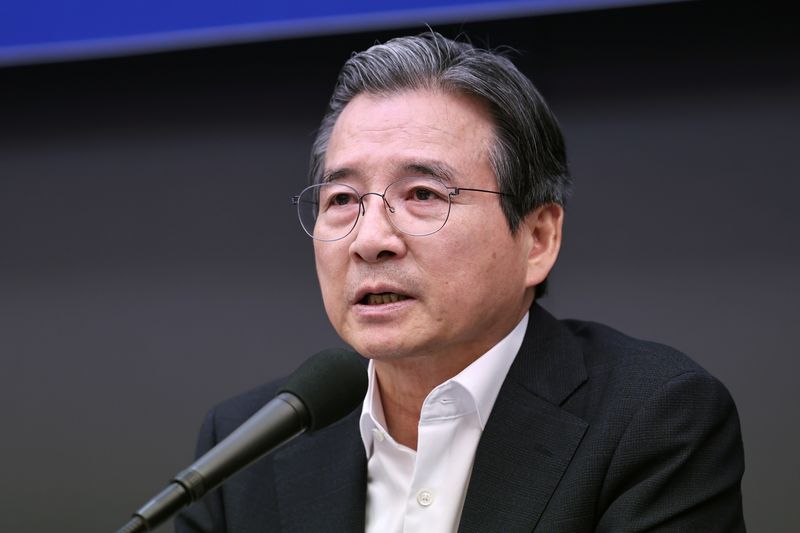
[Financial News] Kim Yong-beom, Chief Presidential Secretary for Policy at the Blue House, said on the 24th that talks over Samsung Electronics and SK hynix reportedly considering semiconductor investments worth hundreds of trillions of won in the Honam region, including Gwangju and Jeollanam-do, as well as in the Chungcheong region, are nearing completion. He added that once the plan is finalized, the companies and ministries will gather together to brief the public at one time. A detailed investment plan is expected to be announced as early as early next week.
■ Samsung and SK push for hundreds of trillions of won in semiconductor investment in Honam and Chungcheong
At the forum hosted by the Kwanhun Club at the Korea Press Center in Jung-gu, Seoul, Kim said, referring to Samsung Electronics and SK hynix, that "serious discussions are taking place among the two companies, ministries, and the government on where to locate the new semiconductor investments."He added that the companies and the government are working together to think through how to support the artificial intelligence (AI) revolution and whether a second cluster is needed. "The companies have their own concerns, and as the government, we are at the stage of sitting down together to plan for major issues such as location, power, water, and labor," he said. Samsung Electronics and SK hynix are reportedly reviewing plans to expand semiconductor cluster investment, focusing on the Honam region, including Gwangju and Jeollanam-do, as well as the Chungcheong region.
However, Kim drew a line against the idea that the existing Yongin semiconductor cluster plan would be moved to the provinces. "This is absolutely not about canceling what was planned for Yongin and moving it to the provinces," he said. "We are not relocating what is in the Seoul metropolitan area. We will build as much as possible in the metropolitan area and create a new cluster."
When the moderator asked again whether it would be fair to summarize the point as meaning that the semiconductor plant planned for Yongin would not be moved elsewhere, but that facilities originally intended for later construction would be advanced and built in Honam because demand is so strong, Kim replied, "That is the principle we should follow."
Kim said the reason for discussing a second semiconductor cluster location is that semiconductor demand is rising faster than expected. "SK hynix had planned to complete its fourth plant in 2044, but that has been moved up to 2034," he said. "What was supposed to be built in 2044 now needs to be built by 2034."
He said the same applies to Samsung Electronics. "Samsung also has plans through 2048," he noted. "It will probably need to be moved up to 2034 or 2035." He added, "The cluster in the metropolitan area must be completed by 2034 or 2035. That will prepare us for what comes after, but there is no land left in the metropolitan area, and neither power nor water is feasible." He explained that building one semiconductor front-end fab takes seven to eight years, so if construction starts only after Yongin is fully built and the next site is selected, it would be too late. That is why the site development project must begin first.
Kim also pointed out that during the Middle East war this year, the government drew up a 25 trillion won supplementary budget, and said an even larger amount of excess tax revenue is expected to come in before the end of the year. He said the current semiconductor supercycle is likely to have a significant ripple effect.
Asked whether there are plans to build additional nuclear power plants to meet electricity demand, Kim said, "I believe there will be serious discussions in the 12th Basic Plan for Electricity Supply and Demand," suggesting the possibility of more nuclear construction.
On concerns about regional conflict, Kim said, "Rather than creating conflict by region, the goal is to find the most suitable location based on the characteristics of the industry." He added, "These are companies with market capitalizations of more than $1 trillion. It is not something they would decide lightly just because the government talks about balanced growth or other principles. These are enormous investments."
On concerns that the Southeast Region of Korea may be left out, he said, "The physical AI sector will become the center in the Southeast Region of Korea." He added, "There will also be investments by region, including the Honam region, the Chungcheong region, the Southeast Region of Korea, and Gangwon Province. We will make meaningful investments in each region."
He also addressed the recent labor-management conflict over bonuses. In response to questions about union demands at Samsung Electronics and SK hynix that a certain percentage of operating profit be paid as performance bonuses, Kim said, "I think we need to have a serious social discussion first about whether something that is not wages can be made the subject of a labor dispute."
■ Semiconductor Special Act to protect Yongin and boost Honam
Meanwhile, the government is reportedly planning to include preferential treatment for non-capital region areas in the enforcement decree of the Special Act on Strengthening and Supporting the Semiconductor Industry's Competitiveness, known as the Semiconductor Special Act. The originally considered exclusion of the Seoul metropolitan area has been dropped, so the Yongin Semiconductor Cluster will proceed as planned. However, observers say the preferential treatment for non-capital regions will give more momentum to the Honam Semiconductor Cluster project promoted by the government and the ruling party.People Power Party lawmaker Koh Dong-jin, a former Samsung Electronics president, said he received a reply from the Ministry of Trade, Industry and Energy confirming that Article 15 of the Semiconductor Special Act enforcement decree will include "preferential treatment for non-capital regions" instead of "exclusion of the Seoul metropolitan area."
"In other words, there will be no problem with the cluster status of the Yongin Semiconductor Cluster under the special act, and support for various industrial infrastructure such as power grids will also proceed smoothly," Koh said. "I have pointed out to MOTIE that if cluster designation is limited to non-capital regions such as Honam, it would create several unreasonable problems, including access to suppliers of materials, parts, and equipment, as well as labor in the metropolitan area."
[email protected] Choi Jong-geun Reporter