"KOSPI Boom Is Fueling Home Prices... Will Lee Jae-myung Administration's Efforts Go to Waste?" FT Reports on the Paradox of a Hot Market
- Input
- 2026-06-24 09:47:01
- Updated
- 2026-06-24 09:47:01
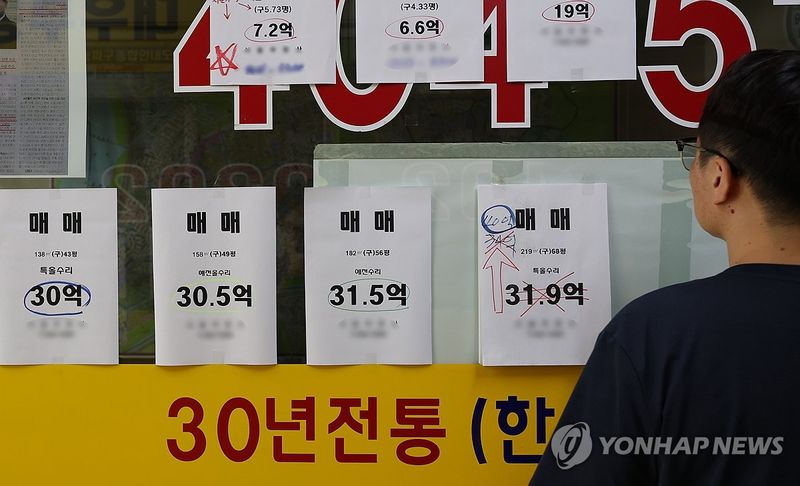
[Financial News] As South Korea's stock market continues to post one of the strongest gains in the world, foreign media reports say Korean retail investors who made profits in equities are pouring that money into the property market. The reports also suggest that this is undermining the government's efforts to cool housing demand.
Yongin IT worker: "Made a lot of money in stocks, then moved into real estate... a vicious cycle"
The Financial Times reported on the 23rd, local time, that recent investment behavior among Korean retail investors shows a paradoxical trend in which the stock market boom is instead heating up the property market.
According to the Ministry of Land, Infrastructure and Transport, 13.2% of high-end home transactions worth more than 1.5 billion won in April were funded by proceeds from securities sales. It was the first time the figure had exceeded 10% since related statistics began to be compiled. That is about three times the monthly average over the past five years.
Kim Won-ik, an IT worker living in Yongin, told the Financial Times in an interview, "When people make a lot of money in stocks, that money eventually flows into the property market." He added, "It is closer to a vicious cycle than a virtuous one."
The government has been pursuing various policies to reduce the excessive concentration of household wealth in real estate. It has argued that high home prices deepen asset inequality and also affect the country's falling birth rate.
"FT Says Government Regulations Are Not Enough to Stabilize the Market"
Lee Jae-myung also pledged when he took office to shift the nation's wealth away from "unproductive real estate investment" and toward productive areas.
Still, FT said the preference for real estate remains strong. This year, the KOSPI has continued its rally, supported by expanded investment in Artificial Intelligence (AI) and a recovery in the semiconductor industry. Samsung Electronics and SK hynix led the gains, and SK hynix recently overtook Samsung Electronics to become the country's most valuable company by market capitalization.
Even so, FT explained that most household assets in South Korea remain tied up in real estate.
According to Morgan Stanley, real estate accounts for about 75% of Korean household assets. Stocks make up only around 9%. Household debt is also equivalent to about 175% of net disposable income, placing South Korea among the higher-debt OECD members.
This trend is closely linked to the long-held view that real estate has delivered higher returns than stocks. Data from KB Kookmin Bank show that from 2015 to 2025, the KOSPI rose by only about 25%, while average home prices in Seoul climbed by more than 50% over the same period.
In fact, Seoul home prices have been rising again this year. KB Kookmin Bank said housing prices in Seoul rose 3.1% from the end of January to the end of May, while the overall Capital Region posted a 1.9% increase.
The government has introduced a range of measures, including tighter lending rules, higher taxes on multi-home owners, and transaction restrictions in some areas. However, critics say these steps are still not enough to cool the overheated market.
[email protected] Seo Yoon-kyung Reporter