Micron Plunges 13% in Semiconductor Stocks... Rekindling Concerns Over Memory Supply Glut
- Input
- 2026-06-24 01:35:22
- Updated
- 2026-06-24 01:35:22
Reuters/Yonhap Semiconductor stocks on the New York Stock Exchange plunged across the board on the 23rd (local time). Memory leader Micron plummeted by over 13%, and market leader Nvidia plunged by more than 4%, with semiconductor stocks recording a general downward trend.
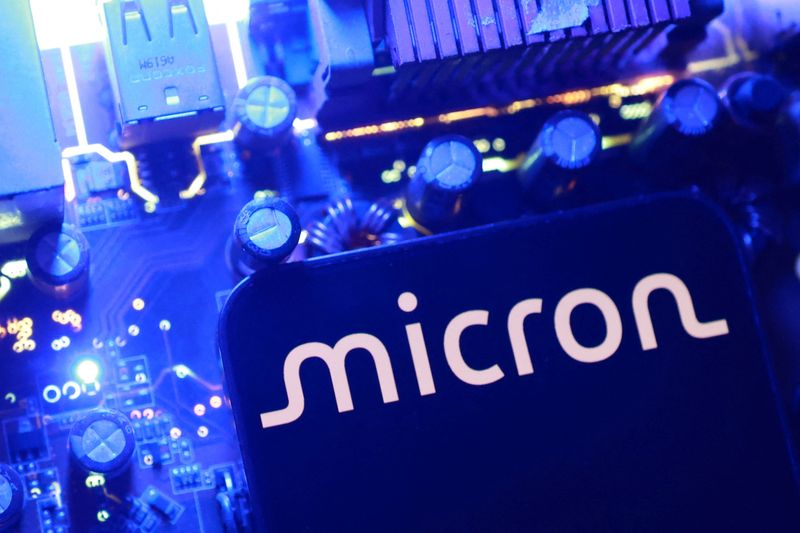
Micron, the epicenter of the New York semiconductor stock crash on this day, faced a sell-off as anxiety intensified ahead of its quarterly earnings announcement after the market close. 2 trillion and marking the highest annual growth rate in its 40-year history.
Pointed out. Relatively low PER, may be a peak Micron's outlook remains optimistic.
The prevailing forecast is that earnings per share (EPS) will increase approximately sevenfold this year to $61, and reach $118 next year. 6 times.
This is about half the level of the S&P 500 forward P/E ratio, which exceeds 20 times. However, Trepis pointed out that one should not be misled by such a low P/E ratio, as memory is the sector most heavily affected by business cycles in the semiconductor industry.
This is because memory semiconductors are an industry that maintains solid profitability when supply is tight and prices are high, but incurs massive losses once these peaks are broken.
With new industry investments already significantly expanded amidst tight demand, supply prices and margins will come under pressure once supply begins to catch up with demand.
Reuters/Yonhap Semiconductor stocks on the New York Stock Exchange plunged across the board on the 23rd (local time). Memory leader Micron plummeted by over 13%, and market leader Nvidia plunged by more than 4%, with semiconductor stocks recording a general downward trend.
This implies that the current P/E ratio may not be at a sustainable level but rather applies only to peaks.
Reuters/Yonhap Semiconductor stocks on the New York Stock Exchange plunged across the board on the 23rd (local time). Memory leader Micron plummeted by over 13%, and market leader Nvidia plunged by more than 4%, with semiconductor stocks recording a general downward trend.Repeated market collapses and stock price halving For this reason, the memory industry has already experienced severe collapses several times.
In particular, much like the economic theory of the 'cobweb theory,' there have been frequent instances where the market collapses because, after increasing supply to meet high demand, actual market demand fails to keep up with the expanded supply.
Constructing a new production line (fab) costs tens of billions of dollars and takes two to three years.
Once a fab is completed, it is most economical for semiconductor companies to operate their factories at full capacity, regardless of price.
However, the market often cools down rapidly by then.
Micron, which expanded its fabs in anticipation of increased PC demand, saw its stock price plummet 70% between 2014 and 2016 when the expected demand failed to materialize.
Reuters/Yonhap Semiconductor stocks on the New York Stock Exchange plunged across the board on the 23rd (local time). Memory leader Micron plummeted by over 13%, and market leader Nvidia plunged by more than 4%, with semiconductor stocks recording a general downward trend.
Furthermore, in 2018 and 2019, inventories surged as cloud providers (hyperscalers) placed large orders but subsequently scaled back actual purchases.
Reuters/Yonhap Semiconductor stocks on the New York Stock Exchange plunged across the board on the 23rd (local time). Memory leader Micron plummeted by over 13%, and market leader Nvidia plunged by more than 4%, with semiconductor stocks recording a general downward trend.DRAM prices plunged 40%, NAND prices 60%, and Micron's stock price dropped 57% from its peak.
31 billion.
Even back then, stock prices were cut in half.
Concerns over supply in 2027–2028 Micron plans to invest over $25 billion in capital expenditures for fiscal year 2026, SK Hynix approximately $27 billion, and Samsung Electronics is also planning a policy of aggressive investment expansion.
The total amount the three memory companies have decided to invest in new facilities annually exceeds $75 billion.
Considering that it takes 2 to 3 years to expand facilities, the point at which memory oversupply is a concern is 2027–2028.
Above all, it has become difficult for memory companies to back out of their investment plans.
Reuters/Yonhap Semiconductor stocks on the New York Stock Exchange plunged across the board on the 23rd (local time). Memory leader Micron plummeted by over 13%, and market leader Nvidia plunged by more than 4%, with semiconductor stocks recording a general downward trend.
This is because wafer fab facility expenditures are set at approximately $145 billion this year and $156 billion next year.
Reuters/Yonhap Semiconductor stocks on the New York Stock Exchange plunged across the board on the 23rd (local time). Memory leader Micron plummeted by over 13%, and market leader Nvidia plunged by more than 4%, with semiconductor stocks recording a general downward trend.Because the time required from the investment decision to the operation of wafer fab facilities is long, it is not easy to cancel an order once it has been placed.
This means that the memory industry is not merely planning facility expansion but is already tied down by these plans.
For this reason, even if the growth of demand slows in 2027–2028, supply is highly likely to increase rapidly.
AI investment is key.
Concerns could be alleviated if hyperscalers such as Amazon, Microsoft (MS), and Alphabet continue to invest in AI.
However, those who committed to investing over $600 billion this year alone are facing increasing pressure, making it uncertain whether they can continue large-scale investments beyond next year.
Reuters/Yonhap Semiconductor stocks on the New York Stock Exchange plunged across the board on the 23rd (local time). Memory leader Micron plummeted by over 13%, and market leader Nvidia plunged by more than 4%, with semiconductor stocks recording a general downward trend.
If their demand decreases, the memory industry will take a direct hit.
Reuters/Yonhap Semiconductor stocks on the New York Stock Exchange plunged across the board on the 23rd (local time). Memory leader Micron plummeted by over 13%, and market leader Nvidia plunged by more than 4%, with semiconductor stocks recording a general downward trend.Will the unique characteristics of HBM be different this time? However, there is a high level of optimism in the market that this time may be different.
The optimism is that HBM (High Bandwidth Memory), which has become the mainstay of the three memory companies in the AI era, will exhibit a different pattern from the traditional memory market.
Reuters/Yonhap Semiconductor stocks on the New York Stock Exchange plunged across the board on the 23rd (local time). Memory leader Micron plummeted by over 13%, and market leader Nvidia plunged by more than 4%, with semiconductor stocks recording a general downward trend.
HBM demand is increasing exponentially.
Reuters/Yonhap Semiconductor stocks on the New York Stock Exchange plunged across the board on the 23rd (local time). Memory leader Micron plummeted by over 13%, and market leader Nvidia plunged by more than 4%, with semiconductor stocks recording a general downward trend.The NVIDIA Rubin GPU (Graphics Processing Unit), which begins shipping in the second half of this year, will contain 288 gigabytes (GB) of HBM, and the Rubin Ultra, which will ship next year, will be equipped with 1 terabyte (TB) of HBM.
In the past, 80 GB of HBM was used in NVIDIA GPUs.
Over the past three years, the demand for HBM in GPUs has surged twelvefold.
In addition, the shift in AI trends from training to inference is also expanding the size of the end-use memory market.
Large-scale high-speed memory is required for applications such as AI agents and real-time video generation.
Furthermore, unlike memory products that were previously centered on the spot market, HBM is increasingly being supplied through multi-year contracts.
The likelihood of sudden order cancellations, which previously caused sharp downturns in memory cycles, has diminished.
Last March, Micron secured its first five-year HBM contract that encompasses both scale and price.
For this reason, there is optimism that, unlike in the past, the memory cycle will not fluctuate wildly this time.
However, the question remains whether the expansion in HBM demand is strong enough to swallow up the record-breaking factory volumes currently being built by memory manufacturers.
6 appears very low, Trepis warns that this current low P/E ratio could be nothing more than an illusion once the expansion volumes from the three major memory companies flood the market in earnest next year.
[email protected] Song Gyeong-jae Reporter