"The exchange rate is excessive relative to fundamentals... Keep the oil price cap system"
- Input
- 2026-06-23 18:27:54
- Updated
- 2026-06-23 18:27:54
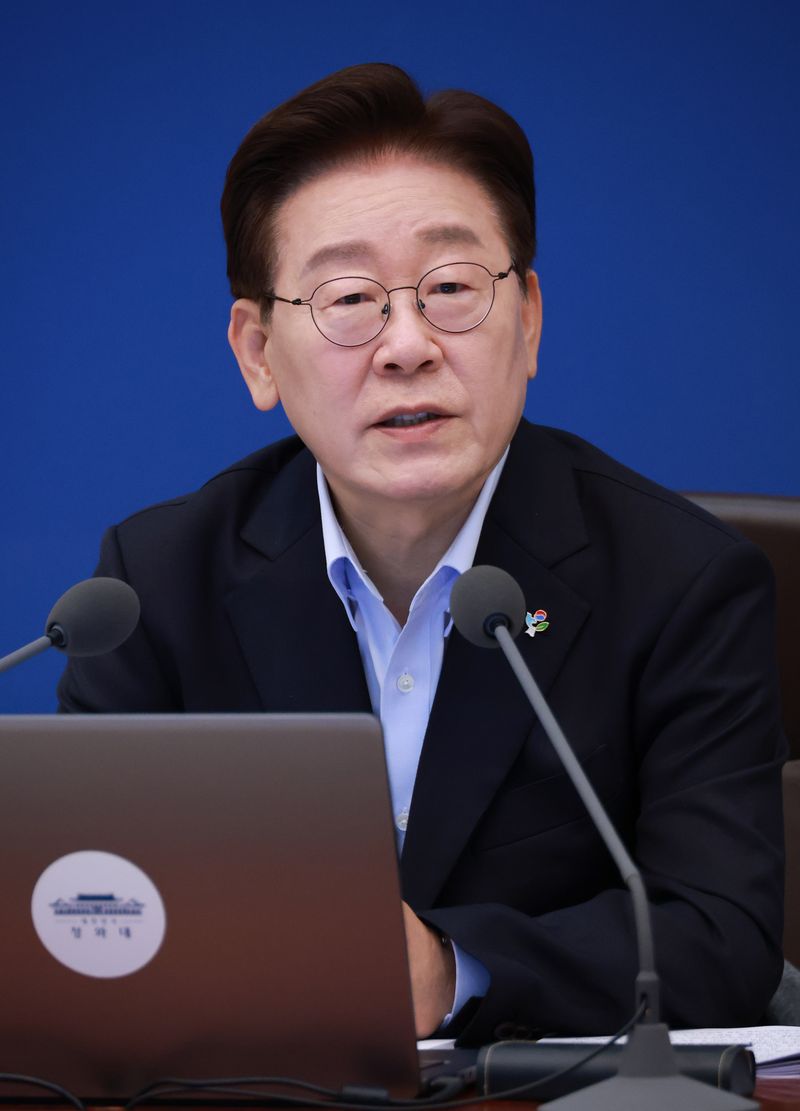
At the State Council of South Korea and Emergency Economic Review Meeting he chaired at the Blue House, Lee pointed to the strong won–dollar exchange rate. He said, "Our exports are at an all-time high, and our current account surplus is also at an all-time high. It is beyond imagination," adding, "Then the exchange rate should normally fall, but it is not."
Deputy Prime Minister and Minister of Economy and Finance Koo Yun-cheol explained, "As our stock market has risen, foreign investors have made a lot of money. So some of them have been selling, and we estimate that about 10%, or around 140 trillion won, has been sold. That has led to currency exchange, which pushed up the won–dollar exchange rate."
Lee analyzed the situation, saying, "When the Korean stock market improves, foreign buying should come in and supply dollars. But now, because the market has risen too sharply, foreign positions have increased and the burden of managing Korean assets has grown, so we are in a situation where we need to reduce that." He then asked whether this was a short-term issue rather than a structural one, and Koo replied, "Yes." Lee added, "Isn't the point when foreign investors' so-called rebalancing is nearing completion also the point when the sharp rise stops? In the end, this is part of the normalization process, and it is a matter of time."
He also voiced concern over asset polarization amid the stock market rally. Lee said, "There is a dazzling achievement in the semiconductor boom, especially the sharp growth of the stock market, but behind it lies a deep shadow of asset inequality." He added, "In particular, the younger generation, which lacks opportunities to build assets through stable jobs and income, is the most marginalized group of our time. That is why careful and steady efforts across all policies to give young people more opportunities are even more important."
He also said, "The government must painfully accept the sense of alienation among young people who feel that record-high bonuses or a record-high KOSPI are stories from another world," and instructed officials that "careful and steady efforts across all policies to give young people more opportunities are therefore even more important."
The meeting also discussed the oil price cap system. Lee said, "We expect some excess tax revenue from semiconductors and other sectors, so lowering the fuel tax would not place a heavy burden on the budget and would also help expand consumers' spending power," adding, "We should be bolder in keeping the oil price cap system in place and should also consider lowering the cap further."
At the meeting, officials reviewed and approved 46 presidential decrees and three general agenda items, including a revision to apply quota tariffs to Liquefied Petroleum Gas (LPG) and other items in order to ease the burden of high oil prices and inflation caused by the Middle East war.
Under the revision, the government will apply a 0% quota tariff from the first day of next month through the end of the year to three items: Natural gas, crude oil for manufacturing Liquefied Petroleum Gas (LPG), and Liquefied Petroleum Gas (LPG).
[email protected] Choi Jong-geun Reporter