In Response to Moves to Cut Grants, Education Chiefs Join Forces to Secure Funding and Accelerate Teacher Rights Recovery [Asking About the Future of South Korea's Education]
- Input
- 2026-06-23 18:27:21
- Updated
- 2026-06-23 18:27:21
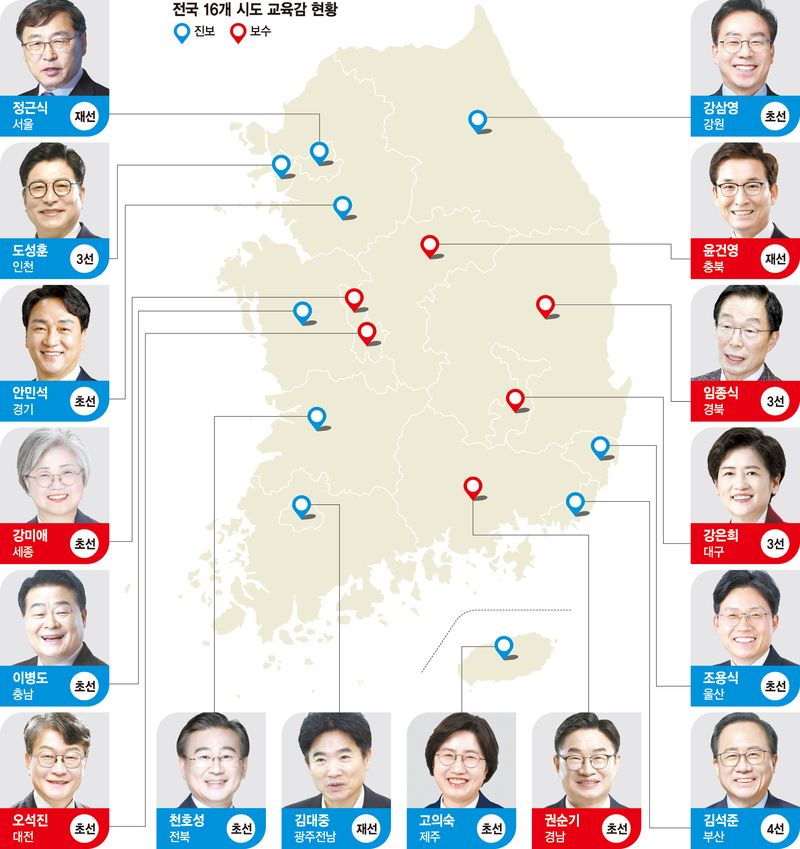
Kang Eun-hee, the three-term superintendent of the Daegu Metropolitan Office of Education; Ahn Min-seok, the Gyeonggi-do superintendent who defeated an incumbent and rose to lead the country's largest education office; and Kang Mi-ae, the Sejong superintendent who won despite controversy over the education minister's alleged election interference. Education chiefs once divided along progressive and conservative lines have begun speaking with one voice on the common challenge of reforming Local Education Subsidy Grants. The 16 provincial and metropolitan superintendents nationwide, who appointed Geun-sik Chung, the re-elected superintendent of the Seoul Metropolitan Office of Education, as the 11th chair of the Korean Council of Superintendents of Education, have agreed to respond jointly to the government's push for grant reform. For the first time, the superintendents elected in the 9th popularly elected local government term will be responsible for managing local education finance worth 100 trillion won. Over the next four years, the success of public education will depend on whether they can move beyond camp politics and address three major tasks: declining student numbers, investment in Artificial Intelligence (AI) education, and restoring teachers' authority.
■ Joint response to grant reform
According to the Korean Council of Superintendents of Education on the 23rd, the total size of local education finance this year is about 100 trillion won. Of that, the Local Education Subsidy Grants, the key funding source, amount to 76 trillion won. Local education finance is not simply money for school operations. It is a national investment fund that supports AI talent development, care systems, responses to low birth rates, and balanced regional development.
Fiscal authorities have recently begun in earnest to discuss reforming the Local Education Subsidy Grants, citing falling student numbers and rising tax revenue. They argue that a new allocation method should be considered to reflect changes in school-age population, rather than the current system, which automatically distributes 20.79% of total internal taxes. The Ministry of Education of the Republic of Korea is also reviewing a plan to raise the cap on grant reductions imposed on education offices with a high share of welfare-type cash benefits from the current 1 billion won to as much as 10 billion won.
Education chiefs nationwide have moved to mount a joint response to the grant reform push. At his appointment as chair on the 15th, Chung said, "Education finance is an investment for future generations," and added, "If education finance is cut solely on the basis of declining student numbers, it could lead to lower educational quality and wider educational gaps." He continued, "Stable local education finance is needed to nurture talent that will determine national competitiveness in the AI era and to drive region-specific educational innovation."
Kang Eun-hee, a leading conservative veteran and superintendent of Daegu Metropolitan Office of Education, and Lim Jong-sik, the three-term superintendent of North Gyeongsang Province, also list financial stability as a top priority. Yoon Geon-young, who was re-elected as superintendent of North Chungcheong Province, said cash-based projects should be reviewed, but the foundation of regional education must be preserved. As the Ministry of Education considers expanding penalty cuts, the fiscal management skills of newly elected superintendents will also be put to the test.
The reality on the ground is not easy. More than 60% of education budgets are fixed costs, such as staff salaries, school facility maintenance, and safety management expenses, which are incurred regardless of changes in student numbers. Maintaining small rural schools, special education, and education welfare programs are also areas that cannot easily be reduced.
■ Rising demand for AI and care investment
New investment needs are, in fact, continuing to grow. Building AI-based personalized learning systems, upgrading digital education environments, supporting basic academic skills, revitalizing small schools, integrating early childhood and care services, and establishing the after-school care program all require large-scale funding.
Attention is also focused on Ahn Min-seok, the superintendent of the Gyeonggido Office of Education, which is the country's largest education office. The Gyeonggi-do Office of Education oversees about one-quarter of all students nationwide. Along with the political symbolism of defeating an incumbent, Ahn faces tasks such as AI education, narrowing educational gaps, and tailoring educational innovation to northern Gyeonggi and rural areas. Analysts say his fiscal and policy choices will have a significant impact on the direction of education policy nationwide.
Kang Mi-ae, the Sejong superintendent, is also drawing attention. She emerged as a new symbol for the conservative camp after winning despite controversy over the education minister's alleged election interference. As Sejong is both the nation's administrative capital and a testing ground for education policy, it faces the task of presenting a leading model in areas such as early childhood and care integration, AI education, and special education zones. Do Seong-hoon, the three-term superintendent of Incheon Metropolitan Office of Education, plans to prioritize budget allocations for closing educational gaps and advancing the digital learning environment. Kim Seok-joon, who won a historic fourth term in Busan, has identified early childhood and care integration and the successful rollout of the after-school care program as key tasks. Elsewhere, Kang Sam-young of Gangwon, Go Ui-sook of Jeju, Cheon Ho-seong of North Jeolla, Lee Byeong-do of South Chungcheong, and Jo Yong-sik of Ulsan have all made nurturing tailored talent to respond to regional decline their central priority.
Restoring normalcy in schools is another essential task. Teacher groups, including the Korean Federation of Teachers' Associations (KFTA), are calling for practical measures to protect teachers' rights, such as a state responsibility system for lawsuits related to educational activities, expanded legal support to respond to false reports, and the transfer of teachers' administrative work to education offices. Kang Ju-ho, president of KFTA, said, "Superintendents-elect should not trap the teaching profession in ideological tests by being confined to partisan logic," and added, "They should focus their budgets on effective teacher protection measures and the transfer of administrative work away from teachers."
The 9th popularly elected local government term also brought notable changes to the political landscape. With more progressive superintendents elected than in the previous election, the balance in the education sector has once again tilted toward the progressive camp.
However, in the face of the massive issue of reforming the Local Education Subsidy Grants, joint action has emerged as the top priority over ideological confrontation. Analysts say South Korea's public education system over the next four years will depend on how the 100 trillion won education budget is managed.
[email protected] Kim Man-gi Reporter