"Waiting for higher capital gains and property taxes in the second half"... Seoul warns of a jeonse and monthly rent bubble
- Input
- 2026-06-23 18:23:50
- Updated
- 2026-06-23 18:23:50
According to an analysis of statistics from the Korea Real Estate Board (KREB), as of May, four areas — Yongsan District, Seongdong District, Gwangjin District and Songpa District — had surpassed their previous peaks in jeonse price index for the first time. Whatever the justification for the policy, the reality is that it is feeding a shortage of rental listings, a rapid shift to monthly rent and higher home prices.
Against this backdrop, the government has already made clear that it will raise property taxes and capital gains taxes within the year. The market is voicing considerable concern.
Chang-Moo Lee, a professor at Hanyang University, warned, "If measures are announced without supply support, they are highly likely to fuel a bubble in jeonse and monthly rent prices."
■ 'Triple strength' in jeonse, monthly rent and sales
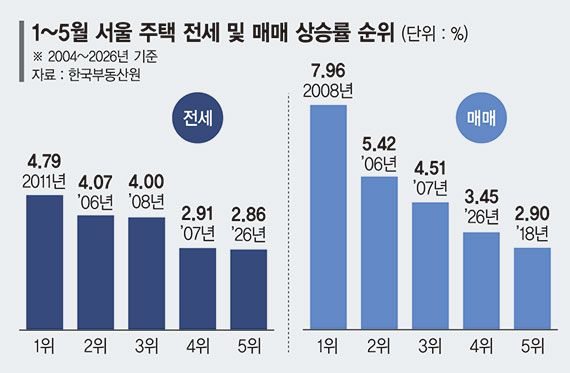
According to KREB statistics released on the 23rd, Seoul's housing jeonse market has been unusually strong this year. Jeonse prices rose 2.86% in the January-May period, the fifth-highest increase for the same period since 2004 and the highest in 19 years since 2007. The strongest January-May increase on record was 4.79% in 2011, followed by 4.07% in 2006, 4.00% in 2008 and 2.91% in 2007.
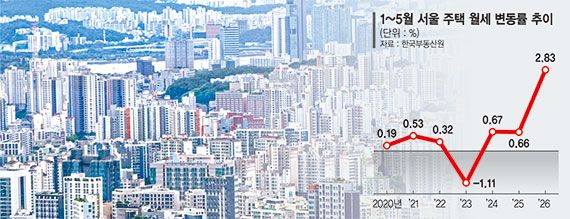
Monthly rent posted its highest increase since the statistics began. Seoul housing monthly rent rose 2.83% in the January-May period, nearly matching the jeonse increase. The share of monthly-rent contracts in Seoul housing also climbed from 62% in the second half of last year to 66% in the January-May period this year.
The sales market is also unstable. Seoul housing prices rose 3.45% in the January-May period, the fourth-highest increase since 2004. In the Seoul housing sales price index, 19 of the 25 districts have already surpassed their previous 2021 peaks.
One expert said, "In the past, there were many cases where people simply did not buy homes, so jeonse prices rose while sales prices stayed negative. Now, jeonse is in turmoil, monthly rent is surging and sales prices are also climbing. This triple-strength trend is spreading beyond Seoul to the Capital Region."
■ Market on edge over 'something stronger is coming'
The government has officially signaled additional measures. The main options include higher capital gains taxes, higher property taxes and tighter jeonse loan rules. The government says these steps are necessary to normalize the market. It plans to release more detailed measures in July.
An industry official said, "From the government's perspective, with the autumn moving season just around the corner, it has no choice but to consider extraordinary measures to stabilize home prices. But given what has happened so far, it is unclear whether the market will move the way the government wants."
That is because, in a situation where supply is absolutely insufficient, stronger demand-suppression policies could create even more side effects.
Ko Jun-seok, a professor at Yonsei University, said, "Regardless of whether the government's idea of normalization is right or wrong, tax increases are very likely to be passed on to tenants in the end. That has already been confirmed under previous administrations."
Kim Jun-hyung, a professor at Myeongji University, pointed out, "Jeonse should be stabilizing and disappearing, but now the increase in jeonse prices is shifting into monthly rent. Policy is creating monthly rent, and the current shift toward monthly rent is a bad form of rental conversion that is worsening housing insecurity for ordinary people."
Woo Byung-tak, a senior researcher at Shinhan Bank's Shinhan Premier Pathfinder, said, "If property taxes and capital gains taxes are raised at the same time, the policy effects the government wants could be cut in half." Ham Young-jin, head of the Real Estate Research Lab at Woori Bank, stressed, "Prices can only be brought under control if the rental market and supply problems are addressed."
[email protected] Lee Jong-bae, Choi A-young Reporter