KOSPI Sees 50 Trillion Won in Daily Trading, Yet Half of Stocks Trade Less Than 1 Billion Won
- Input
- 2026-06-23 18:21:21
- Updated
- 2026-06-23 18:21:21
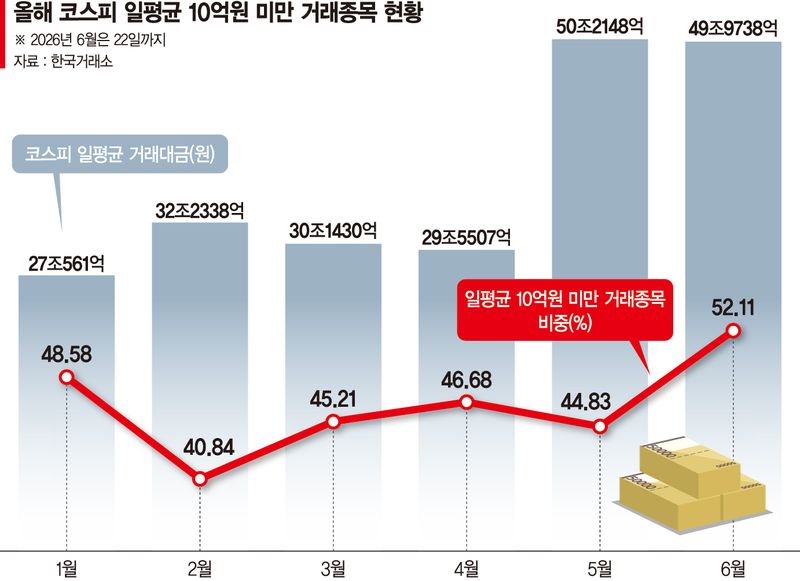
According to the Korea Exchange (KRX) on the 23rd, the average daily trading value on the Korea Exchange Main Board reached 49.9738 trillion won from the start of this month through the previous day. That was the second-highest monthly average on record, following the previous month’s 50.2148 trillion won. In January, the figure stood at just 27.0561 trillion won. It remained in the 30 trillion won range through February to April, but trading has surged sharply since last month.
Trading value refers to the combined amount of buy and sell orders. As trading value rises, it indicates broader market attention and stronger liquidity.
Although trading has been active amid the stock market rally, the concentration in a few names has intensified. Of the 946 KOSPI-listed stocks, 493 had an average daily trading value of less than 100 million won this month through the previous day, accounting for 52.11%. That was a sharp increase from 44.83% in the previous month.
The share of stocks trading below 100 million won a day also stayed in the 40% range during January through April, suggesting that more names have been left behind. Given that KOSPI trading value at the time was only about 60% of current levels, the divide appears to have widened further.
With the market led by large-cap stocks, investment funds are also concentrating on semiconductors and other big names. Samsung Electronics and SK hynix accounted for 29.83% of total trading value in January, but that share expanded to 46.26% this month.
Brokerage analysts say the concentration is natural in an unusual earnings-driven market, where funds tend to flow into sectors with strong results. They add that in an environment of rising rates and other macro uncertainties, investors have little choice but to focus more on fundamentals.
"In a period when rising interest rates tighten liquidity conditions, the true face of earnings becomes more visible," said Hwang Su-uk, a researcher at Meritz Securities. "Unlike a favorable liquidity environment that lifts all asset prices, this phase makes stock-price differentiation based on earnings stand out more clearly."
"When the rate environment limits valuation-driven plays, attention shifts more strongly to fundamentals," he added. "In the domestic market, there is essentially no sector other than semiconductors that has stronger upward momentum in earnings estimates."
Lee Eun-taek, a researcher at KB Securities, also said, "Semiconductors, which have solid earnings and a powerful narrative of structural shortages, may be the leading stocks that investors can hold for relatively longer." He added, "As interest rates rise and the rally nears its late stage, the first stocks to watch carefully are those with weak profits and breakeven points far in the future." He continued, "For example, when the market wobbled in mid-last month over the Samsung Electronics strike issue, theme stocks such as robotics theme stocks and Space moved even more sharply than Samsung Electronics. That suggests investors are feeling greater unease about stocks with weak earnings than about semiconductors, which have already risen a lot." He concluded, "Even if the share price looks expensive after a big run-up, stocks whose earnings are proven are more likely to survive to the end. In today's market, semiconductors still fit that description."
[email protected] Seo Min-ji Reporter