"K-Semiconductor Should Not Be Satisfied With the HBM Boom, or It May End Up as a Mere Supporting Actor on the AI Stage" [Interview]
- Input
- 2026-06-23 18:20:15
- Updated
- 2026-06-23 18:20:15
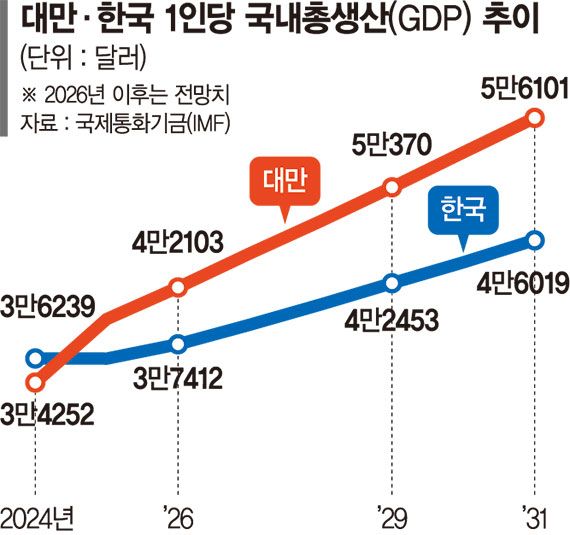

Both Korea and Taiwan have made semiconductors their core growth engine, but what set them apart was a dense industrial ecosystem. As the gains from the semiconductor boom spread beyond TSMC to thousands of supplier companies, they translated into higher income across businesses and households.
Liu Pei-chen, Director General of the Industrial Economy Database at the Taiwan Institute of Economic Research, emphasized in an interview with Financial News on the 23rd that the key to Taiwan's semiconductor industry contributing to higher real income for the public lies in its region-based cluster effects and high concentration of talent.
He pointed to the industry's distinctive structure: high-paying jobs and engineers' spending power remain in the country, supported by a self-sustaining ecosystem that feeds into private income growth. Around TSMC, companies in design, materials, equipment, and construction have formed an interconnected industrial network, allowing the benefits of the semiconductor boom to spread throughout society.
The foundation for this ecosystem is a broad social consensus in Taiwan that views semiconductors as a national security asset. They are seen not merely as a flagship industry, but as a strategic asset tied directly to national survival, often described as the 'Silicon Shield.' One clear example is how quickly lawmakers from both parties move when semiconductor-related bills are involved. Taiwanese politics treats stronger semiconductor competitiveness as a national security issue and advances related policies on a bipartisan basis.
A representative case was the 2023 revision of the National Security Act to block the leakage of core technologies, along with the introduction of Article 10-2 of the Industrial Innovation Statute, known as the 'Taiwan Chips Act.' The main goal is to offer tax credits for advanced process and research and development investments, encouraging semiconductor companies to keep key production facilities and leading-edge processes in Taiwan.
Liu said, "The collective view of semiconductors as a national security asset is what drives the rapid pace of related policy and legislation, including bipartisan agreement in Taiwan's political circles." He added, "On issues such as securing land for semiconductor companies, tax breaks, and regulatory easing, government ministries are effectively operating on a fast track, supporting administrative procedures at the pace of corporate investment."
By contrast, the Yongin Semiconductor Cluster General Industrial Complex, the centerpiece of Korea's K-Semiconductor ecosystem plan, took more than five years to break ground after its announcement in 2019, as water supply issues, transmission line construction, environmental impact assessments, and coordination among local governments all piled up. That is one reason critics say the government must improve its coordination capacity and speed up policy execution.
Warnings are also being raised about an ecosystem overly concentrated in specific areas such as High Bandwidth Memory (HBM) within the AI supply chain. Liu said, "Memory semiconductors are inherently products with very large price volatility depending on the business cycle and supply-demand cycle, and Korea's heavy reliance on this sector makes it vulnerable to sharp economic swings." He added, "HBM is bringing Korea a short-term boom, but unless it secures meaningful market share in advanced foundries and leading-edge processes, the Korean semiconductor industry is likely to remain a 'high-end supporting actor' in the global AI ecosystem."
[email protected] Jeong Won-il, Choi Hye-rim Reporter