The era of cheap resource purchases is over... Beyond leaving the Middle East, toward 'energy independence' [Peace Talks and the 'New East Road' (Part 1)]
- Input
- 2026-06-23 18:15:14
- Updated
- 2026-06-23 18:15:14
Experts stress the need for a new energy mix that combines overseas resource development, nuclear power, Small Modular Reactors (SMRs), and renewable energy. The goal is to move beyond the era of stably buying cheap energy and build 'energy independence' that will not be shaken by external shocks.
■ Heavy dependence on the Middle East remains... energy supply vulnerability resurfaces
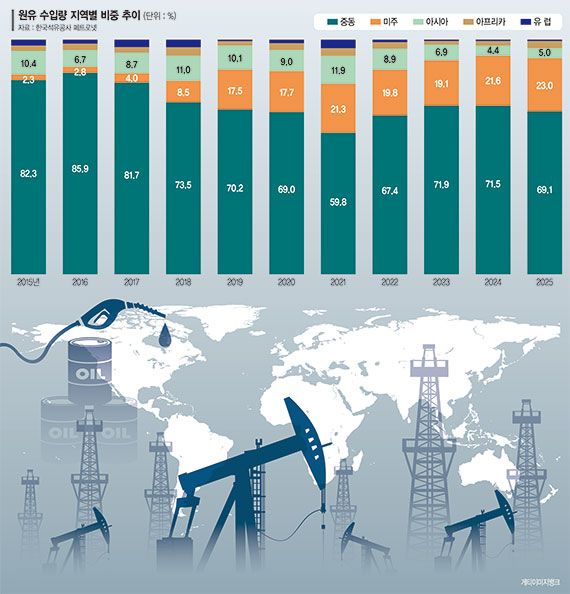
According to Korea National Oil Corporation (KNOC) on the 23rd, 69.1% of South Korea's crude oil imports last year came from the Middle East. That is lower than the 80% range seen 10 years ago, but it is still a high level. This is because Middle Eastern crude is geographically close and relatively inexpensive to transport, while domestic refining facilities are also optimized to process heavy crude from the region.
The Middle East war has once again exposed the weak link in South Korea's energy supply. This is not simply a matter of rising oil prices. It is more like a signal that energy is once again emerging as a key variable in national security and industrial competitiveness.
Since the Russia-Ukraine War, countries around the world have been moving beyond securing cheap energy and accelerating efforts to build systems that can maintain supply chains even in times of crisis. The United States has transformed from an energy importer into a producer through the shale revolution, while the European Union (EU) has pushed ahead with supply chain restructuring through the REPowerEU Plan to reduce dependence on Russian gas. In the past, competitiveness came from buying cheap and stable energy. Now, national competitiveness is being shaped by energy resilience that can withstand external shocks.
■ Need to build a 'transition system' beyond expanding renewable energy
Experts say the Middle East war has raised the need to redesign strategy, not simply to 'leave the Middle East,' but to achieve 'energy independence.' The key is to build an energy system that allows the economy and industry to function normally even under external shocks.
A report by the Korea Energy Economics Institute, titled 'Changes in Global Oil and Gas Trade and Analysis of Korea's Supply Chain Risks,' recommends considering not only diversification of supply sources but also secured equity volumes and the stability of transportation routes.
Kim Tae-heon, a senior research fellow at the Korea Energy Economics Institute, said, "To understand real energy security, we must go beyond simple quantitative diversification and comprehensively assess qualitative indicators such as companies' secured equity volumes and the safety of physical transport routes." He added, "If import sources are concentrated in specific regions, geopolitical risks can spill over into natural disaster and accident risks. That is why we need a 'three-dimensional portfolio' that places crisis types by supplier in a complementary way."
There is also growing support for a new energy mix that combines overseas resource development, nuclear power, and renewable energy. If it is difficult to change the structure of dependence on Middle Eastern crude in the short term, the country must secure multiple supply chains and alternative energy sources and power supplies that can absorb geopolitical shocks.
In this context, Small Modular Reactors (SMRs) are drawing attention. Compared with conventional large nuclear plants, SMRs have shorter construction periods and can be deployed in a distributed way for industrial complexes, data centers, and hydrogen production facilities, making them a possible tool for energy security.
Renewable energy is also seen as one pillar of an energy security strategy. However, analysts say there are limits to simply expanding facilities. In a report titled 'Will the Middle East war accelerate the transition to renewable energy?' the Korea Institute for Industrial Economics and Trade said the war highlights the need for a renewable transition, but that an immediate shift is unlikely. Rising energy prices may encourage investment in renewables, but they also create new constraints, including higher supply chain costs, rising interest rates, and the burden of securing critical minerals. For that reason, the institute said the effort must go beyond merely increasing solar and wind facilities and include building a system that also covers power grids, Energy Storage Systems (ESS), and supply chain diversification.
Researcher Park Yu-mi of the Korea Institute for Industrial Economics and Trade said, "Until now, the expansion of renewable energy has been 'additional energy' added to existing sources to support rising overall energy demand rather than replacing them. But now, an 'energy transition' is needed." She added, "A real energy transition will be possible only when renewable energy expansion is carried out on the premise of reducing total energy demand and curbing fossil fuel use."
[email protected] Park Ji-young Reporter