"It's Exactly Like the Peak of the Dot-Com Bubble" ... Samsung Electronics and SK hynix Plunge Together, as Retail Investors Alone Buy 8 Trillion Won in a 'Bloody Tuesday'
- Input
- 2026-06-24 04:30:00
- Updated
- 2026-06-24 04:30:00
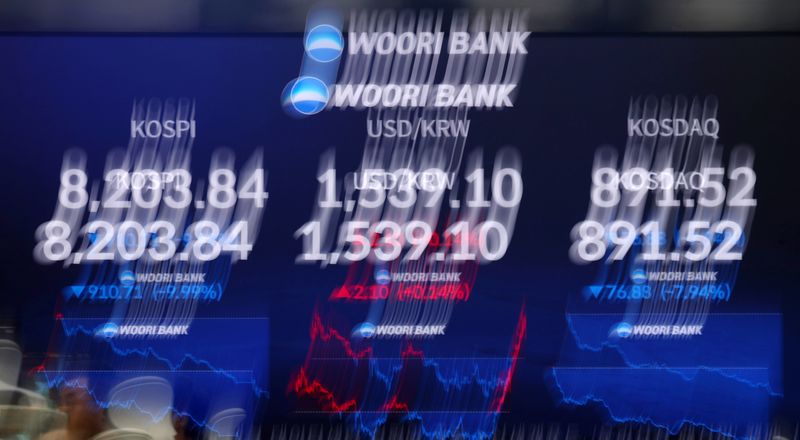
[Financial News] A "black Tuesday" hit the domestic stock market, which had recently broken through the 9,000-point mark and set new all-time highs. Investor sentiment froze in just one day, triggering sell sidecars and circuit breaker mechanisms in both the KOSPI and KOSDAQ markets in an unprecedented sequence.
In particular, Samsung Electronics and SK hynix, the two semiconductor giants that had led the local market, ended the session with their steepest declines in more than 17 years, since the 2008 financial crisis, after massive foreign selling.
According to the Korea Exchange (KRX) on the 23rd, the KOSPI closed at 8,203.84, down 9.99% from the previous day. The KOSDAQ also plunged 7.94% to finish at 891.52, falling below the 900 level.
The market shock deepened as the day went on. Around 11:30 a.m., sell sidecars were triggered in both the KOSDAQ and the Korea Exchange Main Board. Then, at 2:33 p.m., the KOSPI fell more than 8% from the previous day, activating a level-one circuit breaker that halted all trading for 20 minutes. It was the first time since the 8th of this month that sell sidecars were triggered simultaneously in both the KOSPI and KOSDAQ markets.
The crash was driven by heavy selling from foreign investors and institutions. In the KOSPI market, foreigners and institutions net sold 4.1203 trillion won and 4.5477 trillion won, respectively, dragging the index lower. Retail investors alone net bought 8.5783 trillion won, absorbing the supply.
"Samsung and SK hynix post their biggest drop since the financial crisis; foreign ownership hits a 13-year low"
The hardest hit were the semiconductor leaders with the largest market capitalizations. SK hynix closed at 2.555 million won, down 12.47% from the previous session, while Samsung Electronics finished at 310,000 won, down 12.31%. Both stocks recorded their sharpest declines in about 17 years, since the second half of 2008 during the Global Financial Crisis (GFC).
The backdrop to the plunge was a relentless wave of foreign selling. As of the 22nd, Samsung Electronics' foreign ownership stood at 47.52%, the lowest level in 12 years and 10 months, since August 2013. The massive sell-off is seen as the result of cash-raising demand ahead of SpaceX's planned listing, combined with profit-taking after the stock's sharp rally. Geopolitical risks between the United States and Iran, along with concerns over U.S. interest rate hikes, also weighed heavily on investor sentiment.
Amid the market rout, a recent report from Hana Securities became a hot topic again in Yeouido. The previous day, SK hynix had briefly overtaken Samsung Electronics in market capitalization for the first time in 25 years and 7 months.
Hana Securities had said, "When the No. 1 spot in market capitalization changes solely on expectations and overheated share prices, without any reversal in earnings scale, it may be the peak of a bubble and an early sign of collapse, just as Cisco overtook Microsoft during the dot-com bubble in 2000."
Market analysts say that with Samsung Electronics' projected operating profit next year at about 36.3 trillion won, far above SK hynix's 26.3 trillion won, the shift in market cap leadership based only on momentum, without any change in fundamentals, is a sign that the bull market may be ending.
Still, some are urging caution against excessive fear. The KOSPI's forward price-to-earnings ratio is still around 8 times, which suggests valuations remain relatively stable. For that reason, some analysts say the plunge should be viewed not as the start of a prolonged downtrend, but as a correction that is unwinding short-term overheating. Investor sentiment toward domestic semiconductor stocks is expected to hinge on Micron's earnings report, due on the 25th.
[email protected] Moon Young-jin Reporter