"Is the semiconductor boom over?" KOSPI plunges 9.99% in record rout, closes at 8,200 level [Market Close]
- Input
- 2026-06-23 17:29:17
- Updated
- 2026-06-23 17:29:17
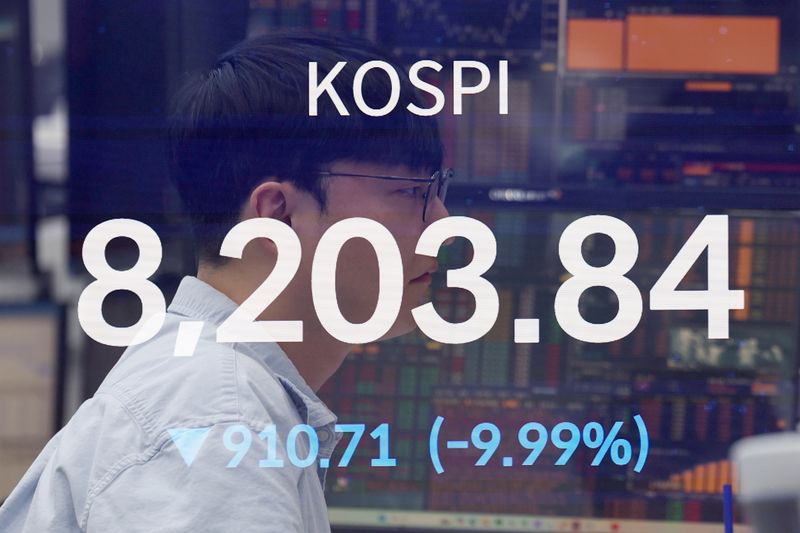
[Financial News] KOSPI suffered a record-setting drop and retreated to the 8,200 level. The decline widened as concerns emerged over the AI industry cycle, while volatility had already increased after the launch of leveraged products. Still, market watchers said the day’s correction did not reflect any fundamental damage, but rather profit-taking and rebalancing.
According to the Korea Exchange (KRX) on the 23rd, KOSPI closed at 8,203.84, down 910.71 points, or 9.99%, from the previous session. That was the largest point drop on record. The index opened at 9,083.54, down 31.01 points, or 0.34%, from the previous close, before extending its losses.
As KOSPI posted an unprecedented plunge, a program sell order temporary suspension, or sidecar, was triggered in the morning. Later in the day, a 20-minute trading halt known as a Circuit breaker was also activated.
A Circuit breaker is triggered when KOSPI falls more than 8% from the previous close for one minute. At the time it was activated, KOSPI was trading at 8,378.25, down 8.07% from the previous session. Even after the Circuit breaker was lifted, the index continued to fall.
Institutions and foreign investors fueled the decline by net selling 4.5489 trillion won and 4.1319 trillion won, respectively. Retail investors were the only net buyers, purchasing 8.5913 trillion won.
Most of the large-cap stocks fell sharply. In particular, the two largest stocks by market capitalization, SK hynix and Samsung Electronics, closed down 12.47% and 12.31%, respectively. Other weak performers included SK Square (-7.01%), Samsung Electro-Mechanics (-10.68%), Hyundai Motor Company (-12.05%), Samsung Life Insurance (-5.66%), and LG Energy Solution (-6.10%).
All sectors also finished lower. The steepest declines came in electric and electronics (-11.92%), manufacturing (-11.04%), medical and precision instruments (-10.37%), construction (-9.75%), transportation equipment and parts (-8.87%), and distribution (-8.60%).
The selloff is being attributed to concerns that investment in technology stocks may fall short of market expectations. Analysts also pointed to volatility amplified by products such as single-stock leveraged exchange-traded funds (ETFs) recently launched in the domestic market.
Lee Sang-heon, a researcher at iM Securities, said, "Recent dollar strength, rising bond yields, and concerns over tightening have combined to raise worries that Big Tech investment may not materialize as much as the market expected." He added, "With leveraged products, a structure has emerged in which gains are magnified on the way up, but losses are also magnified on the way down."
Still, he said the underlying upside story remains intact. "The industry outlook has not worsened; expectations have simply become too high," he said. "The key is whether earnings growth in the quarters ahead, rather than the near term, can meet those expectations. The question is not just whether results are good, but whether they match the elevated bar."
Experts also view the foreign and institutional selling as closer to portfolio rebalancing. Foreign investors typically trim their exposure through profit-taking when Korea's weight in the Morgan Stanley Capital International (MSCI) Emerging Markets Index exceeds 24%, according to the explanation. The rebalancing process in leveraged products also showed up in institutional selling indicators.
KOSDAQ closed at 891.52, down 76.88 points, or 7.94%, from the previous session. It was the first close below the 900 level in about seven months, since Nov. 27 last year. The index opened at 9.76 points, or 1.01%, lower, and then deepened its losses. A sell sidecar was also triggered at one point in the morning.
On KOSDAQ, retail investors sold 398.1 billion won worth of shares. Foreign investors and institutions, meanwhile, bought 258.8 billion won and 132.2 billion won worth, respectively.
[email protected] Reporter Lim Sang-hyuk Reporter