"Minimum wage hike will accelerate automation and ultra-short-term jobs" vs. "Neighborhood businesses can survive only if workers have money to spend"
- Input
- 2026-06-23 17:22:00
- Updated
- 2026-06-23 17:22:00
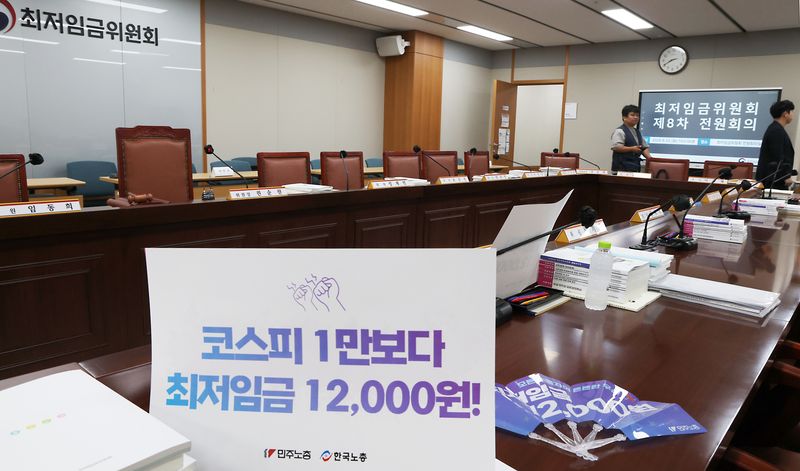
On the 23rd, the Minimum Wage Commission held its eighth plenary session and began deliberations on the 2027 minimum wage. Labor proposed 12,000 won, a 16.3% increase from this year's minimum wage, while management called for a freeze at 10,320 won.
Before the deliberations, labor and management engaged in a tense exchange over whether the minimum wage should be raised.
Ryu Ki-jeong, executive vice president of the Korea Enterprises Federation (KEF), said, "For some industries and small businesses, even the current minimum wage is difficult to meet." He added, "This review should fully take into account the reality that the minimum wage is already high and that the room for acceptance on the ground has reached its limit."
According to a survey conducted in May by the Korea Federation of Micro Enterprises (KFME) of 700 small business owners nationwide, 87% said they felt a heavy burden in paying the current minimum wage. Another 98.5% said next year's minimum wage should be cut or frozen.
The management side also warned that a sharp increase in the minimum wage would deepen a "distorted employment structure," including automation and split work contracts.
Yang Ok-seok, head of the manpower policy division at the Korea Federation of SMEs (KBIZ), argued that a higher minimum wage would lead to lower employment, a wider gap between large and small companies due to labor cost pressure and difficulties in nurturing talent, fewer regular jobs and more split work contracts, and reduced consumer convenience and service quality as business hours are shortened.
Yang said, "Continued minimum wage increases will ultimately accelerate kiosks, automation, and Artificial Intelligence (AI) automation, and will eliminate job opportunities not only for temporary and daily workers but also for vulnerable low-skilled groups." He added, "If the minimum wage rises beyond labor productivity, it will create many side effects in addition to these economic harms, leading to consequences that cannot be fixed with post hoc measures."
Labor's argument is the exact opposite. It says the current economic growth trend is deepening inequality, and that a higher minimum wage is essential to narrow the gap and protect vulnerable workers.
Ryu Ki-seop, secretary general of the Federation of Korean Trade Unions (FKTU), criticized the situation, saying, "Excess profits at large companies are flowing upward, while social risks and costs are quickly spilling over into the lower layers of the labor market. This 'reverse trickle-down effect' is taking place." He added, "The current crisis can rightly be called an era of living-cost crisis, caused by labor market polarization that leaves no room for improvement for all workers."
He went on to say, "The Minimum Wage Commission must not ignore the livelihoods of minimum-wage workers." He added, "In this harsh reality, minimum wage policy should be redefined as a social safety net that compensates for real wage declines caused by high oil prices and high inflation, and that protects vulnerable groups."
Lee Mi-seon, vice chair of the Korean Confederation of Trade Unions (KCTU), also said, "As domestic consumption recovered, the economy produced a positive virtuous cycle. When workers have money to spend, neighborhood businesses can survive, and a path of mutual growth opens up in which small merchants, micro businesses, and self-employed workers can all live together." She added, "This is a time when government attention and policy support are urgently needed."
[email protected] Kim Jun-hyeok Reporter