SK hynix Overtakes Samsung Electronics to Become Top KOSPI Company by Market Cap as KOSPI Hits All-Time High [Financial News Closing Market Report]
- Input
- 2026-06-22 16:38:59
- Updated
- 2026-06-22 16:38:59
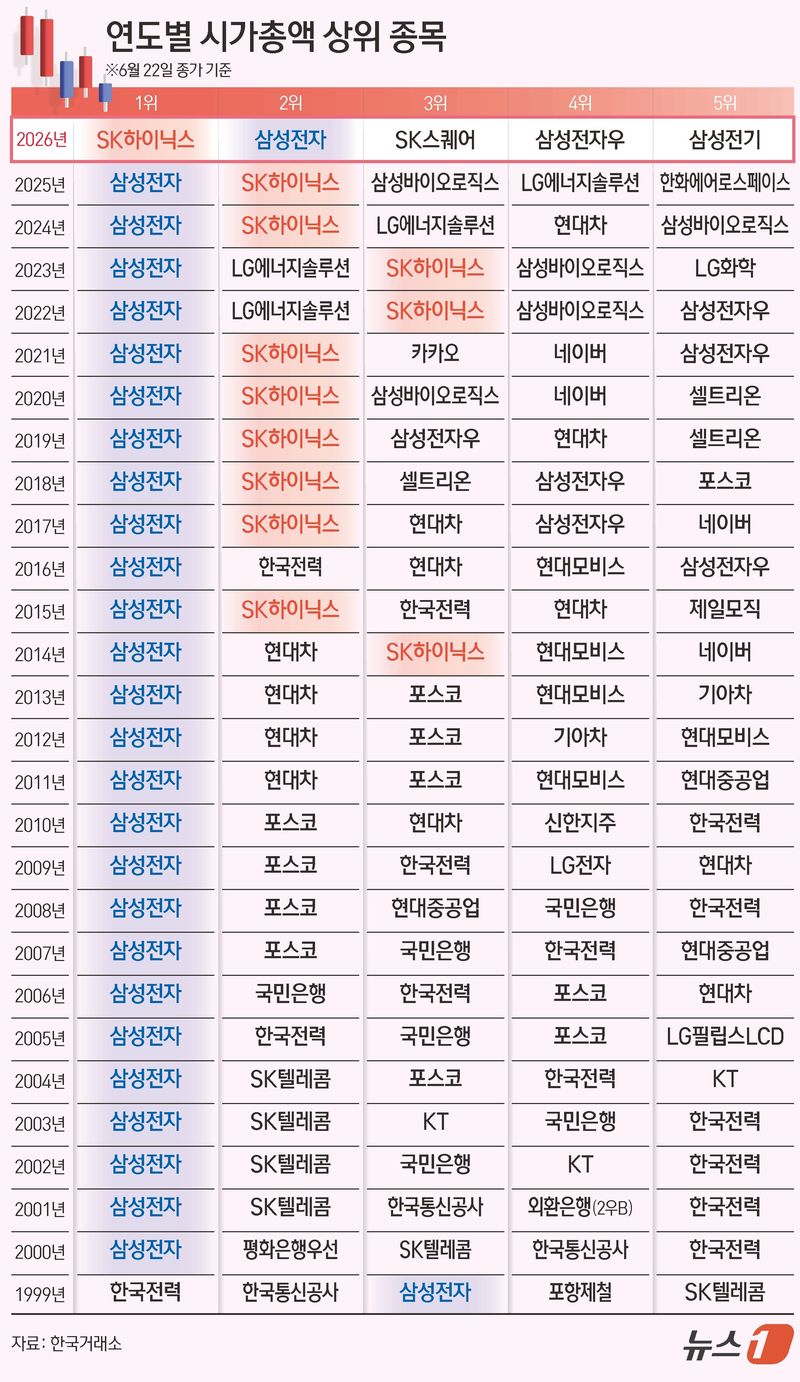
[Financial News] The top spot among KOSPI's market-cap leaders changed hands for the first time in more than 25 years. On the 22nd, SK hynix rose to No. 1 in KOSPI market capitalization at the close, overtaking Samsung Electronics' common stock, supported by expectations of expanding demand for High Bandwidth Memory (HBM) and a U.S. American Depositary Receipt (ADR) listing.
KOSPI closed at 9,114.55, up 62.13 points, or 0.69%, from the previous session, setting a new all-time closing high. The index opened down 1.08% at 8,954.43, then moved up and down before turning higher. KOSDAQ also rebounded, ending the day at 968.40, up 1.81 points, or 0.19%, from the previous session.
The biggest market topic of the day was SK hynix's rise to the top of KOSPI. SK hynix closed at 2.919 million won, up 5.61% from the previous day. Its market capitalization reached 2,080.3782 trillion won, accounting for 24.32% of total KOSPI market cap.
By contrast, Samsung Electronics closed at 353,500 won, down 0.14% from the previous day. Its common stock market cap fell to 2,066.6595 trillion won, or 24.16% of the total. The gap between the two companies' market caps at the close was about 13.7187 trillion won.
SK hynix shares have surged 348.4% so far this year, while Samsung Electronics shares have risen only 194.9% over the same period. That performance gap is seen as the direct reason for the reversal in market capitalization.
As news of SK hynix's rise to No. 1 in market cap drew attention, Samsung Electronics issued a formal rebuttal. The company argued that calculating a firm's total market cap using only common stock while excluding preferred stock could create confusion. As of the close, Samsung Electronics preferred stock finished at 224,000 won, up 0.90% from the previous session. The preferred stock market cap stood at about 179.7311 trillion won. Including both common and preferred stock, Samsung Electronics' total corporate market cap is estimated at about 2,246.3906 trillion won. That is roughly 16.6 trillion won more than SK hynix's single market capitalization.
Still, because Samsung Electronics had never been overtaken even on a common-stock basis, the reaction in the investment industry was intense. Brokerages said the reversal in market cap stemmed from differences in the two companies' business structures and foreign investor flows.
As the global artificial intelligence (AI) boom deepens the semiconductor supply shortage, SK hynix is benefiting from operating leverage as it holds a portfolio centered on memory semiconductors such as HBM. Samsung Electronics, on the other hand, has a more diversified business mix that includes smartphones, home appliances, displays and foundry operations, so the gains from the semiconductor upcycle are seen as more dispersed. Expectations for SK hynix's planned U.S. ADR listing in the second half of the year are also being cited as a factor drawing in demand.
Han Ji-young, an analyst at Kiwoom Securities, said, "This reversal is closer to a kind of stock-price event driven by differences in each company's individual upside catalysts." She added, "Since both Samsung Electronics and SK hynix have the same catalysts in their HBM and DRAM businesses, it is difficult to interpret this as a complete reversal in market premium." She went on to say, "The difference in upside catalysts, including SK hynix's higher beta relative to Samsung Electronics, expectations for an ADR listing, and hopes for large-scale shareholder returns, appears to have affected the change in market cap."
Lee Sang-heon, an analyst at iM Securities, pointed to both operating leverage and supply-demand factors. He said, "Because SK hynix is concentrated in the semiconductor business, the operating leverage effect from an improving industry cycle stands out." He added, "In global financial markets, there are many leveraged products targeting SK hynix relative to Samsung Electronics, while inverse products betting on a stock-price decline are extremely limited."
[email protected] Kim Mi-hee, Lim Sang-hyuk Reporter