Stock Market Reform Resembling 'Abenomics' Puts KOSPI 9,000 and Beyond to the Test
- Input
- 2026-06-23 06:00:00
- Updated
- 2026-06-23 06:00:00
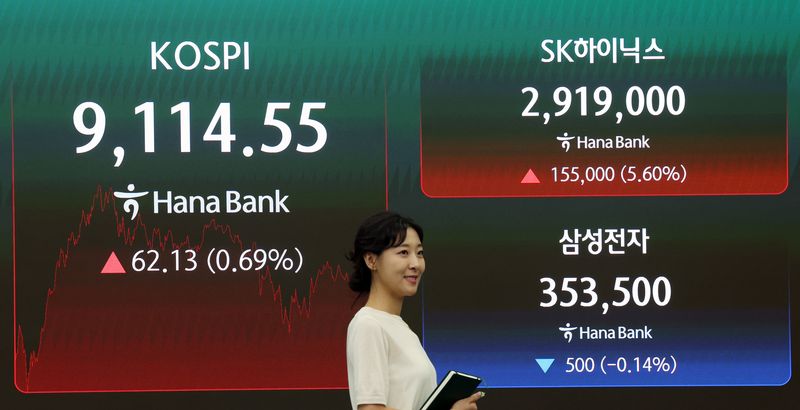
[Financial News] Recent sharp gains in the KOSPI have prompted comparisons with the capital market reforms pursued in Japan after Abenomics and Korea's value-up policy.
Abenomics refers to the economic policies implemented during the second Shinzo Abe administration from 2012 to 2020. Just as Japan laid the groundwork for a long bull market by improving corporate governance and expanding shareholder returns, Korea is also moving to ease the Korea Discount through amendments to the Commercial Act and policies aimed at raising corporate value.
According to the financial investment industry on the 23rd, the KOSPI first broke above the 5,000 mark on a closing basis on Jan. 27 and then finished at 9,063.84 on the 18th. That means it rose by more than 4,000 points in about five months. On the 22nd, it climbed another 62.13 points, or 0.69%, and surpassed 9,100 for the first time. The KOSPI has been setting new all-time highs day after day.
During his presidential campaign, President Lee Jae-myung said, "I will open an era of a 5,000-point stock index by restoring growth and easing the Korea Discount." He also pledged amendments to the Commercial Act, stronger protection of minority shareholders' rights, and a one-strike-out system for stock manipulation.
The ruling party has also made the advancement of the capital market a key priority. At a plenary meeting of the Korea Premium K-Capital Markets Special Committee held in the main conference room of the National Assembly in February, Democratic Party of Korea leader Chung Sye-kyun emphasized, "We must now move beyond the era of Korea risk and the Korea Discount and open an era of Korea Premium."
In a recent report, Kim Yoon-jung, a researcher at LS Securities, said, "Japan's reforms were a long-term project based on consensus among the government, the exchange, and companies, whereas Korea is characterized by a fast policy drive led by the government and the exchange." She added, "Policy consistency and sustainability remain challenges." She also noted that although the third round of Commercial Act amendments has been completed, follow-up legislative tasks remain, so discussions on policy-related changes are expected to continue throughout the year.
During the Abenomics push, Japan introduced the Stewardship Code in 2014 and the Corporate Governance Code in 2015, highlighting transparency in corporate management and shareholder value. Since then, companies have increased dividends and share buybacks, and Japan also expanded NISA (Nippon Individual Savings Account), a tax-free investment scheme for small investors, to attract retail participation.
In 2023, the Tokyo Stock Exchange (TSE) began pressuring companies to improve capital efficiency by requiring listed firms with a P/B Ratio below 1 to disclose plans for improving corporate value. Since then, Japanese companies have continued to expand share buybacks and dividends, and the Nikkei 225 index broke above its 1989 bubble-era peak in February 2024 for the first time in about 34 years.
However, some say the current rise in the KOSPI cannot be explained by policy effects alone. This year's market rally has been driven largely by the AI semiconductor supercycle centered on Samsung Electronics and SK hynix.
An official in the financial investment industry said, "Korea and Japan share the common goal of improving corporate governance and expanding shareholder returns to address undervaluation in their stock markets." The official added, "However, since the current rise in the KOSPI is heavily influenced by the AI semiconductor boom, whether future value-up policies and follow-up legislation will lead to real improvements in corporate value will be the key to revaluing the Korean stock market."
[email protected] Choi Du-seon Reporter