Consumer sentiment improves again on semiconductors and the stock market, but worries over interest rates and home prices grow
- Input
- 2026-06-23 06:00:00
- Updated
- 2026-06-23 06:00:00

According to the Bank of Korea's Consumer Tendency Survey results for June 2026, released on the 23rd, the Composite Consumer Sentiment Index (CCSI) stood at 106.6 in June. That was up 0.5 points from the previous month’s 106.1. After falling below 100 in April for the first time in a year at 99.2, the index rebounded in May with a 6.9-point gain.
The CCSI is a sentiment indicator calculated using six key sub-indexes from the Consumer Sentiment Index. The CSI is compiled by surveying 2,500 urban households nationwide on their views of the economy and expectations for future consumer spending. The survey was conducted from June 9 to 16.
The CCSI uses the long-term average for January 2023 through December 2024 as its benchmark of 100. A reading above 100 indicates optimism, while a reading below 100 indicates pessimism.
Kim Se-yong, head of the Economic Tendency Survey Team at the Bank of Korea's Economic Statistics Department 1, explained that the rise reflected stronger optimism driven by semiconductor-led export gains and higher stock prices, despite weaker perceived conditions due to rising prices.
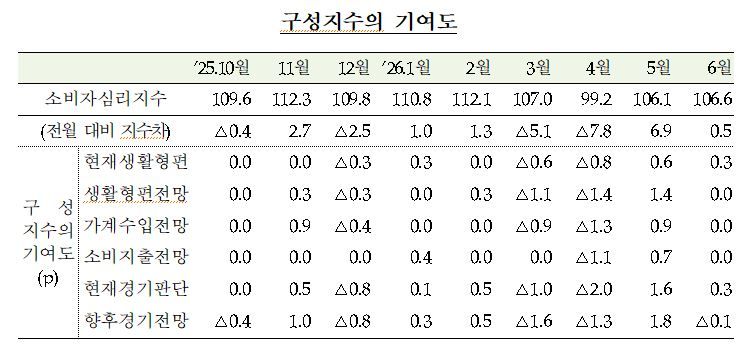
Views on the economy were mixed between the present and the future. The current business conditions index rose 3 points to 86, but the outlook for business conditions fell 1 point to 92.
The outlook for employment opportunities rose 1 point to 89. The interest rate outlook index jumped 12 points to 126. This indicator had been revised upward every month since October last year, when it moved from 93 to 95, before turning slightly lower in May. It then surged this month. The reading is the highest since October 2023, when it reached 128, and the biggest increase since December 2016, when it also rose 12 points.
Lee Heung-hoo, head of the Economic Tendency Survey Team at the Bank of Korea's Economic Statistics Department 1, said the increase was influenced by the central bank's signal that it may raise the benchmark rate in response to the Middle East war, as well as higher market interest rates.
In the market, expectations are that the Monetary Policy Board of the Bank of Korea will raise rates in July.
Looking at perceptions of household savings and debt, the current household savings index and the household savings outlook index both fell 1 point to 98 and 101, respectively. The current household debt index and the household debt outlook index were both unchanged from the previous month at 99 and 97.
In perceptions of prices, the outlook for price levels fell 1 point from the previous month to 150, while the housing price outlook index rose 8 points to 120. It had seemed to ease in March, when it fell to 96, but it has risen for three consecutive months since April. Lee said the increase reflects rising apartment sale prices and jeonse prices, especially in Seoul and Gyeonggi Province. He added that macroeconomic factors, such as higher stock prices on the back of the semiconductor boom and bonus payments at information technology companies, likely also contributed.
The wage outlook index rose 2 points to 124.
Perceptions of consumer price inflation over the past year were unchanged from the previous month at 3.0%. Expected inflation for the next 1 year was also unchanged at 2.8%. For the 3-year and 5-year horizons, the figures were 2.7% and 2.6%, respectively, up 0.1 percentage point and unchanged from the previous month. Across all time frames, the share of responses in the 2% to 3% range was the highest, at 30.1%, 31.7%, and 30.4%, respectively.
As for the main items expected to affect consumer price increases over the next year, petroleum products accounted for 77.5% of responses, followed by public utility fees at 29.6% and agricultural, livestock and fishery products at 28.6%. Compared with the previous month, those figures fell 7.7 percentage points and 1.6 percentage points, and rose 3.8 percentage points, respectively.
[email protected] Kim Tae-il Reporter