"The Bull Market Ends When Hynix's Market Cap Overtakes Samsung's" — Brokerage Warning Issued a Month Ago Resurfaces
- Input
- 2026-06-23 05:00:00
- Updated
- 2026-06-23 05:00:00
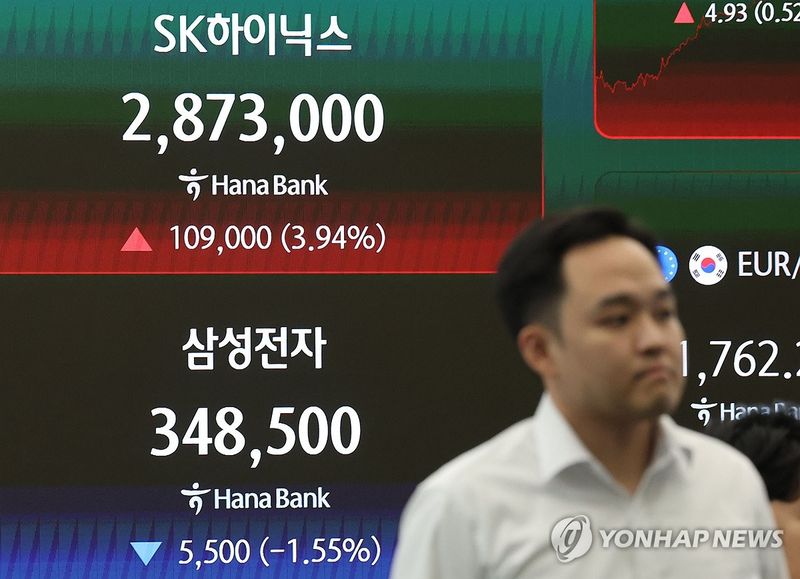
[Financial News] As the KOSPI's rally continues, led by semiconductor stocks, the long-anticipated market-cap reversal between SK hynix and Samsung Electronics, which had been flagged as a sign that the bull market was ending, has become a reality.
On the 22nd, SK hynix overtook Samsung Electronics in market capitalization and rose to the No. 1 spot in KOSPI market cap for the first time in 25 years and seven months, since November 2000. As of 1:20 p.m. that day, SK hynix's market cap stood at 2,062.5606 trillion won, putting it ahead of Samsung Electronics, whose market cap was 2,060.8132 trillion won, by 17.474 billion won. However, the combined market capitalization of Samsung Electronics and its preferred shares was 2,242.9515 trillion won, still higher than SK hynix's market cap.
"The point when Hynix overtakes Samsung Electronics" ... Hana Securities warned of a 'bull market ending signal'
In a report dated last month on the 18th, Lee Jae-man, a researcher at Hana Securities, said, "The signal that the current bull market, driven by earnings growth, is ending will be the point when SK hynix's market capitalization surpasses Samsung Electronics." He cited a reversal in the two companies' market caps as a key benchmark for judging whether the KOSPI is overheating.
The analysis argues that when a company becomes the No. 1 stock by market cap purely because its share price has overheated, without a reversal in earnings scale, that is the peak of a bubble and a warning sign of collapse. In other words, the report's central message was that if market rankings change only because share prices surge, without any shift in the underlying earnings fundamentals of the two companies, investors should prepare for the end of the index's rally.
In making that point, the researcher cited Cisco Systems briefly becoming the largest company in the S&P 500 at the height of the dot-com bubble in 2000. In Cisco's case, expectations pushed the stock higher before earnings did, and the market-cap ranking changed because of overheated share prices rather than profit growth. The NASDAQ then entered a full-fledged downtrend, leading to the bubble's collapse.
Similarities to the dot-com bubble, and the decisive difference
The similarities between Cisco and SK hynix are clear. Both were core beneficiaries of the hottest technology theme of their time, and both saw their market-cap weightings in the index rise to unprecedented levels. But the differences are also stark.
During the dot-com bubble in 2000, Cisco was overvalued on expectations for the future despite lacking profits. SK hynix, by contrast, posted 37 trillion won in operating profit in the first quarter alone, showing a rally grounded in actual performance. Eugene Investment & Securities forecast that SK hynix's operating profit next year will reach 45.95 trillion won, up 67% from a year earlier, while Hanwha Investment & Securities said the company can continue generating high levels of profit based on long-term agreements (LTA) and high bandwidth memory (HBM).
In fact, SK hynix ranked first in the 2025 HBM market with a 61% share, and it is expected to maintain more than 50% of revenue share in 2026 as well. Unlike Samsung Electronics, whose AI boom is spread across a broad portfolio including smartphones, home appliances, and displays, SK hynix stands out for a structure in which the benefits of AI flow directly into its memory-focused business.
In the securities industry, views are mixed between those who see excessive market-cap concentration in a single stock as a risk, as Hana Securities warned, and those who view it as part of broader change driven by the semiconductor industry's growth in the era of artificial intelligence (AI), including structural reshuffling and a revaluation of corporate value.
Park Jun-young, a researcher at Hanwha Investment & Securities, said, "SK hynix is no longer a company with extreme earnings volatility. It is a company that can consistently generate high levels of profit," adding, "There is no reason for it to be undervalued without justification in the global tech sector."
[email protected] Kim Hee-sun Reporter