Will the Lee Jae-myung–Jeong Cheong-rae factional conflict erupt? Democratic Party's local election evaluation committee extended from 8 to 15 weeks
- Input
- 2026-06-22 15:12:05
- Updated
- 2026-06-22 15:12:05
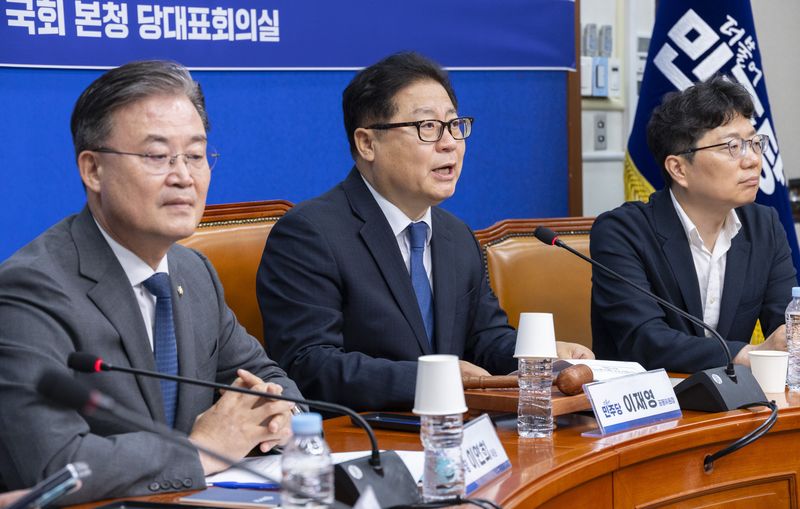
The party officially launched the evaluation committee for the June 3 local elections and National Assembly by-elections at the National Assembly on the day and held its first meeting.
Co-chair Lee Jae-young, head of the Institute for Democracy, said, "I believe the starting point of the evaluation committee should be reflection, not self-praise or self-reproach." He added, "We will humbly summarize our achievements, honestly acknowledge our shortcomings, and turn them into lessons and assets for the future."
Hong Chang-min, former chair of the Democratic Party's Seoul Metropolitan City Party Candidate Nomination Management Committee, who serves as co-chair with Lee, said, "This evaluation must objectively analyze the election results and draw out the tasks and implications needed to prepare for future elections."
Lee Yeon-hee, a Democratic Party lawmaker and secretary-general of the evaluation committee, said, "This review is not a process of conflict to assign blame to someone, but a process of finding lessons for a better victory." She added, "Through this election, we must take a hard look at what was lacking and what needs to be strengthened."
She also said, "What we need now is reflection, not blame; unity, not division; and expansion, not exclusion." She added, "We will work to ensure that the white paper becomes an asset, not a record of conflict, and do our utmost to make it a milestone that opens the Democratic Party's future and path back to power on the foundation of unity and expansion."
During the meeting, the Democratic Party's June 3 local elections and National Assembly by-election evaluation committee significantly extended its activity period from the original eight weeks to 15 weeks. In response, Lee said, "There is a lot to evaluate." He explained, "This election review is not about focusing on conflict, but about creating basic data that can help us win the next election. We will examine various aspects fairly."
However, many in the party believe the real reason for the extension was to take into account the Aug. 17 party convention, which will determine the next party leadership. If the committee had operated for the originally planned eight weeks, its work would have ended on Aug. 10. The white paper would likely have been released around the same time, when the party convention would already be in full swing.
In particular, the Lee Jae-myung and Jeong Cheong-rae camps have sharply different views on the local election results. The Lee Jae-myung camp has effectively labeled the local elections a defeat and has been repeatedly stressing the need to hold the Jeong Cheong-rae leadership accountable. The Jeong Cheong-rae camp, meanwhile, says the result was disappointing but still amounted to a mathematical victory. In this situation, the release of the evaluation committee's white paper could inflame both factions and widen the Lee Jae-myung–Jeong Cheong-rae factional conflict.
There are also clear disagreements between the two camps over what should be included in the evaluation. Democratic Party Secretary-General Cho Seung-rae previously pointed out that media reports about Prime Minister of South Korea Kim Min-seok's possible bid for the next party leadership appeared during the election period and were inappropriate. He argued that the review should also include items related to government officials. The Lee Jae-myung camp, however, insists that elections are run by the party and says it is inappropriate to include government officials in the evaluation items. Against this backdrop, the committee appears to have extended its activity period because even the question of whether government officials are included could trigger the Lee Jae-myung–Jeong Cheong-rae factional conflict.
[email protected] Kim Hyung-gu Reporter