"Even Fried Eggs Are Out of Reach"... 10 Eggs Cost 5,000 Won, Putting Household Food Prices on High Alert
- Input
- 2026-06-22 07:40:37
- Updated
- 2026-06-22 07:40:37
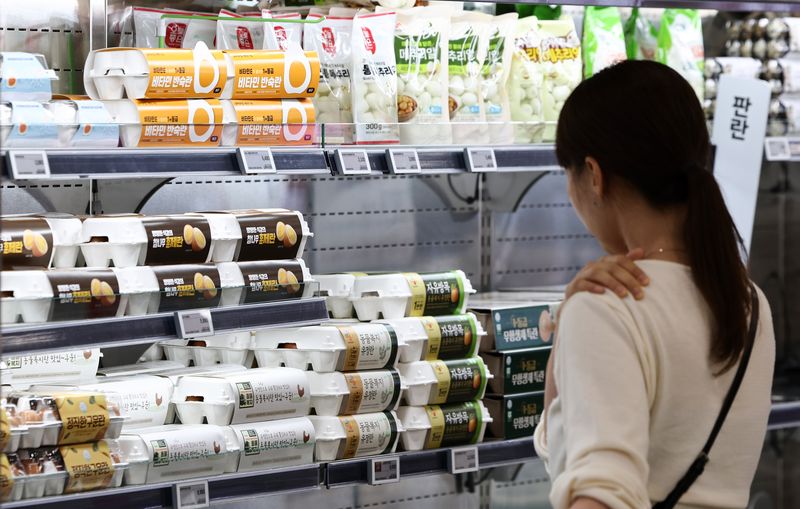
[Financial News] Prices of some agricultural, livestock and fishery products, including eggs and chicken, continue to rise, adding to the burden of summer food costs. With the early arrival of intense heat, concerns are also growing that so-called heatflation, a blend of heat and inflation, could become a reality.
A pack of 10 large eggs has risen nearly 40% in a year... Chicken prices also jump
According to the Dabom Livestock Distribution Information System of the Korea Institute for Animal Products Quality Evaluation (KAPE) on the 21st, the nationwide average retail price of 10 large eggs this month stood at 5,222 won. This is the first time the monthly average consumer price for 10 eggs has exceeded 5,000 won.
The price of 10 large eggs is up 38.6% from 3,786 won in June last year and 16.7% from 4,476 won last month. From March 2022 through April this year, the price had stayed in the 3,000-won range, but it topped 4,000 won last month and then averaged in the 5,000-won range every day from the 28th of that month through the 19th of this month.
For a 30-egg pack, the average consumer price this month was 7,465 won, up 6.5% from 7,008 won in June last year.
Chicken prices are also continuing to climb. The nationwide average consumer price for chicken this month was 6,650 won per kilogram, up 19.4% from 5,568 won in June last year. Chicken prices had stayed in the 5,900-won range through February, rose to the 6,300-won range in March, then moved into the 6,500-won range in April and May, and climbed above 6,600 won this month.
Mass culling after winter avian influenza... Supply shortage
A shortage of supply is cited as the main reason behind the price increases in eggs and chicken.
The culling of laying hens after highly pathogenic avian influenza (HAPI) outbreaks last winter, along with efforts to improve stocking density for laying hens, affected supply. The early arrival of unusually hot weather and stronger demand for summer health foods are also being cited as factors behind the price increases.
Prices of some agricultural and fishery products are also showing instability.
According to the Agricultural Products Distribution Information System (KAMIS) of the Korea Agro-Fisheries & Food Trade Corporation (aT), the retail price of green onions this month was 2,827 won per kilogram, up 18.4% from 2,388 won in June last year. The nationwide average retail prices of red leaf lettuce and green leaf lettuce per 100 grams rose to 1,023 won and 1,024 won this month, respectively, from the 800-won and 900-won ranges last month to the 1,000-won range.
The retail price of a watermelon, a representative summer fruit, is also on the rise. The average price this month was 24,292 won, up 8.9% from 22,309 won in June last year.
Among fishery products, mackerel saw the sharpest increase. Imported salted mackerel was priced at 10,803 won per fish this month, up 26.5% from 8,541 won in June last year.
As the peak of the heat wave begins, agricultural, livestock and fishery prices could rise further. There are growing concerns that heatflation, in which higher temperatures reduce crop growth and cause livestock deaths, could push prices even higher.
The government has also moved to prepare countermeasures. On the 17th, the Ministry of Agriculture, Food and Rural Affairs (MAFRA) formed the Summer Agricultural and Livestock Supply Stabilization Task Force and held its first meeting. The Ministry of Oceans and Fisheries has supplied up to 8,000 tons of government stockpiled fishery products to the market from June 20 through July 15, and it has provided early support to fish farms by increasing the budget for high-water-temperature response equipment from 5.8 billion won last year to a record 7.6 billion won this year.
[email protected] Kim Soo-yeon Reporter