[Global Report] The World Cup Illusion: Host Countries Do the Work, While FIFA Takes the Money
- Input
- 2026-06-21 18:48:23
- Updated
- 2026-06-21 18:48:23

U.S. President Donald Trump expressed confidence in the tournament's success on the 10th, one day before the opening of the 2026 FIFA World Cup. Gianni Infantino, the FIFA president known for his close ties with Trump, also celebrated early success that same day and boasted that more than 6 million tickets had been sold. But in the United States, where 75% of the matches will be played, the mood is far less enthusiastic. What is visible instead are empty seats and red ink.
■ Empty seats in the stands, and weak hotel demand
Infantino's claim sounds convincing if one looks only at the numbers. Ticket sales for past FIFA World Cups stood at 3.1 million in 2014, then 2.8 million and 3.2 million in later tournaments. Even at the 1994 FIFA World Cup in the United States, 3.5 million tickets were sold. But Leander Schaerlaeckens, a football columnist for The Guardian, pointed out on PBS on the 13th that "there are far more matches now, so naturally there are more tickets that need to be sold." Until the 2022 FIFA World Cup in Qatar, the tournament featured 32 teams and 64 matches. Starting with this edition, 48 teams will play 104 matches. The number of games has increased by about 40%.
The Athletic also reported on the 15th that, contrary to FIFA's claims, many matches in this World Cup had more empty seats than the official attendance figures suggested. At the Group F opener in Arlington, Texas, on the 14th, volunteers were even used to fill vacant seats.
On the 19th, The New York Times, citing real estate research firm CoStar, reported that hotel bookings on match days in some host cities, including New York, Toronto, and Miami, were lower than a year earlier.
On the 11th, the New York Hotel Association cut its forecast for hotel revenue growth during the World Cup to $100 million, about half of its previous estimate. Vijay Dandapani, the association's CEO, called the tournament "deeply disappointing and below expectations." He said FIFA had expected 1.2 million visitors in the New York area, but that even 400,000 would be difficult to reach. He blamed soaring prices, business travelers avoiding the city, stadium locations, and visa barriers for the weak hotel demand.
According to the American Hotel & Lodging Association, FIFA canceled up to 70% of the rooms it had reserved for staff and delegations in several host cities, including Boston and Dallas. In a May report, the AHLA said FIFA's room block bookings had created a "false early demand illusion."

The core of the inflation problem lies in ticket prices and public charges. FIFA has introduced dynamic pricing for this tournament. Unlike in the past, when prices were fixed, ticket prices now change in real time depending on demand, much like airline fares. As a result, the cheapest tickets are around $60, while the highest-priced seats for the final have climbed to $7,875.
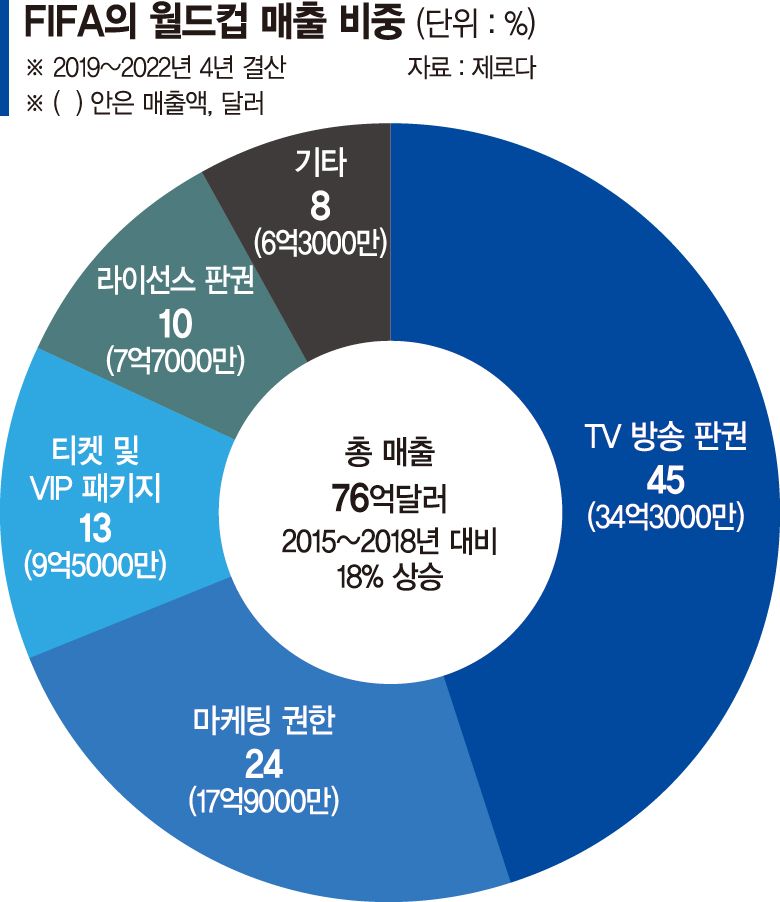
These prices are possible because FIFA is directly controlling everything from ticket issuance to the resale market. On the 19th, Fortune reported that the traditional operating model for the World Cup had been broken. In previous tournaments, local organizing committees ran the matches, bearing the costs while sharing revenue with FIFA, the magazine explained. This time, however, FIFA is directly managing the event, contacting local governments to rent stadiums without going through national football associations. At the same time, it has effectively monopolized nearly all revenue, including broadcast rights, sponsorship deals, and merchandise sales.
Victor Matheson, an economics professor at the College of the Holy Cross, told Fortune in an interview that FIFA's pricing strategy reflects the fact that "FIFA will not be back in the United States for another 30 to 40 years." From FIFA's perspective, he said, "It does not matter if you anger today's ticket buyers, because you can squeeze every last dollar out of them."
Fortune noted that host cities can only keep the amounts specified in their contracts with FIFA and are excluded from additional revenue. It added that the costs of staging the matches fall entirely on the host cities. The magazine said local governments facing heavy financial burdens often pass those costs on to residents through higher public fees.
Some local governments are worried about deficits tied to the World Cup. According to Fortune, Mark Levine, New York City's Comptroller, predicted in a report earlier this year that even if 1.2 million people visit the New York-New Jersey area as FIFA expects, the city would generate no more than $55 million in additional tax revenue. He argued that New York City would have to spend an extra $70 million on police support, emergency measures, and assistance for small businesses, making a deficit unavoidable.
Andrew Zimbalist, an economics professor at Smith College, said that host cities staging four to eight matches must bear extremely heavy costs. "They do not get the benefits, and they are left with more than $100 million in expenses, so no city will come out ahead economically," he argued.
In December last year, The Independent reported that the total cost borne by the 11 U.S. World Cup host cities could reach as much as $250 million. The federal government is said to have allocated $625 million for security enhancements in those 11 cities.
FIFA had previously projected that the World Cup would add $17.2 billion to U.S. Gross Domestic Product (GDP) and create 185,000 jobs. Barron's reported on the 19th, citing Bank of America, that this World Cup could lift global GDP by $45 billion and increase U.S. GDP by $19 billion. FIFA estimated that Canada's GDP would rise by $1.4 billion, while Mexico expects an economic impact of $11 billion. On the 15th, Column Clark, an economics professor at Southern Methodist University (SMU), told NPR that the World Cup may cause consumer tax revenue to rise briefly for a few weeks, but that it would then return to normal.
Meanwhile, the Financial Times reported on the 10th that FIFA expects to generate a total of $13 billion in revenue over four years from this World Cup. That would be a 72% increase from the 2022 FIFA World Cup in Qatar.
Park Jong-won