Stock funds swell amid a booming market; the number of trillion-won "giant funds" triples in a year
- Input
- 2026-06-21 14:07:08
- Updated
- 2026-06-21 14:07:08
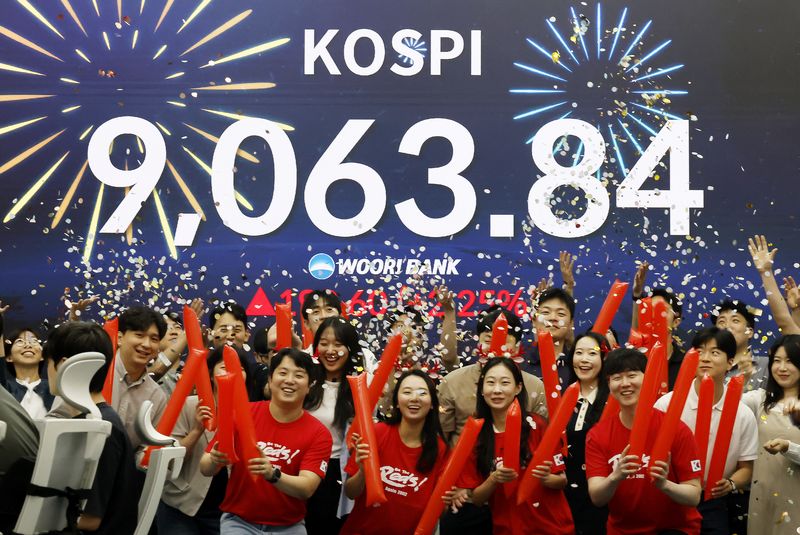
[Financial News] As the stock market rally continues, domestic stock funds are rapidly expanding. The number of "giant funds" with more than 1 trillion won in assets has more than tripled in a year, underscoring the sector's brisk growth.
According to the Korea Financial Investment Association on the 21st, there were 37 domestic stock funds with assets of at least 1 trillion won as of the 18th. That is 3.1 times higher than the 9 funds recorded on June 18 last year.
From 2016 through 2024, the number of domestic stock funds that surpassed 1 trillion won had hovered at around 10. Even last year, there were only six at the beginning of January. But as the local market boomed, the figure rose to 10 by the end of June and then surged to 20 by the end of December.
The upward trend has continued this year as well, topping 30 at the end of April and even reaching 40 last month. Although the number fell to 34 on the 8th as the market took a breather, it is rising again.
As the number of trillion-won funds has jumped, total assets in domestic stock funds have also ballooned. As of the 18th, they stood at 228.8112 trillion won, 3.8 times higher than 59.6037 trillion won a year earlier. In particular, the combined assets of funds worth more than 1 trillion won reached 163.3761 trillion won, an 8.5-fold increase from 19.2721 trillion won a year ago.
With the stock market expected to keep climbing and money likely to continue flowing into equity funds, the number of giant funds is also expected to keep growing. Despite concerns over short-term overheating, the securities industry is increasingly forecasting that the market will break through the 10,000-point level.
Recently, Daishin Securities sharply raised its year-end KOSPI target from 8,800 to 11,500. Analyst Kyung-min Lee said, "As net profits for both semiconductor and non-semiconductor sectors were revised upward last month, the KOSPI's upside potential has expanded." He added, "Although pressure from higher interest rates remains, concerns over rate hikes have already been largely priced in, and we see strong potential for valuation normalization driven by longer-term contracts in the semiconductor sector."
He went on to say, "The KOSPI is currently in a classic earnings-and-policy-driven phase, and the upward trend is likely to continue as long as forward earnings per share (EPS) keep rising." He added, "The market should leave room for further gains until forward EPS begins to weaken."
Still, investors are advised to focus on stock selection, as the market is moving into a period of volatility with clear, stock-specific rallies. Analyst Lee Jae-man of Hana Securities noted, "The KOSPI 200 Volatility Index (VKOSPI) reached 90 earlier this month, surpassing the peak seen during the global financial crisis." He added, "Extremely high profit growth rates that have never been experienced before can fuel expectations, but they can also raise concerns about earnings missing forecasts and about profit growth having already peaked."
He also said, "International oil prices have turned lower, but U.S. market interest rates remain elevated as they reflect expectations for a policy rate hike later this year." He advised investors to adopt strategies that assume both an expansion cycle in the tech sector and a high-rate environment.
[email protected] Seo Min-ji Reporter