Domestic Equity ETFs Cheer KOSPI Surge... Gap with Overseas ETFs Widens to 122 Trillion Won
- Input
- 2026-06-21 09:13:21
- Updated
- 2026-06-21 09:13:21
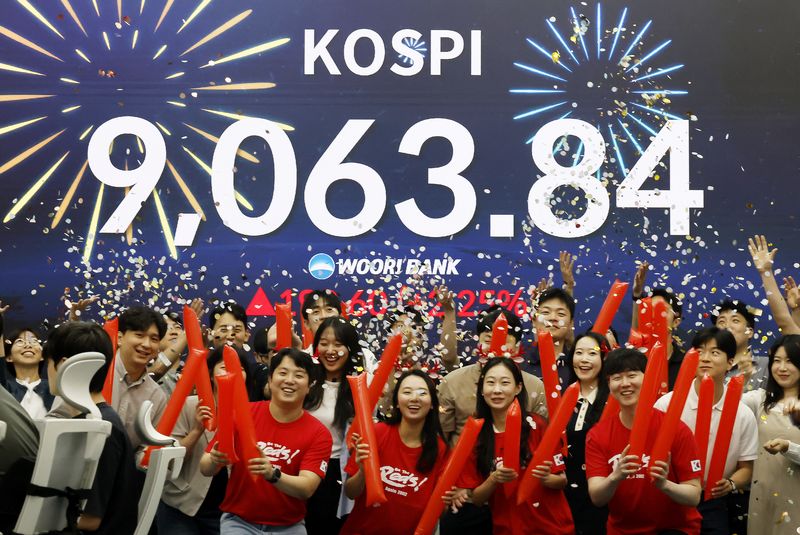
According to financial data provider FnGuide on the 21st, total net assets in domestic ETFs stood at 527.508 trillion won as of the 18th. Of that amount, domestic equity ETFs accounted for 263.54 trillion won.
Domestic equity ETFs had net assets of just 40 trillion won in December 2024. But with the KOSPI's sharp rise in the second half of last year as a catalyst, their net assets had grown to 93 trillion won by the end of that year. At the beginning of this year, they surpassed 100 trillion won and expanded their share to 36.8% by the end of January, overtaking overseas equity ETFs at 29.8%. The figure then rose to 43.0% at the end of February and topped 50% at the end of June.
As of the 18th, overseas equity ETFs had net assets of 141 trillion won, leaving a 122 trillion won gap with domestic equity ETFs.
The recent surge in the share of domestic equity ETFs is due to the KOSPI repeatedly hitting record highs. As the benchmark continued its strong rally, net assets in ETFs that invest in listed companies on the local stock market also increased. In particular, domestic equity ETFs, which are concentrated in local semiconductor stocks such as Samsung Electronics and SK hynix, quickly expanded their net assets. The KOSPI closed at 9,063.84 on the 18th, breaking the 9,000-point mark for the first time. That represents a gain of about 115% from 4,214.17 at the end of last year. Over the same period, the S&P 500 Index rose 7.3%.
Meanwhile, domestic bond ETFs, which had higher net assets than domestic equity ETFs even in 2024, are losing favor with investors as inflation rises and the possibility of a benchmark rate hike grows. As of the 18th, domestic bond ETF net assets stood at 63.483 trillion won, up 2.6% from 61.8506 trillion won at the end of last year. Their share of total ETFs also fell from 20.8% to 12.0%.
[email protected] Reporter Kwon Jun-ho Reporter