"Spent 2.8 Trillion Won in Three Days"... Korean Retail Investors Who Bought SpaceX at the Peak on Alert
- Input
- 2026-06-21 08:41:01
- Updated
- 2026-06-21 08:41:01
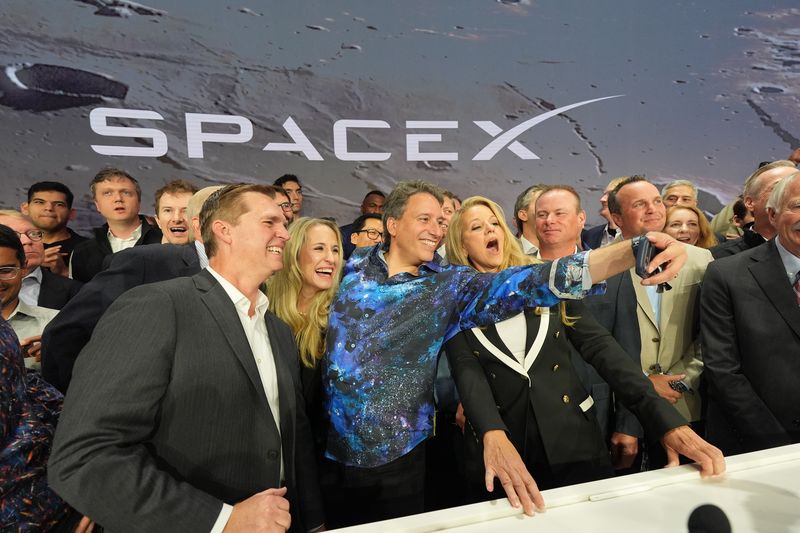
[Financial News] SpaceX, the U.S. aerospace company that drew global investors' attention as the largest IPO in history, swung from euphoria to despair in just its first week on the market. After the stock, which had climbed to fourth place globally by market capitalization, plunged for two straight sessions, domestic retail investors who made large bets, as well as local space-themed exchange-traded funds (ETFs), were left to absorb the full impact of buying at elevated prices.
On the New York Stock Exchange on the 18th local time, SpaceX closed at $184.98, down 3.56% from the previous session.
SpaceX made a dazzling debut at an offering price of $135 and at one point surged to $225 as buying intensified. It briefly overtook Amazon.com, Inc. and Microsoft to take fourth place in market capitalization, but it could not withstand profit-taking that began on the 17th and gave back most of its gains.
The current share price of $184.98 is now just above the volume-weighted average price (VWAP) of $181.71 for the five trading days since listing. In effect, that means the average return for early investors has fallen back to around breakeven.
'Domestic space ETFs hit by the high-price trap, down as much as 25% in a week'
SpaceX's volatility dealt a direct blow to aerospace and space-tech ETFs listed in Korea. According to Koscom Corporation's ETF Check, major domestic space-themed ETFs all posted double-digit losses over the past week.
The worst performer was 'TIGER U.S. Space Tech ETF,' which holds a 25.78% stake in SpaceX and fell 25.71% over the week. It was followed by 'SOL U.S. Space & Aerospace TOP10,' which has a 28.20% allocation to SpaceX and returned -19.75%. 'ACE U.S. Space Tech Active ETF,' with a 31.80% exposure to SpaceX, and 'KODEX U.S. Aerospace ETF,' with a 28.29% allocation, also struggled, falling 14.68% and 13.21%, respectively.
The sharp declines in domestic ETFs stem from a limit on securing enough shares. Asset managers were unable to obtain sufficient SpaceX shares during the offering, forcing them to buy heavily at the market price after the stock jumped at listing. To make matters worse, shares of existing aerospace names such as Rocket Lab and AST SpaceMobile also corrected, adding to the pressure on ETF returns.
"Comparable to Intel"... Korean retail investors who poured in 2.8 trillion won over three days grow anxious
According to Save-ro, the securities information portal run by Korea Securities Depository (KSD), domestic retail investors net bought $1.81292 billion worth of SpaceX shares over three days, including the listing day, on June 12, 15, and 16.
That is roughly equal to Intel's total custodial balance of $1.83082 billion, a stock long favored by Korean retail investors. Having aggressively chased the stock from the start, with $795.93 million bought on the first day alone, investors are now closely watching where it goes next as the share price has turned sharply lower.
Experts say the key factors likely to shape SpaceX's share price in the near term are index inclusion and derivatives trading.
The biggest potential catalyst is early inclusion in major global indices. As soon as next week, SpaceX could be added to benchmarks such as CRSP, S&P Dow Jones Indices, Russell, and Morgan Stanley Capital International (MSCI), according to market speculation. If SpaceX is included, passive funds from giant asset managers such as The Vanguard Group and BlackRock that track those indices are expected to flow in mechanically, helping provide a solid floor for the stock.
However, inclusion in the S&P 500, a flagship blue-chip index, is not likely anytime soon because the company must meet strict requirements, including 12 months of trading history and profitability.
By contrast, the full-scale launch of derivatives trading is expected to act as a trigger for greater volatility. In the U.S. market, leveraged and inverse ETFs based on SpaceX, as well as options on the individual stock, have already begun trading. With the derivatives market now open, speculative money betting on direction is expected to pour in, making short-term swings in the share price unavoidable.
Meanwhile, market traders currently expect SpaceX to trade next week within a range of $166 to $204.
[email protected] Moon Young-jin Reporter