"Trump's shrinking security umbrella is a boon for K-defense industry," POLITICO
- Input
- 2026-06-21 06:58:42
- Updated
- 2026-06-21 06:58:42
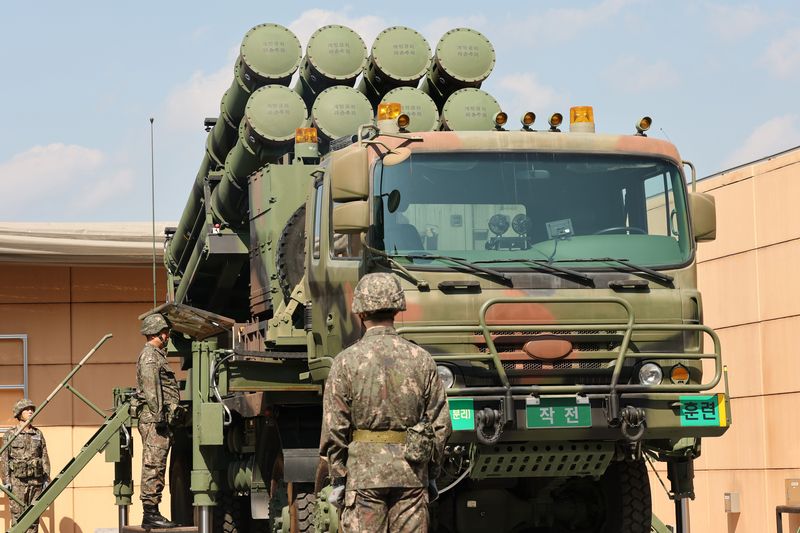
POLITICO reported on the 20th, local time, that South Korea's K-Defense Industry is rising rapidly amid the Donald Trump administration's isolationist foreign policy, a shrinking security umbrella, and heightened geopolitical tensions, including the Russo-Ukrainian war and the Iran war.
POLITICO noted that President Donald Trump echoed former President Richard Nixon's 1969 declaration when he said in a White House speech, "Defending freedom is everyone's duty, not just America's."
The roots of the U.S. security vacuum and the K-Defense Industry
The origins of the K-Defense Industry can be traced back to former President Nixon's 1969 declaration.
At the time, Nixon said, "Allies must defend themselves," and withdrew 20,000 U.S. troops from South Korea.
Faced with the sense that South Korea could no longer rely solely on the United States for security, President Park Chung-hee, then ruling under an authoritarian system, declared self-reliant defense and began pouring huge sums into the defense industry.
South Korea laid the groundwork for the K-Defense Industry by producing foreign weapons under license and reverse-engineering them to build up its own technology.
Thanks to the K-Defense Industry built under former President Park, South Korea is now the world's ninth-largest arms exporter.
This year, sales at South Korea's four major defense companies — Hanwha Group, Hyundai Rotem, LIG Nex1, and Korea Aerospace Industries (KAI) — are projected to reach $37 billion, nearly four times higher than in 2021.
In particular, South Korea has become the second-largest supplier of weapons to NATO member states in Europe, after the United States.
Opportunities for the K-Defense Industry
The K-Defense Industry has seized an opportunity amid rising geopolitical tensions, a U.S. weapons gap, and a crisis of trust.
Major geopolitical events, including the Russo-Ukrainian war, which has dragged on for more than four years, and the Iran war, which began on Feb. 28 and lasted more than 100 days before a ceasefire agreement was reached, have sharply increased global demand for weapons.
Meanwhile, the United States, a key supplier of Western weapons, has seen its defense supply chain become overloaded. Its defense base has weakened amid a prolonged manufacturing slump, and even its own weapons procurement is under pressure as the United States launched the Iran war.
Allies that had been buying U.S. weapons are now struggling to even estimate when their orders will be delivered.
By contrast, the K-Defense Industry's ability to supply weapons, built on a strong manufacturing base, is coming into its own.
The crisis of trust is also an opportunity for the K-Defense Industry.
Lee Jeong-min, a senior research fellow at the Carnegie Endowment for International Peace, said that "the United States is no longer as reliable as it was 10 years ago," adding that allies disappointed by U.S. isolationism and tariff threats are turning to South Korea as an alternative.
Poland
Poland served as a springboard for the K-Defense Industry's leap forward.
When Russia invaded Ukraine in February 2022, Eastern European countries including Poland planned to send their old Soviet-era tanks to Ukraine and replace them with German Leopard tanks. But Germany hesitated to expand production and missed the moment.
The K-Defense Industry moved into that gap and established a foothold in Europe through Poland.
Oskar Pietrewicz, a senior analyst at the Polish Institute of International Affairs (PISM), said that "Germany's hesitation created a major trust gap" and that "South Korea successfully filled that void."
Poland became South Korea's biggest customer and a gateway to Europe after signing a massive $13.7 billion deal for K2 tanks, K9 Thunder self-propelled howitzers, and FA-50 light attack aircraft.
Five strengths
POLITICO said the K-Defense Industry has captured the global market on the back of five key strengths.
First, because factories have remained in constant operation due to the standoff with North Korea, South Korea can deliver quickly. It is one of the fastest suppliers in the world for countries that need weapons immediately.
Mass production also gives it strong cost competitiveness. A solid domestic defense demand base keeps production costs low despite high quality, making prices highly competitive.
Unlike advanced Western countries, South Korea is also willing to transfer technology and establish local production systems, which satisfies middle powers such as Poland that want an independent defense base.
Unlike demanding U.S. defense contractors, South Korea is also highly flexible with customized orders. At Egypt's request, Hanwha Aerospace modified the K9 Thunder self-propelled howitzer for coastal defense against naval vessels.
Another strength is that the political risk is virtually zero.
Ramon Pacheco Pardo, a professor of international relations at King's College London, said that "no one raises political objections to buying weapons from South Korea."
Unlike the United States, which faces delivery delays, hostile states such as China and Russia, and Israel, whose reputation has fallen because of the Gaza war, South Korean weapons are free from political and moral controversy.
Obstacles
LIG Nex1's Cheongung-II interceptor missile system posted a 96.6% interception rate in the United Arab Emirates (UAE), proving highly effective, and South Korea has also stood out in tanks and self-propelled artillery. Still, the K-Defense Industry faces many hurdles.
The barriers are much higher in high-value sectors such as large warships and aircraft.
POLITICO noted that Hanwha Ocean is pursuing a $6 billion submarine deal with Canada, but its chances are fading as it runs into a formidable wall in ThyssenKrupp Marine Systems (TKMS), a fellow NATO member and a traditional heavyweight.
There is also analysis that South Korea may find it harder to enter the market as Europe adopts policies favoring European-made products in order to reduce dependence on the United States and strengthen its own defense industry.
The emergence of a powerful rival, Japan, is another obstacle.
Japan has scrapped its long-standing ban on weapons exports and, led by Mitsubishi Heavy Industries, has begun expanding into Southeast Asian markets such as the Philippines.
Japan has also won Australia's frigate project, worth up to 20 billion Australian dollars, or about 21 trillion won.
[email protected] Song Kyung-jae Reporter