"KOSPI Is No. 1 in the World, KOSDAQ Is Last"... A 17.5-Point Gap Widens Between the 'Two Koreas' of the Stock Market
- Input
- 2026-06-21 06:00:00
- Updated
- 2026-06-21 06:00:00
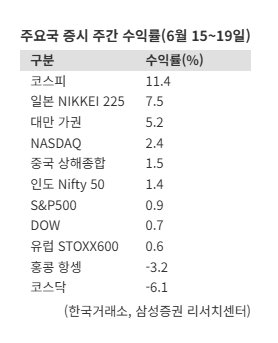
[Financial News] KOSPI has broken above the 9,000 level for the first time ever and posted the highest weekly return among major stock markets worldwide, while KOSDAQ has fallen sharply, pushing the polarization in Korea's stock market to an extreme. As expectations grow for an AI semiconductor supercycle, money is flowing into Samsung Electronics and SK hynix, making the divide within the Korean market even more pronounced. According to the financial investment industry on the 21st, KOSPI rose 11.4% from June 15 to 19, marking the strongest performance among major markets. It far outpaced Japan's Nikkei 225, which gained 7.5%, Taiwan's TAIEX, which rose 5.2%, and the Nasdaq Composite Index, which added 2.4%.
By contrast, KOSDAQ fell 6.1%. Its decline was steeper than that of Hong Kong's Hang Seng Index, which dropped 3.2%. The gap in returns between KOSPI and KOSDAQ reached 17.5 percentage points over the same period. In effect, Korea produced both the best-performing and one of the worst-performing markets among major economies.
Semiconductors are at the center of this polarization. Market funds are concentrating on Samsung Electronics and SK hynix as investors bet on expanding AI data center investment and a surge in demand for high-bandwidth memory, or HBM.
Samsung Electronics and SK hynix accounted for 48.4% of KOSPI's market capitalization, but that share has risen to 56.2%. Together, the two stocks now make up more than half of KOSPI's total market cap. Including SK Square and Samsung Electro-Mechanics, the top four stocks now account for 61.8%, up from 52.0%.
Kim Jong-min, senior analyst at Samsung Securities, said, "The clear center of this fundamentals-driven earnings rally is semiconductors." He added, "Starting with Micron's earnings release on the 25th, followed by Samsung Electronics in early July and SK hynix in mid-July, the sector will draw the attention of global investors."
The concentration of capital was also evident in sector returns. From June 15 to 19, the IT hardware sector surged more than 23%, posting the strongest gains. The semiconductor sector also rose more than 17%. Insurance, energy, trading companies and capital goods, and machinery also advanced.
By contrast, most sectors posted negative returns, including autos, cosmetics and apparel, displays, steel, consumer staples, and hotels and leisure. While KOSPI hit record highs, many sectors actually declined.
Brokerages are describing the current market as a classic case of concentration. Lee Jae-man, a researcher at Hana Securities, said, "SK hynix's market cap has risen to about 95% of Samsung Electronics' market cap, showing an extreme concentration effect." He added, "The current global macro environment is also contributing to higher volatility and deeper concentration."
Hana Securities also noted that KOSPI underwent a short-term correction in late May, when SK hynix's market cap had fallen to about 93% of Samsung Electronics'.
Lee also explained, "In the second half of 1999, only two sectors, information technology (IT) and industrials, outperformed the index." He added, "In a high-interest-rate environment, gains tend to concentrate in a small number of sectors and stocks."
[email protected] Choi Du-seon Reporter