‘Debt-driven investing’ rides KOSPI 9,000 surge as borrowing rises by 240 billion won while the index runs from 7,000 to 9,000
- Input
- 2026-06-20 05:00:00
- Updated
- 2026-06-20 05:00:00
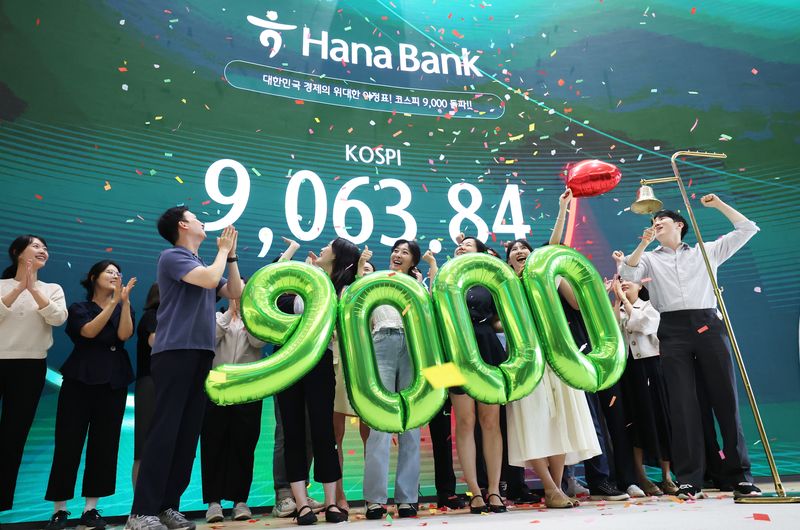
[Financial News] As KOSPI climbed past the 9,000 mark, the scale of individual investors' so-called "debt-driven investing" also expanded. Rather than buying on dips after sharp declines, more investors appear to be using margin trading to chase stocks after an uptrend has already been confirmed.
■Debt-driven investing joins the rally
According to the Korea Financial Investment Association on the 20th, outstanding margin loans in the domestic stock market stood at 37.8005 trillion won as of the 17th. That was up 237.08 billion won from 35.4297 trillion won on May 6, when KOSPI first closed above 7,000.
The trend was especially clear as the bull market continued, with margin financing rising alongside it. After KOSPI first closed above 5,000 on January 27 this year, it crossed 6,000 on February 25, 7,000 on May 6, and 8,000 on May 26, all within 18 trading days. It then settled above 9,000 for the first time on the 18th.
Over the same period, margin loan balances rose steadily from 35.4297 trillion won on May 6 to 36.2547 trillion won on May 26 and 37.8005 trillion won on June 17. In other words, as the index rose, investors borrowed more money to buy stocks.
Market experts interpret this as a form of "chasing-the-rally debt investing." In the past, margin trading was often used to buy stocks after they had fallen sharply, but recently more investors have been using leverage to ride the upward momentum.
■'Fear of missing out' deepens around Samsung Electronics and SK hynix
Margin funds are increasingly concentrated in large-cap KOSPI stocks. Margin loan balances on the Korea Exchange Main Board rose by more than 4.34 trillion won, from 24.5008 trillion won on May 6 to 28.8432 trillion won on June 17. By contrast, KOSDAQ fell from 10.9289 trillion won to 8.9572 trillion won over the same period.
This is seen as the result of individual investors channeling funds into the AI semiconductors rally led by Samsung Electronics and SK hynix. So far this year, retail investors have been net buyers of Samsung Electronics and SK hynix on a scale of tens of trillions of won each, helping drive the rally.
The Korea Capital Market Institute also analyzed in a recent report that domestic stock market margin balances have been rising rapidly since 2025 and are hitting new all-time highs.
Hong Ji-yeon, a senior researcher at the Korea Capital Market Institute, said in a recent report that the expansion of margin trading is centered on the Korea Exchange Main Board and that demand for leading sectors such as AI, semiconductors, shipbuilding and defense is driving greater leverage. She cited increased participation by individual investors, the spread of mobile trading systems, and a lack of alternative investment options as key reasons for the growth.
Margin trading is structured so that collateral value moves in line with stock prices. When prices rise, investors gain room to buy more, reinforcing the rally. But when prices fall, collateral value declines and forced selling can occur. If a wave of liquidations hits all at once, it can deepen the market's decline.
An official from the securities industry said, "This rally is being led by the AI semiconductor boom centered on Samsung Electronics and SK hynix, and individual investors are increasing margin positions while expecting further gains even after prices have already risen." The official added, "Problems do not show up when the market is rising, but once a correction begins, the burden of forced selling could intensify volatility."
Another securities firm official said, "This market is more about chasing gains than buying on dips." The official added, "With KOSPI above 9,000 and margin loans approaching 38 trillion won, leverage risks could come into focus if the market becomes shaky in the future."
[email protected] Choi Du-seon Reporter