[Exclusive] Seoul Received Only 2 Hotel Permits Last Year... 'The Worst Bottleneck'
- Input
- 2026-06-25 15:22:03
- Updated
- 2026-06-25 15:22:03
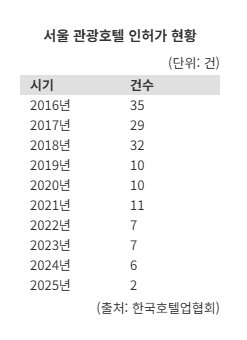
The number of tourist hotel permits in Seoul fell from 35 in 2016 to 32 in 2018, 10 in 2020, and 7 in 2022, before plunging to just 2 last year. Analysts say investment demand weakened sharply as the pandemic and higher construction costs caused by the war added to the burden.
The problem is that, if hotel room capacity remains unchanged, it will not be enough to accommodate the growing number of foreign tourists.
According to the retail industry, the number of foreign tourists expected to visit Korea this year is about 22 million. Applying the 81.7% Seoul visit rate announced in last year’s survey of foreign visitors, roughly 18 million tourists are expected to come to Seoul this year. Given that 79.2% of visitors to Korea used hotels last year, about 14 million people are likely to stay in Seoul hotels. If they stay in Seoul for just two nights, around 28 million room nights would be needed.
However, as of the end of last year, Seoul had a total of 53,503 tourist hotel rooms. Even if every room were fully booked for 365 days, that would only allow for 19.52 million room-night reservations. Adding domestic demand makes the shortage even clearer.
That is why concerns are rising over a possible lodging crisis alongside the government’s goal of attracting 30 million foreign tourists by 2029. According to an analysis by the Korea Hotel Association, if foreign tourist arrivals increase as expected over the next three years, the shortage of tourist hotel rooms in Seoul could reach as many as 26 million.
The industry argues that temporary exemptions from the heavy acquisition tax on hotel investment in major cities, as well as separate taxation on hotel land to exempt it from comprehensive real estate tax, are needed. A hotel industry official said, "Hotels are not assets to be held like homes, but industrial facilities that accommodate tourists." The official added, "Tax policy on hotel real estate should be handled from the perspective of revitalizing the tourism industry."There is precedent for tax relief. The government previously implemented a tax-cut policy once between 2009 and 2014 to boost the tourism industry. Key measures included reductions in acquisition tax for tourist hotel property and the exclusion of heavy tax rates on acquisition tax and registration license tax for tourist hotel property in the Overconcentration Control Area, as well as for corporate registration. Thanks to these measures, the number of tourist hotels in Seoul rose from 130 in 2009 to 211 in 2014, an increase of 62.3%. During the same period, the nationwide growth rate for hotels also jumped from 14.2% to 34.8%. However, after the exemptions ended in 2015, hotel growth slowed over the following six years, with Seoul up 32.9% and the nation up 18.1%.
A hotel industry official said, "The growth rate of tourist hotels became more noticeable three years after the tax cuts." The official added, "If the government wants to achieve its 2029 goal of attracting 30 million foreign tourists, swift action is needed now."
[email protected] Kwon Jun-ho Reporter