Bicycles Without Brakes Could Mean Up to Six Months in Prison... Cracking Down on Teenagers' Fixed-Gear Bikes
- Input
- 2026-06-19 11:18:35
- Updated
- 2026-06-19 11:18:35
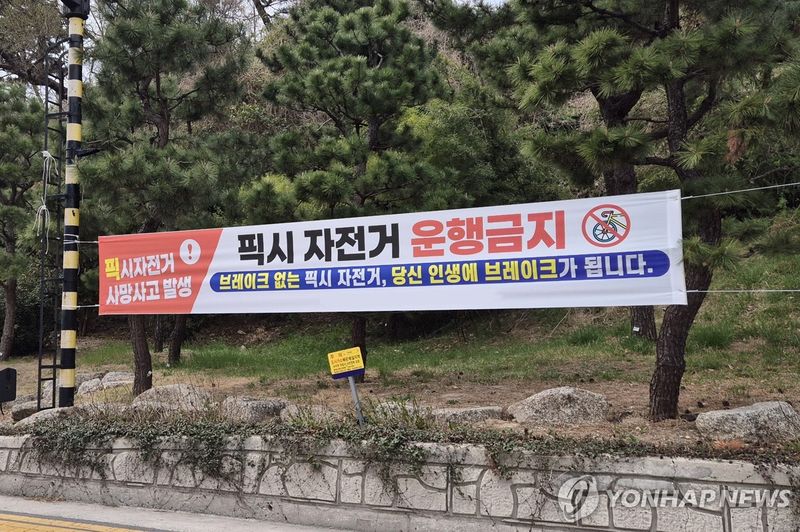
[Financial News] If a fixed-gear bicycle is illegally modified by removing its brakes, the rider could now face up to six months in prison or a fine of up to 5 million won. Riding a bicycle without a braking device on a bike lane will also be subject to a fine.
As the use of brake-free fixed-gear bicycles has spread, especially among teenagers, and accident risks have risen, the government has moved to close legal blind spots and establish a basis for enforcement.
The Ministry of the Interior and Safety said on the 19th that an amendment to the Act on the Promotion of Bicycle Use, which includes these measures, passed the plenary session of the National Assembly on the 18th.
A fixed-gear bicycle is the English abbreviation for a fixed gear bicycle. Its pedals are directly connected to the rear wheel, so when the pedals stop, the wheel stops as well. Unlike ordinary bicycles, it does not have a freewheel function that lets riders coast while resting their feet on the pedals, and it can also move backward if the pedals are turned in reverse.
The problem is that some riders remove the brakes for aesthetic reasons or to perform tricks and then ride on public roads. A fixed-gear bicycle without brakes is difficult to stop in sudden situations.
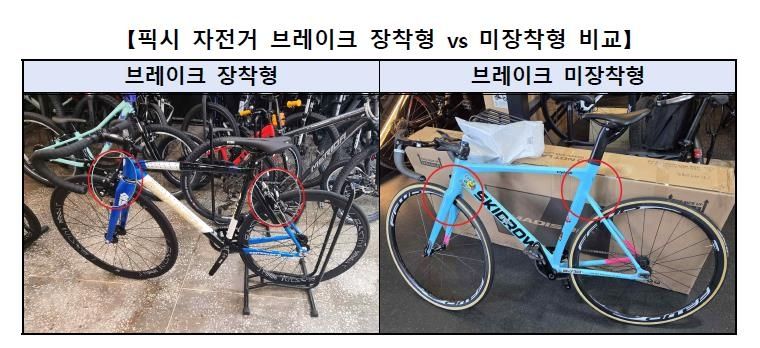
According to the Ministry of the Interior and Safety, a fixed-gear bicycle without a braking device has a stopping distance that is at least 5.5 times longer than a regular bicycle at 10 km/h and up to 13.5 times longer at 20 km/h. In other words, even in situations where a regular bicycle could stop by applying the brakes, a brake-free fixed-gear bicycle would need to travel much farther before coming to a halt. The risk of accidents inevitably rises when riders encounter pedestrians or other cyclists at close range. Concerns about accidents have persisted as some users continue riding on roads after removing their brakes for appearance or trick riding.
The ministry said existing laws had defined bicycles as vehicles that have braking devices. As a result, fixed-gear bicycles with their braking devices removed were paradoxically left outside the bicycle category, making enforcement and management difficult.
The revised bill brings brake-free fixed-gear bicycles under management and requires bicycles to have braking devices that operate independently on the front and rear wheels as part of safety standards.
It also bans illegally modifying bicycles in ways that do not meet safety standards and riding such modified bicycles on bike lanes. The regulation, which had focused mainly on electric bicycles, has now been expanded to cover ordinary bicycles as well. However, riding bicycles without braking devices is exceptionally allowed in places designated by ministerial decree, such as velodromes.
The ministry plans to reflect the key revisions to the bicycle law in safety education and strengthen public campaigns, guidance, and enforcement together with the National Police Agency.
Interior and Safety Minister Yoon Ho-jung said, "This revision is not simply about adding more regulations. It is about putting in place the minimum safety measures needed to prevent our children and citizens from being put at risk on bike lanes." He added, "Please recognize that arbitrarily removing braking devices can pose a serious threat not only to yourself but also to others, and actively cooperate in creating a safe bicycle-use environment."
[email protected] Lee Bo-mi Reporter