Semiconductor Gains, But Why the Current Account Surplus with the U.S. Shrank
- Input
- 2026-06-19 12:00:00
- Updated
- 2026-06-19 12:00:00
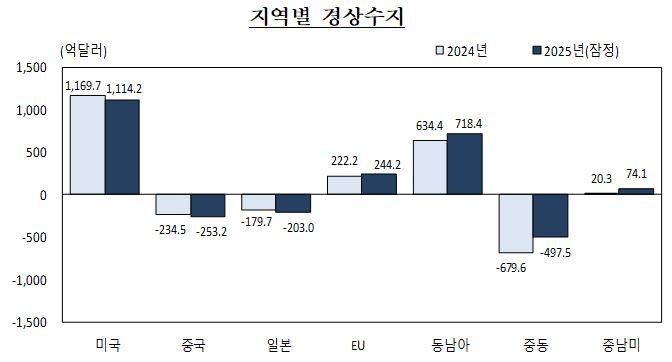
According to the Bank of Korea’s "Regional Balance of Payments by Region, 2025," released on the 19th, last year’s current account surplus came to $123.05 billion. That was up 23.1%, or $23.08 billion, from the previous year’s $99.97 billion, marking an all-time high.
However, the current account surplus with the United States, which makes up the largest portion, fell 4.7% from $116.97 billion to $111.42 billion. It had been rising since 2020, but turned lower for the first time in six years. The goods balance improved on stronger exports of semiconductors and information and communications equipment, but the services balance posted a larger deficit as payments for intellectual property rights increased.
In fact, the goods balance surplus rose from $109.22 billion to $111.98 billion, while the services deficit widened sharply from $8.88 billion to $14.62 billion. Within that, the deficit in the intellectual property rights balance grew from $3.17 billion to $4.28 billion, reflecting higher trademark royalty payments to overseas headquarters of global companies and greater payments by domestic firms for foreign industrial property rights.
Park Sung-gon, head of the International Balance of Payments Team, Economic Statistics Department 1 at the BOK, explained, "When advanced technologies are produced, the use of intellectual property rights rises accordingly." He added, "There will also be payments for using overseas global services such as OTT."
The surplus widened for the European Union, Southeast Asia, and Latin America. The surplus with the EU increased from $22.22 billion to $24.42 billion. Stronger exports of semiconductors and passenger cars lifted the goods balance surplus from $27.05 billion to $28.05 billion, while the primary income balance nearly doubled from $1.64 billion to $3.05 billion.
Current account surpluses with Southeast Asia and Latin America also rose, from $63.44 billion to $71.84 billion and from $2.03 billion to $7.41 billion, respectively. Semiconductors were the main driver in the former, while expanded exports of ships and passenger cars played a major role in the latter.
On the other hand, some regions saw their deficits widen. China’s deficit increased from $23.45 billion to $25.32 billion, and Japan’s deficit also grew from $17.97 billion to $20.3 billion.
Park said, "In Japan, the goods balance deficit widened as exports of petroleum products declined and imports of semiconductor manufacturing equipment increased. The services deficit also expanded as travel payments rose, with the number of Japanese outbound travelers hitting a record high." He added, "In China, the goods balance deficit widened as exports of chemical products and steel products fell amid greater self-sufficiency in intermediate goods and weak domestic demand."
The current account deficit with the Middle East narrowed from $67.96 billion to $49.75 billion, helped by lower imports of crude oil, gas, and other energy products as international oil prices fell.
Park noted, "This year, current accounts in regions that import a large share of South Korea’s semiconductors are likely to increase." He added, "The United States is also one of the key export destinations, but negative trends are continuing for items subject to tariffs, and higher imports of U.S. energy are a downside factor."
Foreign direct investment in South Korea rose to $15.8 billion, up from $12.86 billion a year earlier. Investment from Southeast Asia, Japan, and the EU fell, but inflows from the United States and Latin America increased.
Domestic residents’ overseas portfolio investment more than doubled in scale, rising from $66.97 billion to $140.28 billion. Equity investment, led by the United States, jumped from $42.16 billion to $114.35 billion, while bond investment, mainly in the United States and Japan, increased from $24.82 billion to $25.93 billion.
Foreigners’ portfolio investment in South Korea also more than doubled, increasing from $21.36 billion to $52.54 billion.
Other investment assets rose by $19.88 billion last year, a larger increase than the previous year’s $14.13 billion. Other investment liabilities also expanded, rising from $6.84 billion to $15.55 billion.
[email protected] Kim Tae-il Reporter