"Yongin Is Still Underway, and Now This Too... Semiconductor Capabilities Could Be Spread Too Thin" [Honam Semiconductor Gains Momentum]
- Input
- 2026-06-18 18:30:03
- Updated
- 2026-06-18 18:30:03
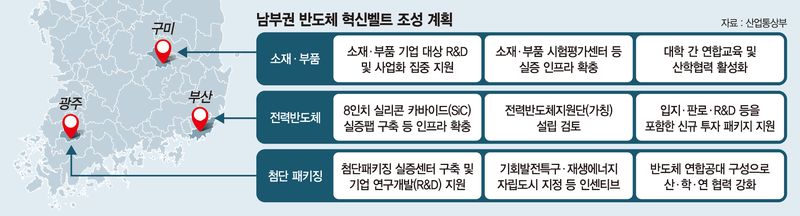
As the boom in the artificial intelligence (AI) semiconductor market converges with the government's push for balanced regional development, expectations are rising in the Honam region for new semiconductor plants. Local governments are also joining the race to attract factories, with talk even turning to possible production transfers and new investment by Samsung Electronics and SK hynix. But industry insiders say it is too early to discuss dispersing production bases when the Yongin Mega Cluster, the core of the country's semiconductor strategy, is still facing major infrastructure challenges such as power and water supply. There are also concerns that the continued concentration of doctorate-level R&D talent in the Seoul metropolitan area could lead to talent outflows and a fragmented ecosystem.
Yongin cluster still lacks water and power infrastructure
According to the industry on the 18th, the Yongin Semiconductor Cluster project is a national strategic initiative centered on Samsung Electronics and SK hynix, with total investment of 1,000 trillion won planned through 2050. While the goal is to build the world's largest semiconductor production complex, the core infrastructure that will determine the project's success, including the power grid and industrial water supply, is still under construction.
Even the Yongin National Industrial Complex, a key part of the Yongin Semiconductor Cluster, is expected to require about 764,000 tons of industrial water per day by 2035, when full-scale operations are set to begin. That is roughly equivalent to the amount of household water used daily by about 2.5 million people. Electricity demand is also estimated to be at the level of several nuclear power plants. That is why the government and companies have spent years building power and water supply systems. In a recent interview with foreign media, SK Group Chairman Chey Tae-won also mentioned the possibility of building an additional production base, but said, "A factory can only be built when power, land, people and water are all secured."
Industry insiders say the recent debate over attracting semiconductor plants to the Honam region must also take this reality into account. Even the Yongin cluster, which is receiving concentrated national support, still requires considerable time for infrastructure construction, permits and stakeholder coordination. For that reason, they argue that discussions about new production bases should be approached cautiously.
A semiconductor industry official said, "The Yongin Mega Cluster is a national project that will determine the competitiveness of Korea's semiconductor industry for decades to come," adding, "Right now, we should focus our capabilities on completing the Yongin cluster as planned, rather than discussing new production bases." Liu Pei-chen, director general of the Industrial Economics Database at the Taiwan Institute of Economic Research, also told Financial News in an interview, "For large-scale semiconductor projects, policy consistency and a fast decision-making system are crucial," and advised that "semiconductor competitiveness ultimately depends on how quickly companies can be supported with investment and infrastructure."
Forced regional expansion could also drive talent away
Another reason the industry is wary of decentralization is talent. The semiconductor industry is both a large-scale manufacturing sector and a high-skill talent industry. Without securing doctorate-level R&D personnel and production technology experts, it is difficult to maintain competitiveness. Korea's core semiconductor workforce is currently centered around Samsung Electronics' Pyeongtaek Campus and Hwaseong Campus, as well as SK hynix's Icheon Campus. Because many key workers are based in the Seoul metropolitan area, the industry says it would be difficult in practice to relocate them in large numbers for new plants in the Honam region.
There are also concerns that an aggressive push to attract factories to regional areas could weaken the talent competitiveness of Korean companies and put them at a disadvantage globally, especially as the United States and Taiwan compete for talent with massive subsidies and R&D support. Industry observers say the priority should be how to protect talent and the ecosystem around the Yongin Mega Cluster, rather than debating plant locations.
A semiconductor industry official said, "As the reluctance of doctorate-level R&D personnel to work outside the capital region remains strong, forcing the dispersion of production bases could lead to talent outflows and increased job changes."
[email protected] Jung Won-il, Im Su-bin, Lee Dong-hyeok Reporter