KOSPI Soars Despite Hawkish U.S. Signals, Putting the Dream of 10,000 Within Reach [KOSPI Breaks Above 9,000]
- Input
- 2026-06-18 18:29:55
- Updated
- 2026-06-18 18:29:55
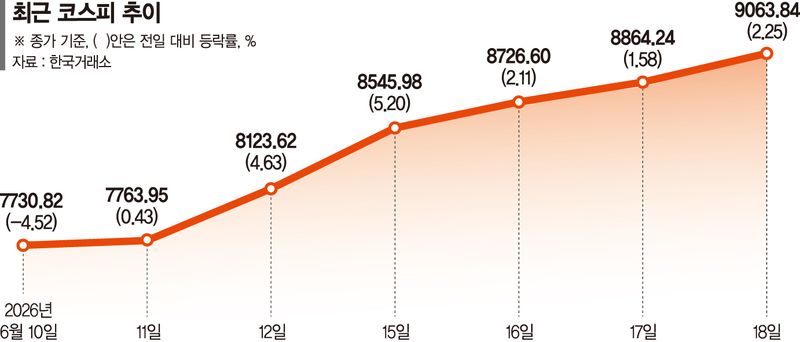
According to the Korea Exchange (KRX) on the 18th, the KOSPI closed at 9,063.84, up 2.25% from the previous session, finishing above 9,000 for the first time ever. In the KOSPI Market, foreign investors led the rally with a net purchase of 1.3128 trillion won. By contrast, retail and institutional investors sold a net 423.2 billion won and 770.8 billion won, respectively.
The rally is being described as unusual when viewed against the backdrop of U.S. monetary policy. At the June FOMC, which Warsh chaired for the first time, the base rate was left unchanged, but the dovish signal markets had expected disappeared. Language in the statement that had previously hinted at the possibility of cuts was removed, and the dot plot showed nine officials expecting a rate hike this year, matching the number who expected no change or a cut. Inflation forecasts were also revised upward.
Ahn Yeha, an analyst at Kiwoom Securities, said, "The key point of this FOMC was not the decision to hold rates steady, but the shift in the dot plot," adding, "The sharp increase in rate-hike projections this year suggests the Fed is concerned about the persistence of recent inflation pressures."
Still, not all experts see a high likelihood of an actual rate hike.
Heo Jin-wook, an analyst at Samsung Securities, said, "This dot plot was more hawkish than expected, but the hurdle for a rate hike remains high," adding, "If oil prices remain stable and inflation continues to cool, the Fed is more likely to maintain a hold stance rather than tighten further."
Normally, concerns over U.S. rate hikes weaken appetite for risk assets. In fact, immediately after the FOMC, the yield on 2-year United States Treasury securities (U.S. Treasuries) rose by more than 10 basis points, with the US dollar also strengthening. Market participants interpreted this as the Fed placing more weight on prolonged rate holds or even additional hikes rather than cuts.
On this day, large semiconductor stocks, including SK hynix, surged more than 10% intraday and lifted the index.
Samsung Electronics also rose more than 4%, extending its strength and emerging as a key driver behind the KOSPI's move above 9,000. In effect, expectations for improved AI semiconductor conditions and stronger earnings, rather than U.S. monetary policy, drove the market.
Investor attention is shifting from rates to earnings. Analysts say upward revisions to earnings forecasts centered on Samsung Electronics and SK hynix are driving the KOSPI rally, making corporate profits a key factor in determining the market's direction.
Kang Jin-hyuk, a senior analyst at Shinhan Investment Corp., said the market has recently been reacting more strongly to improving semiconductor conditions and higher earnings estimates than to the FOMC outcome. He explained that expectations for earnings improvement driven by expanded AI investment are offsetting the impact of interest-rate variables.
Shin Seung-jin, an analyst at Samsung Securities, said most of the KOSPI's gains over the past year can be explained by corporate profit growth. The contribution from EPS growth reached 244.8%, while changes in valuation, measured by PER, were negative. In other words, corporate earnings have risen faster than stock prices, easing valuation pressure. Shin said, "The current market is closer to an earnings-driven rally than a bubble," adding, "Unlike in the past, corporate profit growth is explaining the index's rise."
As the KOSPI has broken above 9,000, forecasts for a move to 10,000 are gaining traction in the brokerage community. Lee Jae-man, an analyst at Hana Securities, said, "If the 2027 KOSPI net income forecast of 853 trillion won is applied along with the historical average price-earnings ratio (PER), the fair value of the index would reach 10,380."
Lee Eun-taek, an analyst at KB Securities, raised his KOSPI target from 7,500 to 10,500 and said, "As expanded AI investment translates into higher earnings for semiconductor companies, the pace of profit growth in the domestic stock market is outpacing that of major global markets."
[email protected] Choi Du-seon Reporter