Growing doubts over the 'big deal'... Iran kept its uranium and secured 456 trillion won [U.S.-Iran ceasefire agreement]
- Input
- 2026-06-18 18:29:02
- Updated
- 2026-06-18 18:29:02
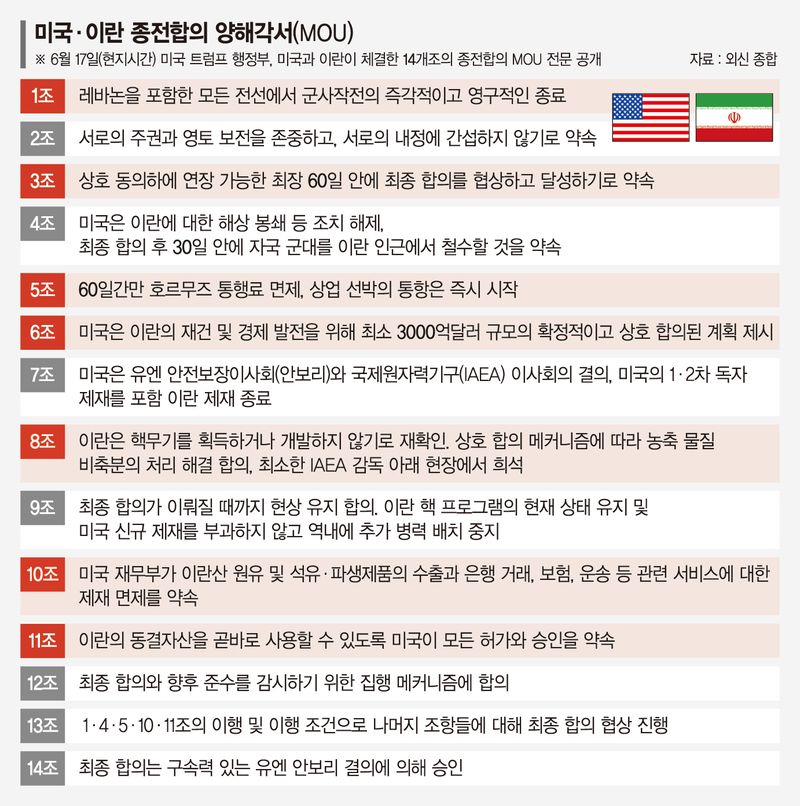
According to local media including CNN on the 17th (local time), the ceasefire MOU between the United States and Iran consists of 14 clauses. The two sides will enter follow-up talks for up to 60 days to reach a final ceasefire agreement.
■ Full ceasefire and lifting of the maritime blockade
Article 1 of the agreement states that the United States, Iran, and their allied forces will declare an immediate and permanent end to the war on all fronts, including the Lebanon front. The two sides also agreed to stop the use of force and military threats going forward.
Article 2 sets out the principles of mutual respect for sovereignty and territorial integrity, as well as noninterference in internal affairs. Article 3 defines the deadline for a final agreement as 60 days.
Articles 4 and 5 address the lifting of the maritime blockade and the normalization of shipping routes. The United States will immediately lift the blockade and restore vessel traffic to prewar levels within 30 days. If a final agreement is signed, U.S. forces will also withdraw from areas near Iran. Iran, for its part, will restore commercial shipping to normal levels within 30 days through mine clearance and route restoration work.
■ Allowing oil exports in exchange for 456 trillion won in support
The economic provisions amount to a large-scale support package for Iran. Under Article 6, the United States, together with its Middle East allies, will raise at least $300 billion to support Iran's reconstruction and economic development. The specific implementation method will be worked out during the next 60 days of negotiations.
Article 7 says sanctions on Iran, including those imposed by the United Nations Security Council (UNSC), the International Atomic Energy Agency (IAEA), and the United States' primary and secondary sanctions, will be lifted in stages.
Article 10 stipulates that the U.S. Department of the Treasury will immediately allow exports of Iranian crude oil and petrochemical products. Related services such as banking, insurance, and shipping are also included in the authorization.
Article 11 concerns the release of frozen assets. The United States will allow Iran's frozen and restricted assets to be used and will provide the necessary licenses so that payments can be made to final beneficiaries designated by the Central Bank of Iran.
The most sensitive issue is the nuclear question. In Article 8, Iran reaffirmed its existing position that it will not acquire or develop nuclear weapons.
However, the full removal of highly enriched uranium from the country, which the United States had demanded, was not specified. Instead, the two sides agreed to decide in the final negotiations how to handle the stockpile of enriched uranium, and as a minimum measure, to apply on-site dilution under IAEA supervision.
This is seen as a clause that reflects Iran's position to a significant extent, more than had previously been known. The two sides are expected to hold further talks on the scope of permitted enrichment activities and the method for handling uranium stockpiles.
Article 9 sets out a status quo arrangement until the final agreement is reached. Iran will keep its nuclear program at its current level, while the United States will refrain from imposing new sanctions and deploying additional troops.
Article 12 calls for the creation of a joint implementation body to oversee compliance with the MOU. Article 13 says final negotiations will proceed only after the United States carries out its economic measures. Article 14 states that if a final agreement is reached, it will be given international legal force through a UNSC resolution.
Diplomatic sources say the MOU is meaningful in that it lays the groundwork for ending full-scale war and normalizing energy supplies. However, since many of the key issues in the nuclear talks have been pushed to the final agreement, the next 60 days of negotiations are expected to become the real test.
[email protected] Reporter