Semiconductor performance to improve tenfold by 2030, with 100 GW of power supply expansion
- Input
- 2026-06-18 15:32:34
- Updated
- 2026-06-18 15:32:34
[Financial News] By 2030, semiconductor performance will be increased tenfold, and energy supply will reach 100 GW through an artificial intelligence (AI) smart grid.
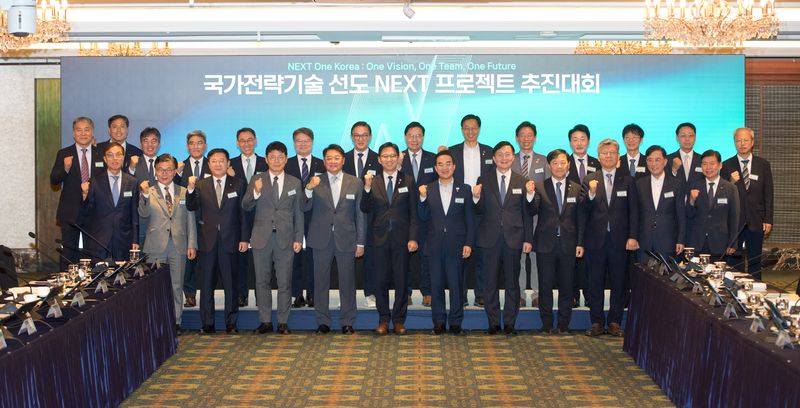
The Ministry of Science and ICT and the Ministry of Planning and Budget held the National Strategic Technology Leading NEXT Project Promotion Conference at Lotte Hotel in Jung District, Seoul, on the 18th, with about 100 participants including representatives from major National Strategic Technology companies, universities and research institutes, as well as vice ministers and ministers from relevant ministries. At the event, they announced next year's new policy direction, which includes the measures above. NEXT stands for "New, Emerging, and eXponential Technology" and refers to next-generation and emerging technologies that will drive new industries through exponential growth.
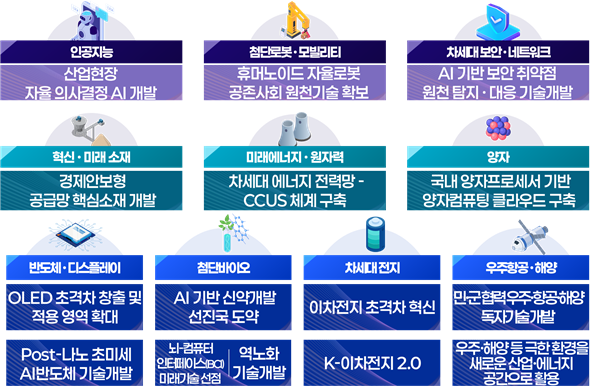
Among the field-specific missions announced that day, the new tasks scheduled to begin in 2027 span a total of 10 areas. These include AI, advanced robotics and mobility, next-generation security and networks, innovative and future materials, future energy and nuclear power, and quantum. They also include semiconductors and displays, advanced biotechnology, next-generation batteries, and aerospace and marine sectors.
In semiconductors, the government will use the Semiconductor Special Act, which takes effect in August, to support the creation of semiconductor clusters. It also plans to build a cooperative framework among semiconductor companies to develop common foundational technologies for future innovation. Through these efforts, the government aims to raise performance per watt to the world’s highest level by 2040. In particular, it seeks to develop semiconductors that combine memory and computation by 2030, while increasing performance tenfold and cutting power consumption to 60%.
In energy, the government will support the development of a smart grid using AI. It plans to establish an integrated data management system for the power grid and demonstrate an AI-based grid system in Distributed Energy Special Zones. The goal is to achieve 100 GW of deployment by 2030.
In advanced robotics, the government will develop a world-leading general-purpose intelligence model and a world model that supports learning in virtual environments to localize core Physical AI technologies. It also plans to build a foundation for humanoid development, demonstration and mass production, while pushing R&D on five key robot components, including robot hands.
Core projects under the NEXT initiative will be designated by the end of this year as "national strategic technology R&D projects" under the Act on the Promotion of National Strategic Technologies. They will receive priority consideration in R&D budget allocation and coordination, along with eased requirements for corporate matching contributions. By the second half of this year, the government plans to reorganize comprehensive roadmaps by field, including core projects, and carry them forward with relevant ministries and the private sector.
Starting in the second half of this year, the Ministry of Science and ICT will establish and operate the cross-ministerial, public-private "NEXT Alliance," made up of field-specific consultative bodies and project support teams, to accelerate results from the NEXT project. Based on the NEXT National Strategic Technology R&D portfolio, the government will establish a National Strategic Technology Innovation Roadmap, implement it swiftly together with other ministries and the private sector, and manage project outcomes through the Special Committee on National Strategic Technologies.
Earlier, to provide concentrated support for strategic technology development, the government began designating National Strategic Technologies in 2021 and enacted the Special Act on the Promotion of National Strategic Technologies in 2023, focusing R&D, investment and policy support on these technologies. This year’s National Strategic Technology R&D investment stands at 8.6 trillion won.
Deputy Prime Minister and Minister of Science and ICT Bae Kyung-hoon said, "Securing National Strategic Technologies is essential for the survival of the country. From now on, we want universities, industry, research institutes and government ministries to think together rather than separately." He added, "Through the NEXT Alliance, the government will support the linking of capabilities from industry, academia and research with R&D projects, finance, investment and policy support, and we will keep moving forward to secure the world’s first and best technologies through the National Strategic Technology Leading NEXT Project."
Park Hong-keun, minister of the Ministry of Planning and Budget, said, "Setting priorities for investment is also very important for the government. We will play a strategic investment role to secure the future." He added, "The NEXT project will be an opportunity to concentrate government and private-sector capabilities on strategically important technologies and build a system that creates results from research and development."
[email protected] Yeon Ji-an Reporter