Rates Hold, but the Dot Plot Jumps Higher as the FOMC Turns More Hawkish
- Input
- 2026-06-18 14:48:13
- Updated
- 2026-06-18 14:48:13
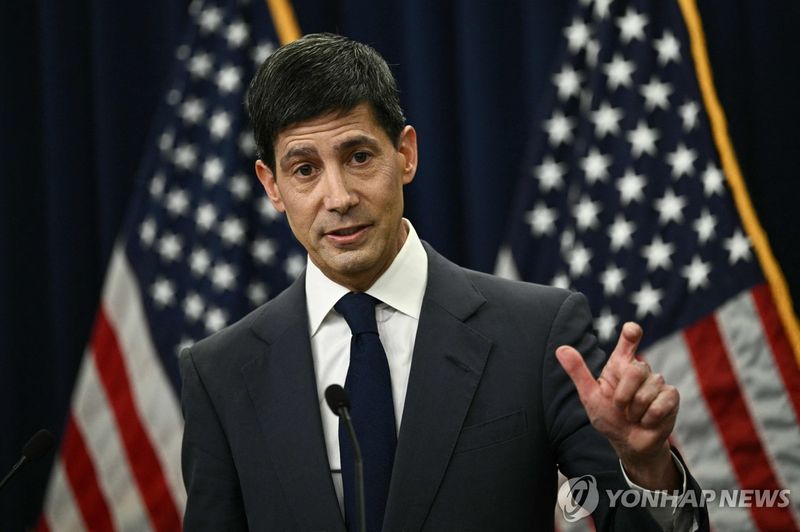
■The dot plot shifts higherAccording to local market information from the Bank of Korea's New York Office on the 18th, market participants viewed the FOMC decision announced on the 17th local time as hawkish. The policy rate was unanimously left unchanged at 3.50% to 3.75%, but key factors included the removal of dovish language from the policy statement, half of the committee projecting a rate hike this year in the dot plot, and stronger emphasis on meeting the inflation target.
In the policy statement, the assessment of the labor market was revised from "job gains have remained at a low level on average" to "job gains are consistent with the pace of labor force growth." In the Summary of Economic Projections (SEP), the forecast for this year's Personal Consumption Expenditures (PCE) inflation rate was also raised from 2.7% to 3.6%. However, the real Gross Domestic Product (GDP) growth forecast was lowered from 2.4% to 2.2%.
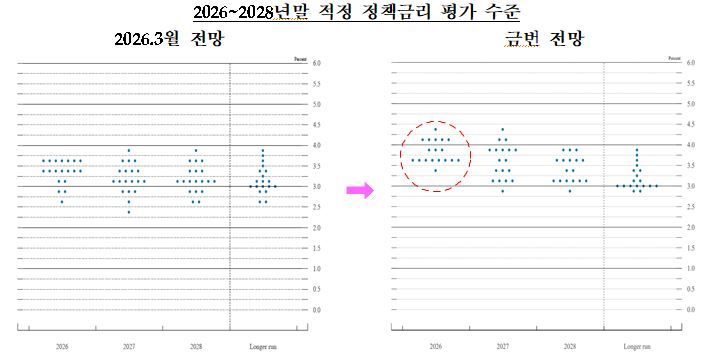
More specifically, 9 of the 18 members, excluding Chairman Kevin Warsh, projected a rate hike this year. Three members pointed to 25 basis points, five to 50 basis points, five to 75 basis points, and one to 100 basis points.
However, all related forward guidance language was removed this time.
Warsh said, "If financial markets respond to and price in the economic indicators they themselves believe are important, the central bank can make better policy decisions based on that," and added, "Toward the end of this year, there will be a review of the overall communication framework, including press conferences, the dot plot, and the release of meeting minutes."
His emphasis on fighting inflation also reinforced expectations of a hawkish stance. He said, "The Fed has failed to meet its inflation target over the past five years, and we will work to correct that," adding, "We must prevent price increases from spreading across the broader economy."
Warsh also said of the labor market, "The FOMC assesses the labor market as broadly stable, and some members even say it is improving."
■"More hawkish than expected"Major investment banks largely agreed that the outcome was "more hawkish than expected." Goldman Sachs (GS) said, "The Fed's concern about inflation persisting beyond the initial shock has grown stronger," adding that "the fact that half of the members supported a rate hike this year was decisive."
Bank of America (BoA) also noted, "Core PCE inflation was revised up to 3.3% this year, and more notably, next year's forecast was raised to 2.5%," adding that this means "the argument that inflation is temporary is no longer valid."
JPMorgan Chase said, "Until a few months ago, the market expected Chairman Warsh's first FOMC meeting to signal a dovish policy pivot, but the actual outcome was hawkish in the exact opposite direction."
Still, some said it is unclear whether a rate hike will actually happen. Cho Yong Gu, a researcher at Shinyoung Securities, said, "The median dot plot for this year implies 0.5 rate hikes, but I would not interpret that as a signal of an actual hike," adding, "The hawkish views are concentrated among regional Fed presidents, and 9 committee members still projected no change or lower rates."
Warsh also cautioned against jumping to conclusions when asked why no measures were taken to signal tightening. He said, "None of the 19 committee members at the meeting reached that judgment."
On the day, Yoo Sang-dae, vice governor of the Bank of Korea, chaired a Market Situation Review Meeting and said, "A shift in monetary policy stances among major countries is becoming visible," adding, "Given the remaining downside risks at home and abroad, including developments in the Middle East, trends in international oil prices, expansionary fiscal policies in major countries, and concerns related to the Artificial Intelligence (AI) industry, we will remain alert to the possibility of greater volatility in financial and foreign exchange markets."
[email protected] Kim Tae-il Reporter