"Seeing '2.8 Million Nix' and '350,000 Samsung Electronics' Makes It Even More Frustrating... Am I the Only One Who Became a 'Lightning-Rod Pauper'?" Kim Manager Missed the Chance, But He Would Have Had 'This Weapon' [In Chi-beom's Stock Investing Boot Camp]
- Input
- 2026-06-20 09:00:00
- Updated
- 2026-06-20 09:00:00

[Financial News] "Crises repeat themselves. To avoid being hurt by them again, we must not forget. We must keep questioning and thinking. We must not take the obvious for granted. And we must always look at the world with open eyes. I do not want to lose twice." — Han Si-hyun (played by Kim Hye-soo), head of the monetary policy team at the Bank of Korea, in "The Day the IMF Hit Korea"That line comes from Han Si-hyun, the protagonist of the 2018 film "The Day the IMF Hit Korea." The monologue in the ending scene resonates deeply with stock investors as well. Let me ask individual investors in their 20s: what should you never forget if you want to avoid being crushed by crises in a highly volatile stock market? The answer can be found in the moves of the world's greatest investor.
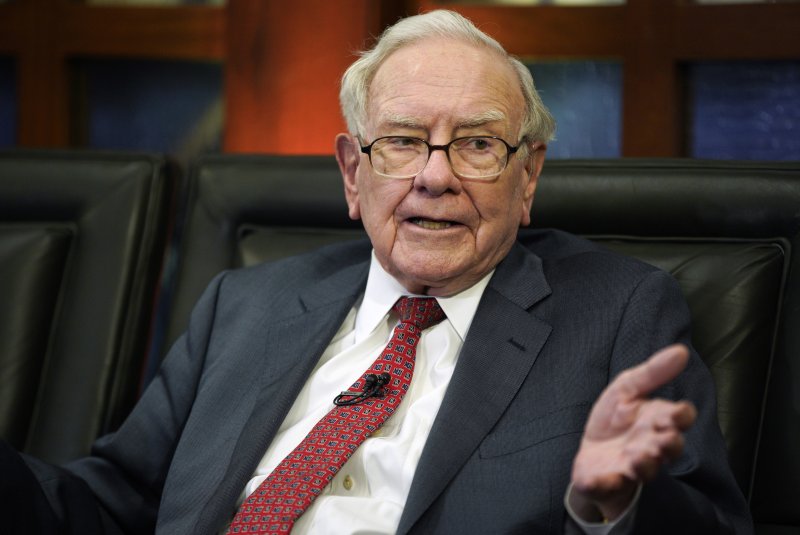
Warren Buffett's cash ratio stands at a staggering 30%
Berkshire Hathaway, led by Warren Buffett, holds as much as 31% of its total assets in cash. That amounts to about $397 billion, or roughly 590 trillion won, in cash and short-term Treasury bills out of total assets of about $1.2522 trillion. Buffett has long been known for maintaining at least $20 billion in liquidity. Recently, however, he has increased cash and cash equivalents to an all-time high. Cash equivalents include short-term Treasury bills and similar instruments. (Based on data released in the first half of 2026)What does it mean for individual investors in their 20s when major asset holders emphasize cash? For them, cash is not simply money sitting idle. It is a way to secure future options and an insurance policy that raises the odds of survival in a volatile stock market. It also serves as a powerful psychological buffer that helps prevent mental collapse during routine market shocks. To make the importance of holding cash easier to remember, I have summarized it as the 3Cs: CHANCE, CUSHION, and CONTINGENCY.
Reason to hold cash 1: CHANCE (securing opportunities to buy at lower prices during declines)
When the market plunges, cash allows you to buy quality assets at very low prices. Suppose the KOSPI or Nasdaq falls 30%. Investors who have set aside cash can use additional purchases to significantly lower their average buying price. Of course, this assumes that they have thoroughly studied the future value of the stocks they already hold, so that the move becomes a calculated risk.In particular, holding cash is a good option for securing investment opportunities. Markets periodically produce so-called next big things and tenbaggers, stocks that deliver gains of more than tenfold. These are usually high-quality companies leading innovation or pioneering new industries. There are also stocks that benefit from macroeconomic variables or government policy. Sharp declines in such names are the best opportunities for cash holders. But what if your entire portfolio is already all-in on stocks and prices suddenly collapse? Let's look at what history teaches us.
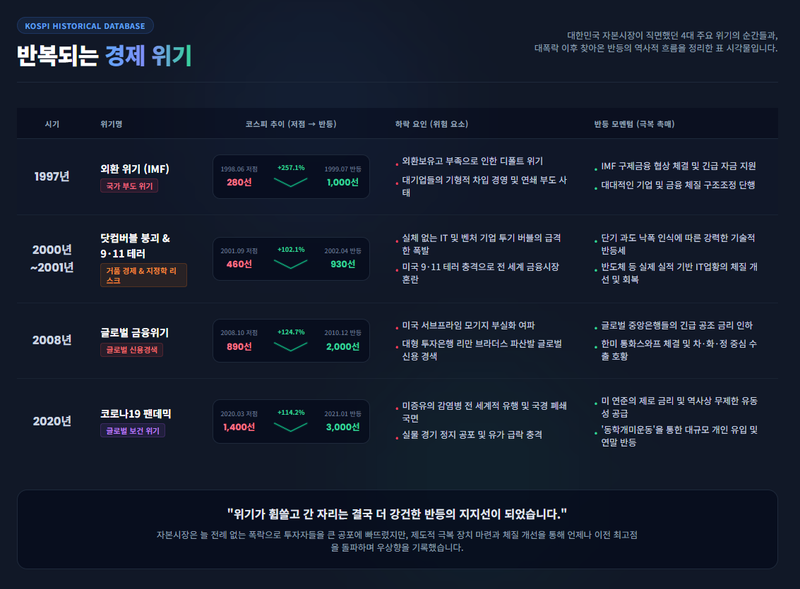
With cash, you can treat a market crash as a stock sale
Let's revisit the IMF Crisis of 1997, the Dot-com bubble burst in 2000, the September 11 attacks in 2001, the credit card crisis in 2003, the Financial crisis in 2008, and the coronavirus disease 2019 (COVID-19) period in 2020. For individual investors who were fully exposed to stocks without cash, or who lost their jobs during a crisis, those were brutal times in which even survival was at risk, let alone investment opportunities. They had to sell off beaten-down stocks at a loss just to cover immediate living expenses. On the other hand, some people did find opportunities. They were not necessarily rich, but they had set aside some cash. It is clear that 1997, 2001, 2008, and 2020 were periods of sharp market declines. But did you know that they were also the starting points for strong rebounds after the crisis? Paradoxically, a crash can be the best chance to buy quality assets at very low prices.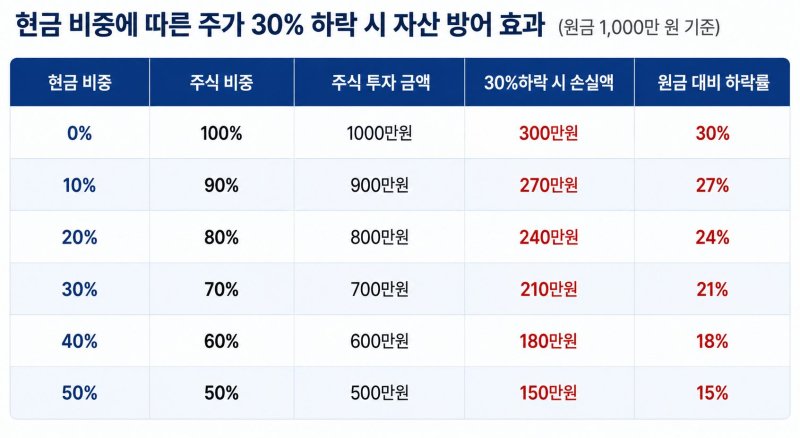
Reason to hold cash 2: CUSHION (acting as a psychological buffer)
If you invest all of your available funds in stocks, it is hard to endure the fear of a market crash. For example, suppose you put 10 million won into stocks and the market falls 30%. That means 30% of your total assets have effectively vanished. By contrast, if you invested 6 million won in stocks and kept the remaining 4 million won in cash, the same 30% drop in stock prices would reduce your total assets by only about 18%.((6 million won × 0.3) = 1.8 million won, 1.8 million won ÷ 10 million won × 100 = 18%) The psychological gap between a "30% loss" and an "18% loss" is larger than it may seem. That difference helps prevent frightened investors from making irrational decisions. Of course, holding too much cash is also a problem. If stock prices rise sharply, you may suffer opportunity cost losses and a sense of relative deprivation, or fear of missing out (FOMO). In the end, the key is to hold an appropriate amount of cash that fits both market conditions and your own temperament.
Reason to hold cash 3: CONTINGENCY (securing emergency funds)
Holding a certain amount of cash also prepares you for unexpected situations. Life can bring job loss, or you may need capital to start a business. You may face substantial medical expenses for treatment, surgery, or hospitalization. You may need to move because of a job change, or you may need to raise your deposit for a rental home. We all have to deal with unexpected funding needs. Without cash, you may be forced into decisions you do not want to make when money is suddenly needed. You may even have to sell stocks at a loss despite the downturn. It is especially painful if the stock you bought is actually a good one. After a temporary plunge, prices may recover quickly, almost as if nothing happened.In a previous column, I said that one of the tools for asset management is stocks, which help you earn money, spend it on living expenses, and then decide how to preserve and grow what remains. Cash is also one of the tools of asset management, alongside stocks, bonds, foreign exchange, and real estate. Please remember that holding cash is not a passive act of simply storing money. It is an active step taken to preserve future choices. Experts in investing, the financial industry, and academia all emphasize that holding cash is itself a form of position, and that sitting on cash is also a very deliberate investment decision.

"Cash is a powerful weapon for buying cheap in a crash"
Let's look at how investment legends view cash holdings. Seth Klarman, founder of the Baupost Group and often called the "second Warren Buffett," is known for maintaining a high cash ratio when markets are overheated or when investment opportunities are hard to find. He defines cash not as money that is resting without working, but as a powerful weapon prepared to buy the best assets cheaply when markets collapse. In asset allocation reports from global financial firms such as Charles Schwab and JPMorgan Chase, cash is described as insurance that allows investors to move when fear takes over.As noted earlier, Warren Buffett has long maintained at least $20 billion to $30 billion in liquidity. Berkshire Hathaway's recent increase in cash holdings is said to reflect an overheated stock market and a lack of attractive large-scale investment opportunities, meaning companies available at reasonable prices.
"When chaos comes, no one has enough cash"
Crises cannot be predicted, but they can be managed. The answer is to ease up on greed and keep part of your assets in cash. Cash is often seen as a non-yielding asset, but in a crash it becomes the most liquid and powerful form of optionality. Investors must therefore manage not only returns, but also future choices. The market always offers opportunities, but only those who are prepared can seize them. Remember the saying: "When chaos comes, no one has enough cash."[About the author]
Executive Director In Chi-beom worked for 30 years in corporate communications, including finance at Samsung Life Insurance, IT at AhnLab, Inc., Hancom, and SK Communications, and retail at Samsung Tesco. He is currently focused on writing books about investing and corporate communications at KPI Investment Advisory. He believes that success in stock investing begins above all with automating the right habits for handling money.
[email protected] Kim Seong-hwan Reporter