"Is the roller-coaster KOSPI over?" KOSPI 'fear index' falls as brokerages say the market is headed for 10,000
- Input
- 2026-06-18 10:14:46
- Updated
- 2026-06-18 10:14:46
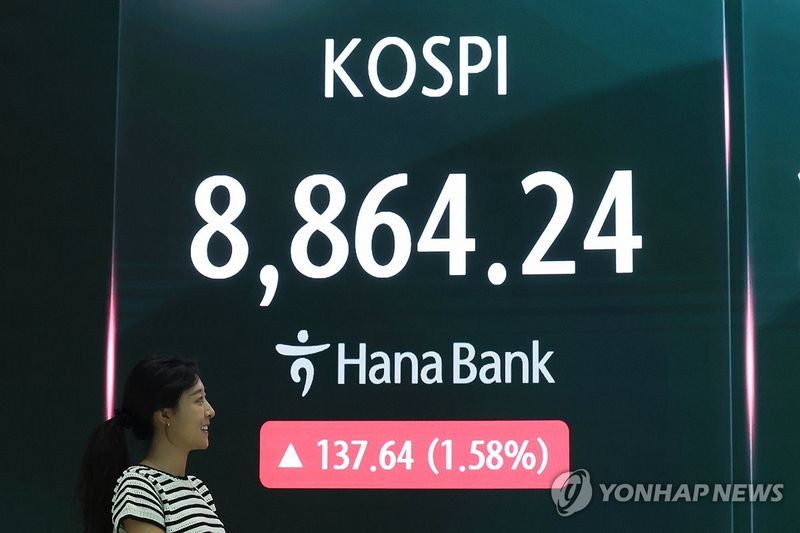
[Financial News] The KOSPI (Korea Composite Stock Price Index) has swung sharply up and down this month, but the KOSPI 200 Volatility Index, known as Korea's fear gauge, fell below 80 for the first time in seven trading days. As geopolitical risks eased after the United States and Iran reached a ceasefire agreement, excessive market anxiety has begun to subside.
According to the Korea Exchange (KRX), the KOSPI hit an intraday high of 8,975.52 on the 18th, setting a new record. The previous intraday peak was 8,933.62, recorded on the 2nd.
Despite concerns over a possible U.S. interest rate hike, the KOSPI opened higher and was trading at 8,927.19 as of 9:11 a.m., up 62.95 points, or 0.71%, from the previous session.
According to Newsis, some market watchers are even forecasting that the KOSPI could surpass the 10,000 mark this year. Although short-term volatility remains, brokerages say the medium- to long-term uptrend is still intact, citing earnings improvements and rising corporate profits driven by the semiconductor supercycle.
Domestic stocks have seen extreme volatility this month. The KOSPI plunged 5.54% and 8.29% on the 5th and 8th, respectively, dragging the index down to the 7,400 range before rebounding sharply on the 9th, 12th, and 15th with gains of 8.18%, 4.63%, and 5.20%. On the 10th, it fell 4.52% and then recovered the next trading day, the 11th, extending a roller-coaster pattern in which the market changed direction almost daily.
As volatility intensified, the KOSPI 200 Volatility Index, also known as Korea's fear gauge, moved sharply as well. The index surged to 91.23 at the close on the 9th and briefly reached 94.25 intraday on the 15th. But as the market stabilized, it fell to 79.40 intraday on the 17th, slipping below 80 for the first time in seven trading days since the 8th.
The easing of inflation concerns and fears of further tightening by the Federal Reserve (Fed) after the United States and Iran reached a peace agreement appears to have helped improve investor sentiment. Brokerages say the stock market's upward trend remains valid as long as earnings continue to improve. At the same time, they caution that it remains to be seen whether volatility will return to normal levels in the short term, given that recent gains have been led mainly by large-cap semiconductors and other blue-chip stocks.
Daishin Securities raised its KOSPI target for this year from 8,800 to 11,500, citing earnings improvements from the semiconductor supercycle and expanded long-term contracts with big tech companies. The firm said the market's valuation normalization is now in full swing, making a "KOSPI 10,000 era" possible.
In a report released on the 17th, Kyung-min Lee of Daishin Securities said, "The KOSPI has now entered a classic earnings-and-policy-driven phase." He added, "As the upward trend in forward earnings per share (EPS) continues, the index's upside should remain open until earnings forecasts begin to weaken."
Lee also highlighted the improving earnings outlook for the semiconductor sector. He said, "Operating profit and net profit in the semiconductor industry are expected to rise 56% and 37%, respectively, from the previous quarter in the second quarter." He added, "TrendForce's forecast for semiconductor price increases in the second quarter also ranges from 58% to 75%, leaving room for further upward revisions to earnings."
He went on to say, "The strengthening profit momentum in semiconductors and the upward revisions to earnings forecasts will expand the KOSPI's upside potential, not just for semiconductors but for the broader market as well." He added, "With 17 to 19 sectors seeing upward revisions to quarterly and annual operating profit forecasts, earnings season in the second quarter should make improvements visible not only in semiconductors but also in non-semiconductor sectors."
He also pointed to stable oil prices following the peace agreement between the United States and Iran as a favorable factor for the stock market. Lee said, "As oil prices stabilize in the high $70s per barrel, bond yields and the dollar are also likely to stabilize lower." He added, "That could further strengthen the KOSPI's upward momentum in July and August."
[email protected] Kim Hee-sun Reporter