'Five Major Reforms' Warsh Overhauls Dot Plot and Statement
- Input
- 2026-06-18 06:05:48
- Updated
- 2026-06-18 06:05:48
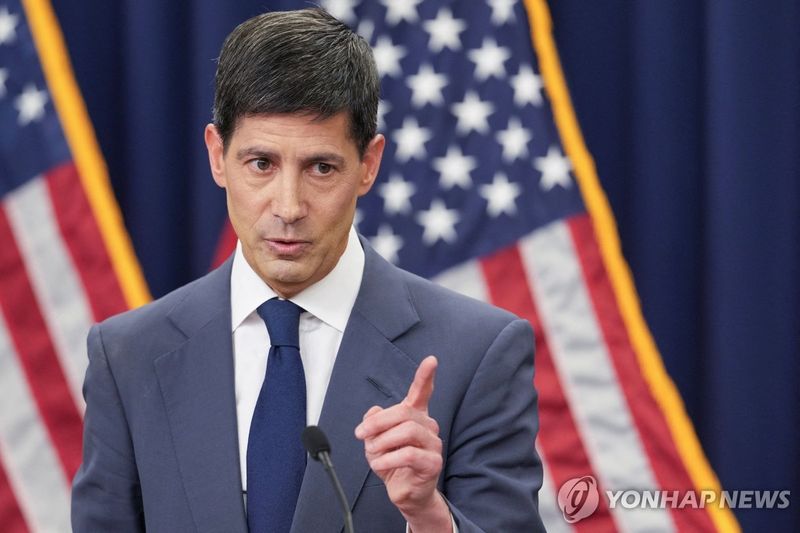
【Financial News New York = Lee Byung-chul】 Kevin Warsh, chair of the Federal Reserve System (the Fed), presided over his first Federal Open Market Committee (FOMC) meeting since taking office and laid out his monetary policy philosophy in earnest. After presenting five key reform tasks for the Fed, Warsh sharply simplified the policy statement and skipped the dot plot that signals the future path of interest rates, signaling a shift toward a more "Warsh-style" Fed.
'Warsh-style Fed reform' begins... Five task forces launched
On the 17th local time, Warsh announced the creation of five task forces as his first official reform measure since taking office. The new task forces will focus on five areas: the Fed's policy communication methods, management of its $6.7 trillion balance sheet, the collection and use of economic data, changes in productivity and the labor market driven by the spread of new technologies such as artificial intelligence, and the Fed's inflation policy framework.
These were the areas Warsh had already identified as core reform priorities before taking office. The most closely watched is the balance sheet task force. Warsh has criticized the Fed's assets, which swelled to $6.7 trillion through the financial crisis and the COVID-19 pandemic, saying they distort market price signals and expand the central bank's role too far. The task force will review from scratch the appropriate size of the balance sheet and the operation of quantitative tightening, or QT.
The data task force will conduct a full review of the economic indicators and analytical framework used in Fed policy decisions. Warsh has argued that existing statistics alone cannot fully capture a rapidly changing economy and has called for greater use of real-time data and new analytical methods.
The AI and productivity task force will study how the spread of artificial intelligence affects productivity, the labor market, and long-term inflation, and how those effects should be reflected in monetary policy. Warsh has repeatedly said that AI will boost productivity and, over the long term, create a disinflationary effect by lowering the prices of goods and services.
The communications task force will be responsible for redesigning the Fed's policy messaging. During his confirmation hearing and other appearances, Warsh has said that the dot plot and forward guidance reduce policy flexibility. He has also taken a negative view of frequent public remarks by Fed officials and the press conference held after every meeting, saying they can send unnecessary signals to the market. At the meeting, Warsh said, "A press conference is an effective communication tool, but it is preferable to hold one only when there is an important announcement."
The inflation framework task force will review the Fed's approach to measuring inflation and making policy decisions. Warsh has stressed the need for a new framework that can more precisely distinguish between temporary price increases caused by supply shocks and structural inflation.
Warsh outlined the broad direction for each task force and said more details would be released within days. "Each task force will operate toward a single goal shared across the entire Fed system," he said. "The goal is to build a Fed that makes policy with a clearer and more objective perspective."
He revised both the statement and the dot plot... Warsh-style communication reduces 'hints'
The first area to show change among the five task forces was communication. In fact, the FOMC policy statement and dot plot released that day reflected Warsh's philosophy directly.
According to The Wall Street Journal (WSJ) and other major foreign media outlets, this month's policy statement was 132 words long, down sharply from 345 words in April. Its structure also changed, with the policy decision placed first, followed by a brief description of economic conditions. The statement also removed all language explaining which members voted for or against the decision and why.
The way the Fed communicates with markets also changed significantly. The Fed sharply scaled back so-called forward guidance, which hints at the future direction of monetary policy, and greatly shortened the statement. The statement also removed the language from the April FOMC meeting that noted dissent from three members. Another paragraph stating that the Fed considers "a broad range of information" when setting monetary policy was also deleted. In its place, only the short and firm sentence, "The Committee will achieve price stability," remained.
Until now, Wall Street has analyzed even the smallest wording changes in the statement to predict the Fed's next policy move, but under the Warsh era, reading those "hints" is expected to become much more difficult.
Warsh explained, "It is a little more concise, a little simpler, and some older expressions have been removed," adding, "This statement focuses on including only the facts we need to convey."
Warsh did not submit his own dot plot. The dot plot is a key indicator showing Fed officials' future interest rate projections. In this FOMC meeting, a total of 18 dot plots were submitted, one fewer than in March, and Warsh confirmed at the press conference that the missing dot plot was his.
He has argued that the Fed has been sending too many signals to the market through the dot plot and forward guidance. His view is that if the future path of rates is spelled out too specifically, it becomes harder to adjust policy flexibly even when economic conditions change.
Warsh, however, drew a line and said his decision did not represent the Fed's overall policy. "I encouraged the other members to submit their own dot plots," he said. "My decision not to submit one was entirely personal."
[email protected] Lee Byung-chul Reporter