"The Value of IP Created by AI Requires Government Reinvestment, Officials Should Consider" [16th International Conference on Intellectual Property Protection]
- Input
- 2026-06-17 18:53:32
- Updated
- 2026-06-17 18:53:32
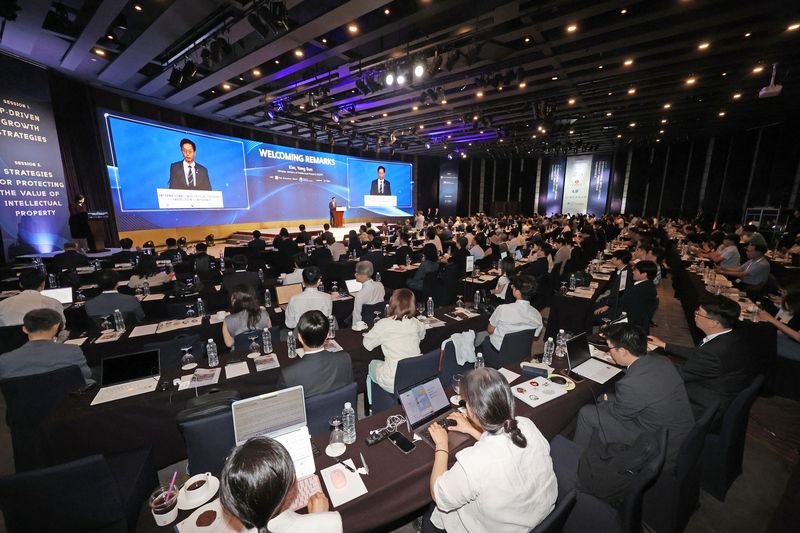
"Intellectual property rights are a matter of national importance. The government's role is to think about how to reinvest the value created by intellectual property rights back into society."
Susan Harrison, CEO of Persipiens LLC and former chair of the Patent Public Advisory Committee at the United States Patent and Trademark Office, delivered the keynote speech at the 16th International Conference on Intellectual Property Protection, jointly hosted by Financial News and the Ministry of Intellectual Property at the Westin Chosun Hotel in Jung District, Seoul, on the 17th under the theme, "In the Era of Intellectual Property, Ideas Become Assets and Protection Becomes Innovation." She said, "The development of artificial intelligence is having a major impact on the value of intellectual property rights as well. I do not have the answer either, but I think it would be better to have more discussions about intellectual property rights."
Harrison also cited an example from a New York Times op-ed by U.S. Senator Bernie Sanders, who argued that because AI is built on the collective knowledge accumulated by humanity, the wealth it generates should be shared by society as a whole. She added that the idea of turning tacit knowledge, which is internalized through learning and experience but cannot be easily expressed in speech or writing, into data and using AI to replace workers is not the right direction. While the future remains uncertain, she stressed that people's experience is still valuable.
Harrison also said that intellectual property management capabilities have been elevated into a major "national task" that goes beyond the survival of individual companies and determines the fate of national security and the economy.
Today, as the free trade order weakens and geopolitical risks intensify, intellectual property is emerging as a strategic asset that shapes national competitiveness and economic security, rather than merely a legal right. In this context, the elevation of the Korean Intellectual Property Office (KIPO) to the Ministry of Intellectual Property in October last year is being viewed as a meaningful turning point.
In his welcome speech, Kim Yong-sun, commissioner of the Ministry of Intellectual Property, said, "This event is especially meaningful because it is the first International Conference on Intellectual Property Protection held since the launch of the Ministry of Intellectual Property." He added, "We will work to build a revenue-generating intellectual property ecosystem so that creative ideas and R&D achievements can be linked to investments that create high added value."
In her congratulatory remarks, Member of the National Assembly Lee Eon-ju also said, "We are now living in an era where a single idea can change a company's fate and one patent can shape a market for decades." She pledged strong support, saying, "In step with this change, I will do my best in the National Assembly to support the country's leap forward as a powerhouse in intellectual property."
In his remarks, Jeon Jong-hak, president of the Korean Patent Attorneys Association, said, "In line with global trends, we must recognize intellectual property not as a mere legal or administrative matter, but as a strategic asset that protects national competitiveness and the industrial ecosystem. In this changing environment, the role of patent attorneys is becoming even more important." He added, "We need the 'patent attorney confidentiality privilege,' which is the minimum safeguard needed to protect our companies' technology and strategic information and to defend national competitiveness."
In a panel discussion during Session 2 on "Suggestions and Expected Effects for Establishing the K-discovery System," Ahn Ki-hyun, executive vice president of the Korea Semiconductor Industry Association, said, "K-discovery could be a double-edged sword for domestic materials, parts, and equipment companies." He added, "There is a need to codify the confidentiality privilege between patent attorneys and clients."
Special reporting team
[email protected] Park Shin-young, Kim Dong-ho, Cho Eun-hyo, Kim Hak-jae, Kang Gu-gwi, Im Su-bin, Kim Dong-chan, Jeong Won-il, Lee Dong-hyeok Reporter