[Exclusive] Bold Supply Measures to Convert Unused Private Land for Other Uses Are on the Way
- Input
- 2026-06-17 18:53:27
- Updated
- 2026-06-17 18:53:27
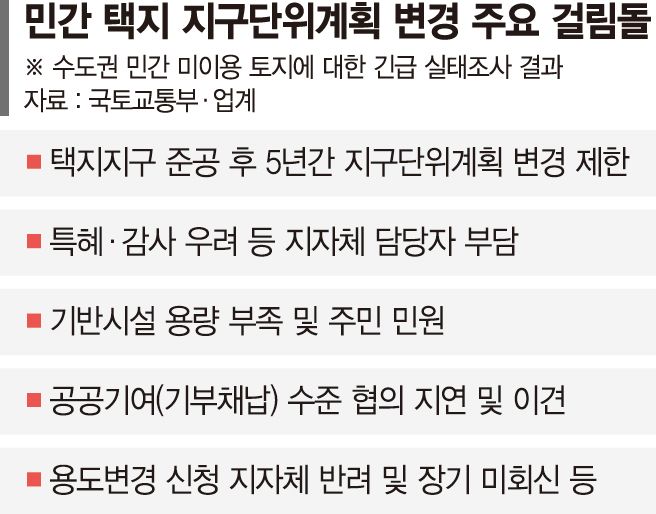
It has been confirmed that the Ministry of Land, Infrastructure and Transport recently carried out an emergency survey of unused private land in the Seoul metropolitan area. The survey targeted project sites where housing supply is difficult because changes to land-use zones are restricted under district unit plans. At present, conversion of privately owned non-residential land, including sites that have not yet broken ground, remains blocked. Attention is now focused on whether the government will unveil an unconventional measure to expand housing supply, which has become an urgent issue.
According to the industry on the 17th, the ministry conducted a two-day survey on the status of unused land in the Seoul metropolitan area among construction and development companies on the 15th and 16th. The survey covered non-residential land, such as industrial and office sites, as well as residential land that has not yet started construction, within district unit plan areas in Seoul and Gyeonggi Province. It focused on cases in which land use cannot be changed for reasons tied to district unit plans, rather than building-use changes.
The reason the industry is paying close attention is that this survey targets privately held land. As part of efforts to expand housing supply, the government is pushing to convert non-residential facilities into residential use. However, the current target is vacant properties or non-office land within land development districts owned by Korea Land and Housing Corporation (LH). Conversion of privately owned non-residential land has been blocked for several reasons.
According to industry sources, in the case of land development districts, district unit plans cannot be changed for five years after completion. When it comes to changing district unit plans for private land, local governments are reluctant to approve such requests, citing concerns over preferential treatment. In reality, changes to district unit plans for private land are rarely carried out because of insufficient infrastructure capacity, complaints from residents, delays and disagreements in negotiations over public contributions, and the rejection or prolonged silence on land-use change applications.
The ministry said the survey is part of its ongoing push for faster housing supply. Industry players and those on the ground are expecting the government to come up with a bold policy for converting private land to residential use.
Earlier, the housing and construction industries had repeatedly asked the government, including the ministry, to include not only privately owned vacant assets but also land in measures to convert land to residential use in order to expand housing supply.
A senior industry official said, "Third New Towns and other projects will only supply homes far in the future, so immediate supply is extremely important." The official added, "Converting only vacant non-residential properties to residential use has very clear limits. The policy should also include land, including sites that have not yet broken ground, so that broader residential land-use conversion can be pursued."
[email protected] Choi A-young Lee Jong-bae Reporter