Iran Sanctions on Oil to Be Lifted, Signaling a Reshaping of the Global Oil Market [U.S.-Iran Armistice Agreement]
- Input
- 2026-06-17 18:47:46
- Updated
- 2026-06-17 18:47:46
U.S. media outlets including The Wall Street Journal (WSJ) and Axios reported on the 16th local time, citing government officials, that the U.S. plans to lift existing sanctions on Iran's oil sales and related services such as financial settlement, maritime transport and insurance immediately after the signing ceremony on the 19th. Saudi Arabia's Al Arabiya also reported on the 16th that the MOU includes a clause stating that frozen or restricted Iranian assets will be released for full use as negotiations toward a final agreement progress.
The unfreezing of Iran's overseas assets is also expected to proceed in stages, depending on progress in the armistice talks. After the signing ceremony on the 19th, the two sides will hold final ceasefire and denuclearization talks for 60 days. The ceremony will take place in Bürgenstock, Switzerland.
■ Biggest loser: China
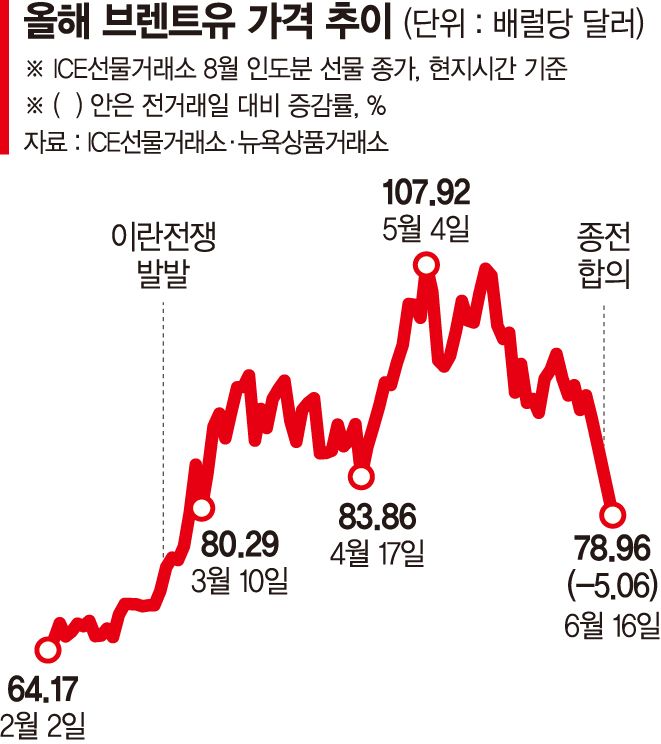
If the U.S. maritime blockade on Iran is lifted and sanctions related to oil sales are also removed, global oil prices, which have been on a steep upward trend, are expected to fall sharply. Competition among oil-producing countries, including Russia, will become even fiercer. Under current U.S. sanctions, Iran has been exporting more than 90% of its crude oil exports to China at discounted prices. That could deal a significant blow to China, which has benefited from cheap oil. Major changes are expected in the structure and operation of the existing international oil market.
However, it will take several months or more for Iran to restart war-damaged production facilities and idle oil fields in order to raise output. If these measures are implemented, Iran is expected to gain substantial economic benefits from crude oil exports. Iran ranks fourth in proven oil reserves and fifth to sixth in production worldwide.
As economic recovery through oil exports advances, concerns are also growing over Iran's military buildup and expanded support for its proxy forces in the Middle East, including Hezbollah, a pro-Iran armed group. The Trump administration also made clear that the easing of sanctions is a 'performance-based reward' amid concerns over lifting sanctions on Iran. Iran would only receive the benefits set out in the MOU if it complies with the agreement, including abandoning nuclear weapons, processing enriched uranium and guaranteeing free navigation in the Strait of Hormuz.
■ Emphasis on 'performance-based phased rewards'
Vice President JD Vance said in an interview with Fox News on the day that "there will be benefits for Iran if it fulfills its obligations," adding that "if Iran does not behave properly, it will not be able to enjoy any benefits from this deal." A U.S. government official noted that Iran must implement all of the agreements, including not developing nuclear weapons, neutralizing enriched material and not obstructing free navigation in the Strait of Hormuz, in order to receive the benefits.
Still, the U.S. could extend an olive branch first in an effort to speed up negotiations. The WSJ said the U.S. is willing to allow the Central Bank of Iran access to some assets for designated purposes, adding that some assets could be released even before a final nuclear deal is reached.
After first imposing sanctions on Iran in 1979, the U.S. designated Iran as a state sponsor of terrorism in 1984 and in the 1990s pushed ahead with a secondary boycott that punished third-country companies investing in Iran's energy sector. Since the 2000s, as Iran accelerated nuclear development including uranium enrichment, the U.S. has maintained heavy financial sanctions. Some sanctions were lifted in 2015 when the Joint Comprehensive Plan of Action (JCPOA) was reached under the Obama administration, and oil exports resumed. But in 2018, under Trump's first administration, the U.S. withdrew from the JCPOA and tightened sanctions, including blocking Iran's oil exports.
Meanwhile, Trump told reporters on the 16th that he would make the armistice agreement public within days. He said, "I plan to read the document word for word so the media can report it accurately," adding that he would hold a press conference.
[email protected] Park Jong-won Reporter