"From now on, watch the growth rate"... What comes next after 8,800 on the KOSPI
- Input
- 2026-06-18 06:00:00
- Updated
- 2026-06-18 06:00:00
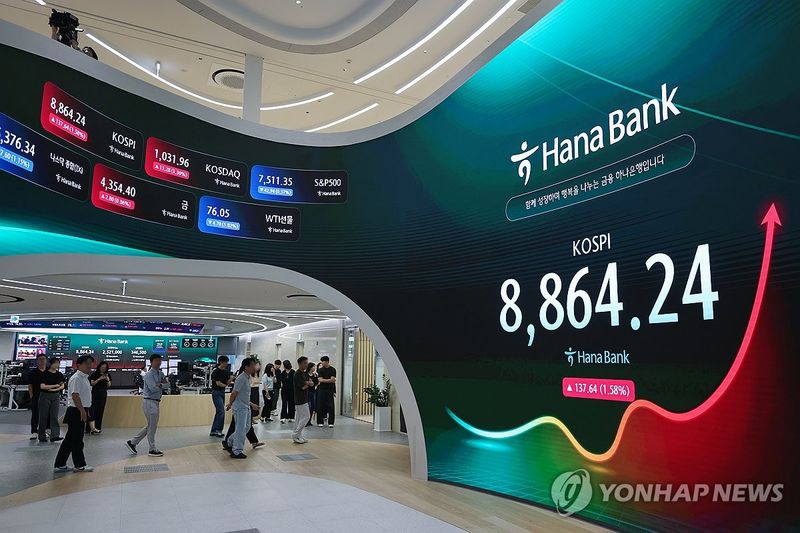
[Financial News] "The market will now start looking at growth rates, not earnings."
As the KOSPI (Korea Composite Stock Price Index) closed at 8,864 the previous day, setting a new all-time high, analysts said the market has now moved beyond earnings driven by Samsung Electronics and SK hynix in semiconductors and into a phase focused on growth rates.
Lee Sang-heon, a researcher at iM Securities, said on the 18th that last year's market was largely driven by liquidity. He explained that the rally gained momentum as DRAM and NAND flash memory prices, which had been falling for a long time since last September, turned upward, signaling a full-scale recovery in the semiconductor industry.
He described last September as a turning point from a liquidity-driven market to an earnings-driven one. As Artificial Intelligence (AI) evolved from a training-focused stage to an inference-focused stage, demand for Graphics Processing Units (GPU) and High Bandwidth Memory (HBM) surged. With HBM supply constrained, demand for regular DRAM and NAND flash memory also rose, pushing prices higher.
The rise in memory prices in turn improved the earnings of Samsung Electronics and SK hynix. Lee said, "As semiconductor prices kept rising from the fourth quarter of last year through the first half of this year, the two companies' earnings improved dramatically." He added, "Since semiconductors account for 30% to 40% of total exports, export data also reached record highs."
This year, the concentration of funds into Samsung Electronics and SK hynix has intensified. In January and February, customer deposits rose to around 130 trillion won, bringing in a large amount of retail money. In March, the stock market briefly corrected on war-related concerns, but it quickly absorbed the shock.
Lee said, "War usually acts as a market variable for only one to two months," adding, "Even after April, the market went its own way despite the ongoing war." In fact, the Philadelphia Semiconductor Index surged after April, and domestic semiconductor stocks also resumed their upward trend.
He noted, "Although the war pushed up inflation and major central banks maintained a tight hold, the market effectively ignored it." He added that a powerful narrative around AI investment had overshadowed all negative factors.
He also said the market has not been shaken much by recent interest rate hikes by the European Central Bank (ECB) and the Bank of Japan (BOJ) because investors do not expect further tightening to continue.
Still, Lee pointed to interest rates as a variable the market is overlooking. He said, "Thanks to AI investment demand, DRAM and NAND prices remain strong, but ultimately higher interest rates will curb investment." He added, "So far, the market has barely taken interest rates into account, but at some point it will have to react."
He also said options trading and Single-Stock Leveraged ETFs are increasing volatility during the recent surge in semiconductor stocks. Lee explained, "As Call Option trading has surged, option sellers are buying the underlying shares to manage risk, creating a gamma squeeze." He added, "It is a kind of 'Wag the Dog' situation. This supply-demand effect can amplify gains, but in a liquidation phase it can also increase downside volatility."
He stressed that the key market focus ahead is not earnings themselves, but growth rates. Lee said, "The market already knows second-quarter earnings will be strong." He added, "From now on, what matters is how long export growth rates and profit growth rates can be sustained." He continued, "If June exports hit a record high, it will not be easy to keep setting records in July and August. Even if earnings are strong, a slowdown in growth rates could lead to a stock price correction."
Lee named holding companies, Distribution stocks, and KOSDAQ as sectors to watch in the second half. For holding companies, he said discount factors could ease as regulations on duplicate listings tighten and governance reform continues. For the retail sector, he expects higher foreign consumption and rising asset prices to support spending. As for KOSDAQ, he advised approaching it from the perspective of rotation rather than earnings improvement.
He said, "Rather than because KOSDAQ is improving, investors should focus on the possibility that funds concentrated in Samsung Electronics and SK hynix may move elsewhere." He added, "In the second half, rotation may emerge alongside policies to revitalize KOSDAQ."
[email protected] Park Ji-yeon Reporter