"Even After Age 60, They Keep Working..." Older Women's Income Is Only 40% of Men's
- Input
- 2026-06-17 11:05:18
- Updated
- 2026-06-17 11:05:18
[Financial News]
The number of older women in work is rising, but their income remains less than half that of men. The gap is even wider in social insurance and retirement benefits, raising concerns that support for older women’s employment should go beyond simple job placement and lead to stable retirement income.
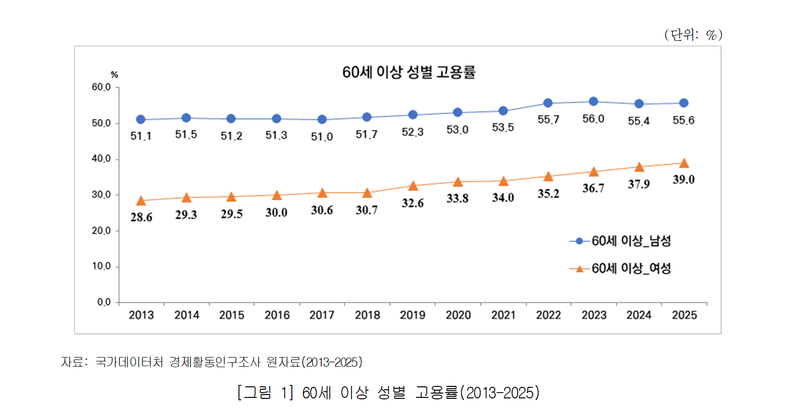
According to key findings released on the 17th by the Korean Women's Development Institute (KWDI) in its report, "Current Status of Retirement Income for Older Women and Employment Support," the employment rate for women aged 60 and older rose by 9.5 percentage points over the past decade, from 29.5% in 2015 to 39.0% in 2025. Over the same period, the gender gap in employment rates narrowed from 21.7 percentage points to 16.6 percentage points.
However, the expansion of older women's participation in the labor market has not translated into stable retirement income. The average individual income of women aged 60 to 79 was only 40.4% of men's. Based on the 2022 Korean Longitudinal Study of Aging, the average annual individual income for men in that age group was 22.78 million won, while women earned just 9.2 million won.
The gap in earned income was also large. Men's average earned income was 14.74 million won, accounting for 64.7% of their total individual income. By contrast, women's average earned income was 5.38 million won, or 36.5% of men's level. Earned income made up 58.5% of women's individual income.
Gender differences were also evident in public pensions. Men's average public pension income was 6.02 million won, while women's was 1.86 million won, or 30.8% of men's level. The analysis suggests that differences in past labor market participation and pension enrollment histories are feeding into retirement income inequality.
Older women workers were also relatively vulnerable in social insurance and retirement benefits. As of 2024, among wage earners aged 60 to 79, 49.1% of women were not enrolled in the National Pension Service (NPS), compared with 33.7% of men. The share not enrolled in Employment Insurance (EI) was also higher for women, at 58.8%, versus 47.2% for men.
The share without retirement benefits was 51.3% for women and 36.7% for men. This means that, despite the growing number of older women in work, major blind spots remain in the institutional framework that should connect employment to stable retirement income. Among the self-employed, women also had higher non-enrollment rates than men in NPS and Workers' Compensation Insurance.
The researchers said policies to support older women's employment should not stop at increasing the number of jobs. They called for tailored job matching that reflects older women's careers and preferred working conditions, reduced blind spots in social insurance and retirement benefits, and stronger support functions for older women at existing employment services such as Saeil Centers.
They also proposed expanding vocational education and training programs suited to older women and strengthening counseling support on labor relations and employment equality. The goal, they said, is to design income stability and employment safety nets together so that older women's participation in the labor market does not lead only to short-term, low-paid jobs.
Kim Nan-ju, a research fellow at KWDI, said, "The number of older women workers is increasing, but they remain in a more vulnerable position than men in terms of individual income, social insurance, and retirement benefits." She added, "Support for older women's employment needs to be designed not merely to increase the number of jobs, but to lead to stable income and an employment safety net."
[email protected] Park Ji-young Reporter