"South Korea Can't Live Without Hangul, Japan Can't Live Without Chinese Characters"... A Japanese Writer's Painful Realization
- Input
- 2026-06-17 11:17:44
- Updated
- 2026-06-17 11:17:44
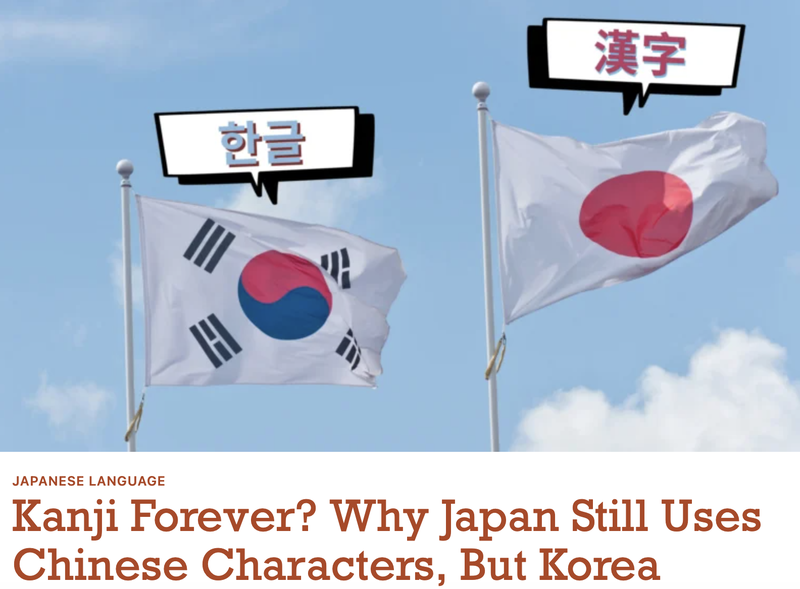
[Financial News] "Why did Japan continue using Chinese characters, while South Korea effectively abandoned them?"On the 12th, a Japanese user on X (formerly Twitter) posted this message, saying it was written by someone believed to be Korean. The Japanese user said, "It seemed to assume that getting rid of Chinese characters was progress. I realized that this is different from the way we view Chinese characters."
The post quickly drew attention online, and interest grew in why the writing systems of South Korea and Japan took such different paths.
On the 14th (local time), the U.S.-based Japanese culture outlet Unshin Japan analyzed the phenomenon in an article titled "Are Chinese Characters Eternal?"
According to Unshin Japan, South Korea and Japan both adopted Chinese characters from China and developed their written cultures, but differences in history and language structure led them to end up with entirely different writing systems.
Japan currently maintains a mixed writing system that uses Chinese characters together with hiragana and Katakana. The government-designated Jōyō kanji total 2,136 characters and are widely used in school education, official documents, newspaper articles, and broadcast subtitles.
By contrast, South Korea has established a writing life centered on Hangul. Chinese characters are used only in limited cases, such as personal names, place names, historical materials, and specialized terms, while everyday communication is mostly possible using Hangul alone.
Japan was not without attempts to eliminate Chinese characters. From the Meiji era onward, proposals were raised to abolish them, use only kana, or switch to Roman letters. After World War II, during the Allied Forces occupation, Chinese character reform was also seriously discussed. The argument for reform was that Chinese characters lowered literacy.
But the reform ultimately failed. The biggest reason was the unique structure of the Japanese language.
Japanese has many homophones that sound the same but have different meanings. Chinese characters help distinguish those meanings. In addition, because Japanese rarely uses spaces, Chinese characters also serve as visual markers that show word boundaries.
In fact, a postwar Japanese government literacy survey found that the illiteracy rate was only around 2 percent, and Japanese society chose to adjust the scope of Chinese character use rather than abolish them.
South Korea, on the other hand, has Hangul, a powerful alternative script created by Sejong the Great. Hangul is an alphabet that represents sounds directly, making it easy to learn and well suited to the structure of Korean. In particular, during the Japanese colonial period, it became a symbol of national identity and resistance, further strengthening the Hangul-centered system.
After liberation, the use of Hangul expanded in government documents and education, and the digital environment accelerated the move toward Hangul-only usage. Although many Korean words also come from Chinese characters, Korean has relatively fewer homophone problems than Japanese, which also helped make communication possible with Hangul alone.
South Korea has not completely abandoned Chinese characters, however. Schools still teach about 1,800 characters, and knowledge of Chinese characters is used in the fields of law, history, philosophy, and medicine. Recently, amid concerns about declining literacy, voices have also emerged calling for expanded Chinese character education.
[email protected] Seo Yoon-kyung Reporter