President Lee Holds Back-to-Back Bilateral Talks with Germany and Canada Ahead of $43 Billion Submarine Deal Decision
- Input
- 2026-06-17 08:09:16
- Updated
- 2026-06-17 08:09:16
■ Lee and Merz exchange views on defense cooperation
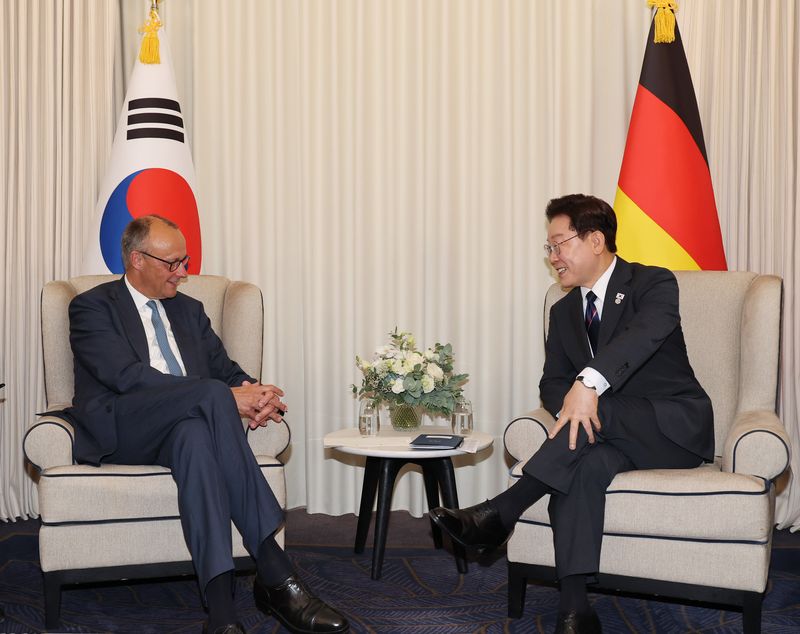
On June 16 (local time), President Lee met with Chancellor Merz in Évian and exchanged views on ways to develop bilateral ties and on the international situation. Lee said, "I believe Germany and the Republic of Korea are countries that can cooperate in many areas and create synergy through that cooperation."He added, "I hope we can hear a lot of your views today, share some new ideas of our own, and work together so that Korea and Germany can truly leap to a new stage, different from before."
Merz responded, "Thank you very much for making time for me. I also appreciate your visit to France for this G7 summit." He added, "The most important thing seems to be dialogue with invited countries. I am very pleased that we can discuss key agenda items while talking with the G7."
He continued, "Our bilateral relationship is also very good. The Republic of Korea is highly regarded in Germany, and our cooperation has been progressing well so far." Merz said he plans to visit the Republic of Korea at the end of October and expressed hope that they could meet again then. He also said he hoped Lee would attend a meeting being prepared by his side and share his thoughts.
The two leaders also exchanged views on the situations in the Middle East and Ukraine. Lee said he hoped stability in the Middle East would be restored as soon as possible, including the resumption of navigation through the Strait of Hormuz, following the recent agreement between the United States and Iran. He also stressed the importance of international cooperation for peace and stability.
Merz said global oil and financial markets have recently shown a relatively stable trend, but added that the Middle East situation still needs to be closely monitored. He also said the international community must continue its efforts to end the war in Ukraine.
The two leaders were also reported to have discussed potential cooperation in the defense industry. Lee noted that the two countries could move beyond competition and explore various models of cooperation, including joint research and development, joint production, and joint entry into third-country markets. Merz agreed and said Germany also hopes to expand cooperation not only among EU member states but also with partner countries including Korea.
Cheong Wa Dae emphasized, "The two leaders agreed to continue close communication at the summit level and further expand strategic cooperation in a wide range of fields, including the economy, industry, defense, science and technology, and international security."
■ Lee: "Korea, a defense powerhouse, will contribute to Canada and strengthen energy cooperation"
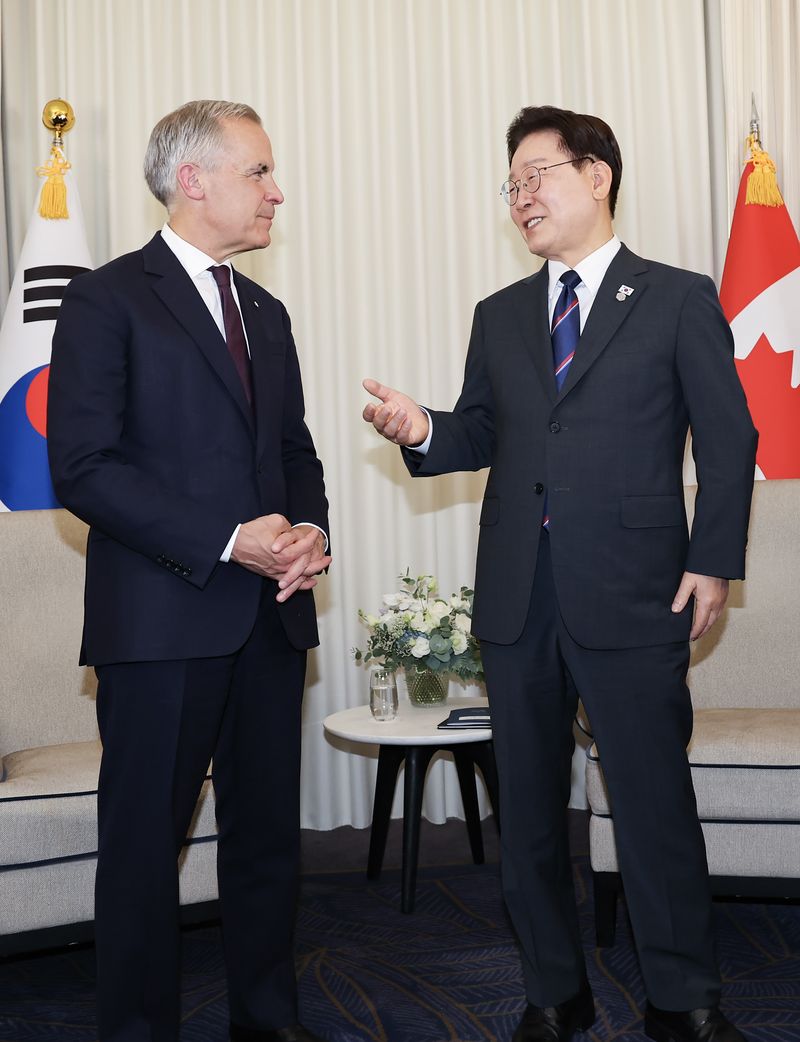
Lee then held a summit with Canadian Prime Minister Mark Carney. At the meeting, Lee said, "Canada and the Republic of Korea have had a very deep connection since the Korean War," adding, "We received great help, and now, as like-minded countries, our relationship is developing very well as we help each other." He continued, "We have a lot to cooperate on, so let's discuss today how we can make that cooperation more concrete."Carney responded in kind. "I am very happy to see you again," he said. "Since we met in Korea, our bilateral relationship and partnership have continued to grow." He added, "We have strengthened cooperation in a variety of areas, including defense, investment, and culture."
Earlier, Carney met with Lee at the Asia-Pacific Economic Cooperation (APEC) summit in Gyeongju last October and announced the establishment of a "Korea-Canada Security and Defense Cooperation Partnership," which outlines cooperation in security and defense.
Attention is also focused on whether the two sides discussed the Canadian Patrol Submarine Project (CPSP), a project currently being pursued by the Canadian government and worth up to 60 trillion won. At present, South Korea's Hanwha Ocean and HD Hyundai Heavy Industries consortium and Germany's ThyssenKrupp Marine Systems (TKMS) are competing for the CPSP.
According to Cheong Wa Dae, the two leaders agreed that it is important to strengthen strategic cooperation between the two countries in key areas such as defense and security, energy, and critical minerals, and that they will actively work together to do so.
In particular, Lee stressed that, as the global order is being reshaped, Korea, a defense powerhouse, is ready to actively contribute to strengthening Canada's security capabilities based on trust. Carney said he values building a cooperative relationship with Korea and agreed to continue consultations on related issues.
They also agreed on the importance of cooperation to build a stable energy supply chain and plan to expand mutually beneficial cooperation in areas such as crude oil, liquefied natural gas (LNG), and critical minerals. In particular, they decided to make full use of the strengths of Korea, which has advanced industrial capabilities, and Canada, which has abundant resources and technological expertise.
[email protected] Choi Jong-geun Reporter