President Lee says aid should lead to self-reliance, cites LG vocational school at G7 Summit
- Input
- 2026-06-17 02:43:10
- Updated
- 2026-06-17 02:43:10
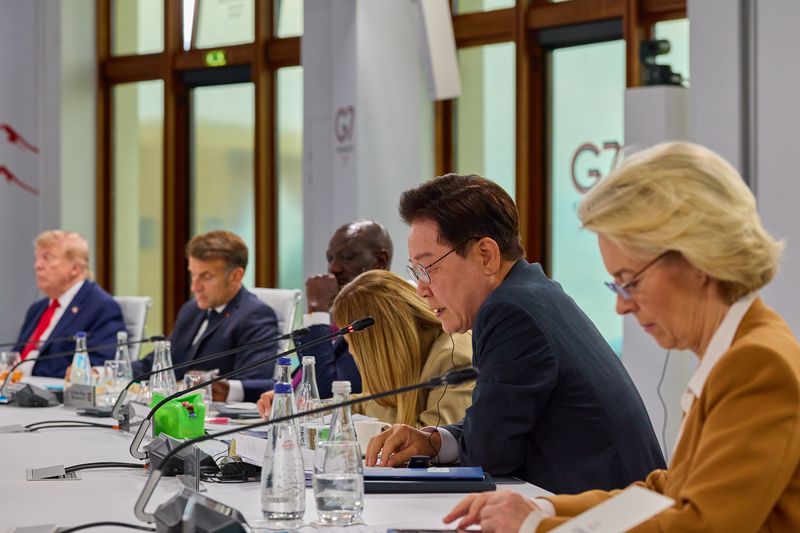
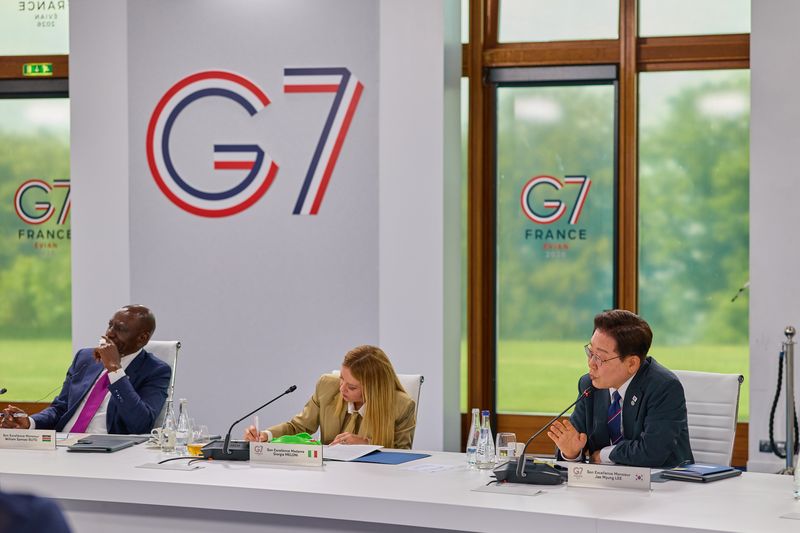
[Financial News, Évian (France) = Reporter Choi Jong-geun]At the Group of Seven (G7) Summit, President Lee Jae Myung stressed the need for a new development cooperation model that goes beyond simple aid and helps recipient countries achieve real self-reliance. He highlighted the case of the LG-KOICA Hope TVET College, where young people in Ethiopia learn electricity, electronics and Information and Communications Technology (ICT). He said the transfer of skills should lead to jobs, entrepreneurship and meaningful change.
Speaking at the first session of the expanded G7 Summit in Évian, France, titled "Building New Partnerships and Restoring International Solidarity," Lee said the results of development cooperation should be measured not only by the amount of funding provided, but also by how much it actually changes people's lives in recipient countries.
Lee said many Ethiopian youths are studying electricity, electronics and ICT at the LG-KOICA Hope TVET College, which was established by KOICA and a South Korean company. He emphasized that such learning should lead to employment and entrepreneurship, and become an opportunity to change a person's life. He added that development cooperation should go beyond financial support and strengthen recipient countries through technology transfer and industrial development.
As a new direction for development cooperation, Lee proposed greater private investment, technology sharing and more tangible results. He said that as development aid budgets for low-income countries are shrinking, private investment must open new paths for growth in recipient countries. To do that, private capital and domestic resources in partner countries must be mobilized together, while public funds should play a catalytic role.
In this regard, Lee said South Korea is creating examples of "investment-type public goods" by using public funds to spur private investment in recipient countries. He pointed to a recent KOICA case in Indonesia, where the agency supported 12 local startups in agriculture, energy and the environment over the past five years. The project attracted $50 million in private investment based on $1 million in grant aid.
Lee said, "We will support the sustainable growth of partner countries by making sure aid leads to investment and investment leads to self-reliance."
Closing the AI technology gap was also presented as a key agenda item. Lee noted that although the AI revolution is a new challenge and growth opportunity for humanity, many developing countries still do not have sufficient access to it. He said recipient countries must be supported so that technological gaps do not turn into growth gaps, and stressed the importance of sharing the benefits of AI progress with the world and growing together.
He said South Korea has proposed a vision for a "Global AI Basic Society," in which all humanity can share the benefits of AI development.
Lee also thanked France, the G7 chair, for hosting the discussions. He said South Korea would do its part in building international partnerships, drawing on its own experience and capabilities as a country that has grown from receiving aid to providing it.
[email protected] Choi Jong-geun Reporter