Benchmarking the "Han River Renaissance"... Hanoi's Massive Overhaul Project Gains Speed
- Input
- 2026-06-16 18:21:01
- Updated
- 2026-06-16 18:21:01
A construction industry source working in Hanoi said, "Since Trong's second term system began, the pace of permits and approvals related to infrastructure development has clearly accelerated." The source added, "As benchmarking of Seoul's development model becomes more active, the field of urban development cooperation between Korea and Vietnam is expected to expand significantly."
Hanoi, the capital of Vietnam, has launched a massive urban overhaul project aimed at transforming the city from a thousand-year-old capital into a multi-centered megacity with a population of 20 million. The plan centers on completely reorganizing the urban structure around the Red River and gradually relocating 860,000 downtown residents to the outskirts over the next 20 years.
Large-scale development plans have been announced before, but many lost momentum at the implementation stage. This time, however, the mood is different. The National Assembly of Vietnam passed the revised Capital Law, granting Hanoi unprecedented special authority in areas such as land expropriation, independent financing, and designing incentives to attract global investment.
Korean companies operating in Vietnam are also hoping for new opportunities in metro rail, Smart City projects, and waterfront development.
■ Urban restructuring centered on the Red River
According to local media and others on the 16th, Hanoi will unveil the detailed blueprint of the Hanoi Capital Construction and Development Master Plan, approved on the 13th of last month, to domestic and foreign investors at an investment promotion event to be held on the 29th at the Vietnam National Convention Center.
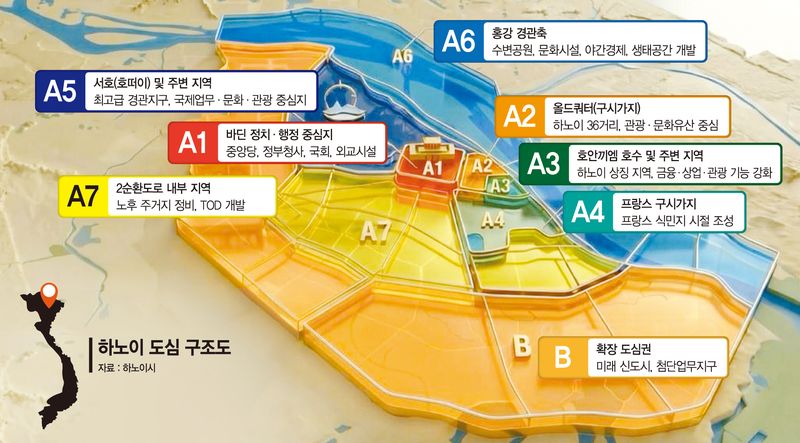
The core of the 100-year master plan is to move away from the existing single-core urban structure and build a "multi-layered, multi-polar, multi-centered" city system centered on the Red River.
Hanoi plans to develop the Red River scenic corridor, covering a total area of about 11,000 hectares, into an ecological, cultural, and tourism hub. The idea is to reshape the city by placing the Red River within the urban space, rather than continuing the old pattern of development that turned its back on the river to prevent flooding.
At the same time, the city will accelerate development in outlying areas around nine growth axes. The existing central areas, including the 134.5-hectare Ba Dinh District political and administrative zone and the Hoan Kiem District area, will be preserved through expanded plazas, green space, and underground development. Meanwhile, Dong Anh, Jarum, and Hoa Lac High-Tech Park north of the Red River will be developed as hubs for the economy, international services, and advanced industries.
A construction industry source said, "It appears to be a plan to create new growth axes similar to Yeouido, Yeongdeungpo District, and Gangnam District in Seoul by combining Gangnam's development model with the Han River Renaissance model."
To that end, the largest population relocation in Vietnam's history is also being pursued. According to the master plan, Hanoi aims to move more than 860,000 residents to new towns and newly developed areas on the outskirts between 2026 and 2045.
■ Building a 1,153-km metro network
Instead of reducing population density in the old downtown area, Hanoi will convert the area inside Ring Road No. 3 into a Transit-Oriented Development (TOD) system through block-by-block redevelopment. High-rise mixed-use development will be allowed within a 500-meter radius of major metro stations to improve land-use efficiency.
The key infrastructure for the urban restructuring will be a metro network consisting of 14 lines with a total length of 1,153 km. Hanoi plans to invest $55.4 billion between 2026 and 2035 to build major lines, including Lines 1 and 2, which will connect Noi Bai International Airport and the city center. Local experts say the metro network will help shift Hanoi's real estate market from horizontal expansion to high-density development centered on station areas. They also expect high-rise mixed-use projects within 500 meters of stations to accelerate the relocation of downtown residents and the formation of new growth hubs.
■ Targeting a GRDP per capita of $100,000
Through the master plan, Hanoi aims to maintain annual GRDP growth of more than 11% over the next 20 years. Under the city's scenario, the economy is projected to reach $200 billion by 2035, $640 billion by 2045, and $1.92 trillion by 2065. It also envisions GRDP per capita rising above $12,000 by 2030 and reaching $95,000 to $100,000 by 2065.
The city is also pushing night-time economy development to foster tourism and the service sector. According to the "2026-2030 Night-Time Economy Development Plan" finalized by the Hanoi People's Committee, the city plans to create 68 key night-time economy zones and 15 to 20 late-night operating areas by 2030. Along the Red River scenic corridor, projects such as cruise tourism linking Long Bien Bridge and the Red River sandbars, night cultural and artistic performances, and food-themed streets are being promoted.
■ "This time is different" as momentum strengthens
Local observers in Hanoi say this project is different from previous plans. With the implementation of the revised Capital Law, Hanoi has secured independent authority over land expropriation, investment attraction, and fiscal management, significantly strengthening its ability to push the project forward.
Still, the astronomical project cost and the social conflict that may arise during the large-scale relocation of residents remain major challenges.
A local official said, "What is most emphasized in Trong's second term system is execution." The official added, "Now that the Capital Law has taken effect, the likelihood that this plan will remain only a declaration is not high." The official also noted, "There are many areas where Korean companies have strengths, such as metro rail, Smart City projects, and TOD development, so active participation is needed."
[email protected] Reporter