Shared accommodations are making a comeback, growing 400% in a year
- Input
- 2026-06-15 18:28:57
- Updated
- 2026-06-15 18:28:57
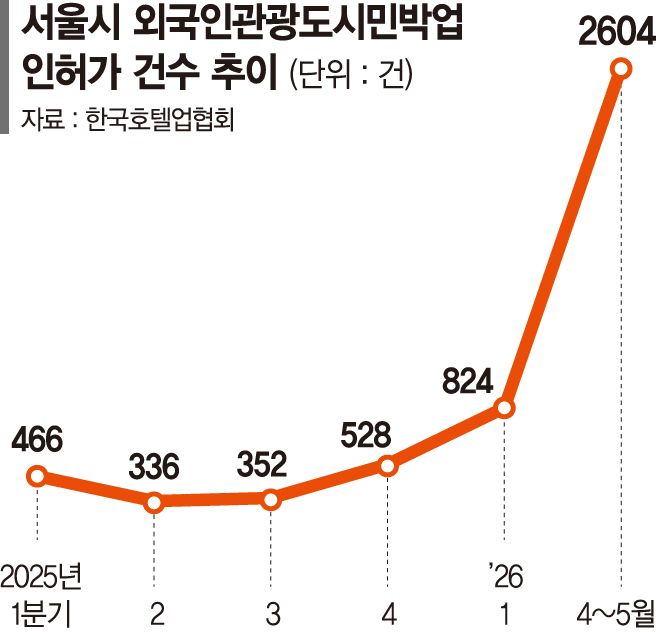
According to the Korea Hotel Association on the 15th, a total of 3,428 permits were issued for Seoul's urban homestay businesses for foreign tourists from January to May this year. That far exceeds last year's 1,682 new registrations. Compared with the same period last year, the figure has grown by nearly 400% in just one year. Given that Seoul had 5,797 permits for such businesses as of the end of last year, more than half the size of the existing market has been created anew in just five months. By district, Mapo District led with 1,674 cases, the only one among Seoul's 25 districts to top 1,000. Yongsan District ranked second with 518, followed by Jongno District with 417.
The sharp increase in urban homestay businesses for foreign tourists is directly linked to the rise in foreign visitor arrivals. According to the Ministry of Culture, Sports and Tourism (MCST), the number of foreign visitors to Korea last year reached 18.7 million, setting a new all-time high. That works out to roughly one visitor every 1.68 seconds. The momentum has continued this year, with 4.76 million foreign visitors in the first quarter, up 23% from the same period last year.
Interest in urban homestays for foreign tourists rose further after MCST announced regulatory easing in October last year. The key change was that buildings older than 30 years were previously excluded from permit eligibility, but they will now be allowed if they pass a safety inspection.
Shared accommodation can be quite lucrative. A Seoul Mapo District resident who operates an Airbnb, Inc. said, "My monthly income is about what an assistant manager at a large company would make," adding, "My bookings are always full for the month." The operator added, "Some people call it a red ocean, but there are still people around me who want to get into the business."
Phone lines at district offices have been ringing nonstop. Permits for urban homestay businesses for foreign tourists can be obtained from each district office. A Yongsan-gu Office official explained, "Inquiries related to this have increased significantly recently," adding, "Most of them are about how to obtain permits."
The Korea Tourism Organization (KTO) has announced a goal of attracting 30 million foreign tourists by 2028, up 60% from last year. Industry observers expect permits for urban homestay businesses for foreign tourists to rise in tandem. Meanwhile, an urban homestay business is an accommodation service in which residents of urban areas use their own homes to provide lodging and meals to foreign tourists.
[email protected] Kwon Jun-ho Reporter